Fire alarm questions and answers collected from what building owners, facility managers and technicians in Saudi Arabia ask: how the system works, the types of detector, where manual call points go, how long batteries must last and how often the system is tested. Answers are short, and each links to a detailed article.
Learn more about the fire alarm systems AZEIDK designs, supplies, installs and tests.
Key takeaways
- The system detects fire early, alerts occupants and triggers building control outputs.
- Main components: panel, detectors, manual call points, notification appliances, modules, cables and batteries.
- Figures in the answers come from NFPA 72 and BS 5839-1; the final reference is the approved design and Civil Defense requirements.
Basic fire alarm questions
1. What is a fire alarm system?
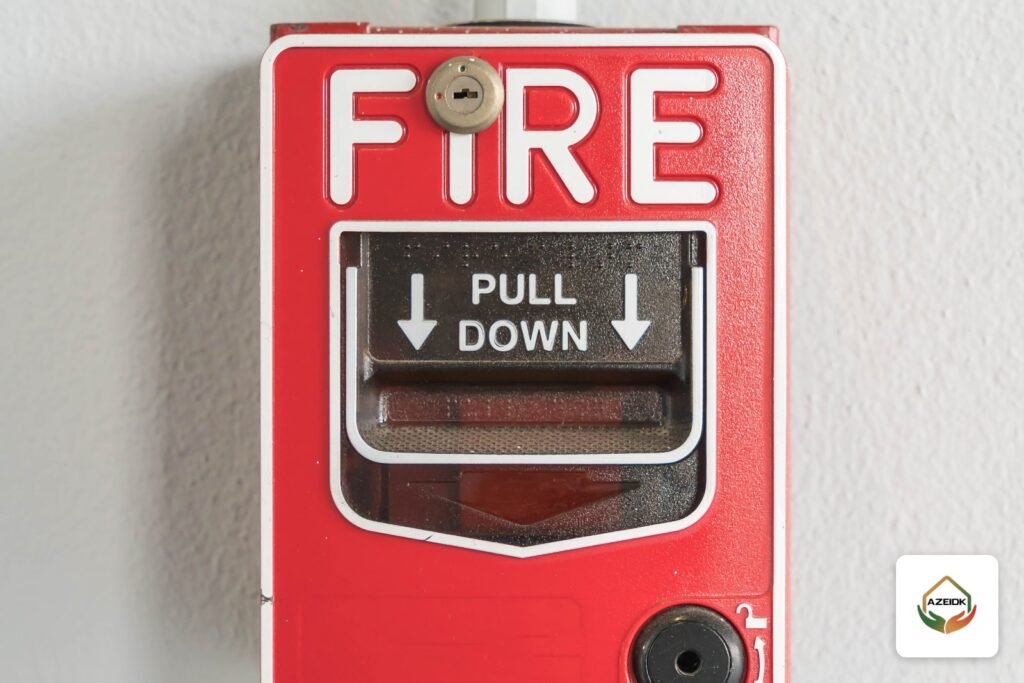
A system that detects smoke, heat or flame, or receives a manual alarm, then alerts occupants to evacuate and signals building systems such as HVAC shutdown and lift recall. Details in fire alarm devices and how the system works.
2. What is the fire alarm working principle?
A detector or call point signals the panel; the panel identifies the location, operates sounders and strobes and runs the cause and effect matrix. The panel also supervises cables and devices continuously and reports any fault.
3. What is the difference between conventional and addressable?
Conventional divides the building into zones and shows only the zone; addressable gives every device an address, pinpointing its location and easing maintenance. See addressable vs conventional fire alarm.
4. When is a fire alarm mandatory in Saudi Arabia?
The Saudi Fire Code SBC 801 sets it by occupancy, area, storeys and occupant load. Details in when a fire alarm is mandatory under SBC 801.
Questions on detectors, call points and notification
5. What types of fire detector are there?
Optical smoke, fixed and rate-of-rise heat, multi-sensor, beam, aspirating smoke, flame detectors and linear heat detection cable. See fire detector types and selection.
6. When should I use a heat detector instead of a smoke detector?
Where smoke, steam or dust would cause false alarms in normal conditions, such as kitchens, laundries and some car parks, because a heat detector is less sensitive to those sources.
7. How far apart should smoke detectors be?
NFPA 72 gives a nominal 9.1 m (30 ft) spacing for spot smoke detectors on a smooth flat ceiling, adjusted for ceiling shape, height and beams. The method is in smoke and heat detector spacing.
8. Where are manual call points installed?
At storey exits and emergency exits on escape routes. NFPA 72 places them within 1.5 m (5 ft) of the exit door at 1.07 to 1.22 m (42 to 48 in) high; BS 5839-1 limits the travel distance to a call point to 45 m. See manual call points and notification appliances.
9. How loud must the alarm be?
NFPA 72 requires 15 dB above the average ambient sound level; BS 5839-1 sets a general minimum of 65 dB(A), rising to 75 dB(A) at the bedhead in sleeping areas. Details in fire alarm bell, sounder and strobe.
10. Why fit a strobe with the sounder?
To alert people with hearing loss and to reach high-noise areas where the sound may not be heard.
Questions on the panel, batteries and cables
11. How long does a fire alarm panel run on batteries?
Under NFPA 72, 24 hours of standby followed by 5 minutes of alarm, or 15 minutes for voice evacuation, sized from the actual device current. See fire alarm battery calculation.
12. What is the difference between silencing and resetting?
Silencing stops the sound while the alarm condition remains; resetting returns the system to normal after the cause is cleared. See the silence and reset guide.
13. What does a fault on the panel display mean?
A fault means a problem in the system itself, such as a broken cable, a missing device or a low battery, not a fire. Messages are explained in fire alarm panel faults.
14. Is any cable acceptable for a fire alarm?
No. Circuits that must work during a fire need fire-resistant cable, and the size is calculated from current and length. See fire alarm cables.
15. Is the fire alarm linked to the sprinkler system?
Yes, through waterflow switches that send an alarm and valve tamper switches that send a supervisory signal. See waterflow and tamper switches.
Questions on testing, maintenance and cost
16. How often is a fire alarm tested?
BS 5839-1 recommends a weekly test using a different call point each week; NFPA 72 requires annual functional testing of detectors and devices, with periodic visual inspections. See how to test smoke detectors.
17. Why do false alarms happen?
The usual causes: a smoke detector in a steamy or dusty area, dirty detectors, hot work or smoking near a detector, and poor terminations. See fire alarm beeping and chirping.
18. Does the system call Civil Defense automatically?
Not by default. An outside connection needs a signal transmission link to a monitoring party where the design or the authority requires it, so ask about it at design stage.
19. Is a maintenance contract required?
In practice yes: documented routine maintenance keeps the system ready and supports renewing the safety licence. See Salamah licence renewal and maintenance contracts.
20. How much does a fire alarm system cost?
There is no single figure; cost is the sum of panel type, device count, cables, programming and testing. See fire alarm system price factors.
Frequently asked questions
Are these answers enough to design a fire alarm system?
No. They are introductory; design needs an engineer applying SBC 801 and the approved standard to the actual building drawings.
Where do I start if my building needs a fire alarm?
Start by confirming the requirement for your occupancy, then get a design and bill of quantities, then compare offers on the same items.
Have a question about the fire alarm in your building? Send the drawings or a description of the building, and the AZEIDK team will answer and handle design, supply, installation and testing. Contact AZEIDK
Related guides
- Fire Alarm Commissioning and Acceptance Testing Before Handover
- Fire Alarm Systems in Khamis Mushait and Abha: Choosing a System for Shops, Schools, Hotels and Rest Houses
- Perfume and Oud Shop Fire Safety in Saudi Arabia: Storage, Incense Burners, Extinguishers and Alarms
- Hikvision Intercom DS-KIS604-S(B): Video Intercom Kit Components, Installation and Hik-Connect Phone Setup