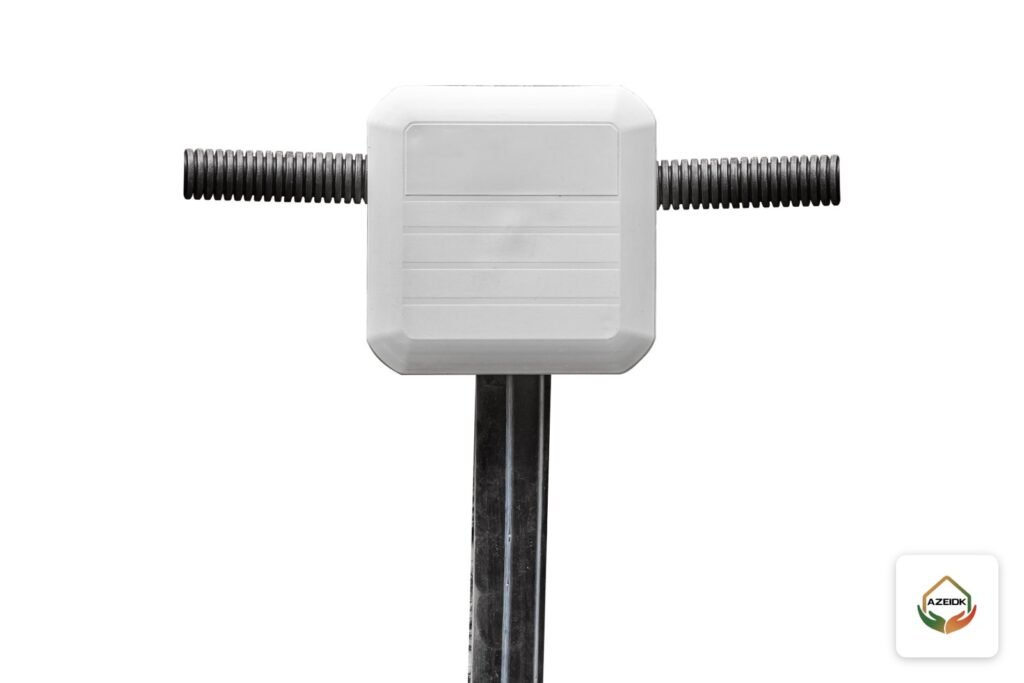
A fire alarm junction box is the enclosure where fire alarm cables are joined, branched or terminated, for example at the end of a line. It looks like a minor line in the bill of quantities, but it is a common weak point: a poor joint in a ceiling void can cause an intermittent fault that is hard to trace, and an ordinary plastic box on a fire-resistant circuit can cancel the benefit of the whole cable. This article explains the types of box, when each is used, and what drives the cost, without fixed prices.
Junction boxes are part of the fire alarm systems AZEIDK supplies, including Context Plus boxes for linear heat detection cable.
Key takeaways
- Keep joints outside equipment to a minimum, and put any necessary joint in a dedicated, clearly marked fire alarm box.
- Never share a box between fire alarm cables and mains or other systems.
- On fire-resistant circuits, the box and terminals must not be weaker than the cable.
- Outdoors and in damp areas, choose a suitable IP rating and proper cable glands.
- FirePlus-LHD linear heat detection cable has two dedicated boxes: LHD-JP-5T for junction or end of line, and LHD-EOL for end of line with a test facility.
In this article
What does a junction box do in a fire alarm system?
A box is used in three situations: a branch, when a spur leaves the main route to a remote device; a joint, when the cable drum is shorter than the route; and an end of line, where the end-of-line resistor or a test unit sits at the end of the circuit. On addressable systems most terminations are inside detector bases and modules, so boxes are fewer; they are more common on conventional systems and long sounder circuits.
The practical rule, reflected in practice guides such as BS 5839-1: every extra joint is a possible fault point, so minimise joints outside equipment. Where one is needed, put it in an accessible box clearly identified as fire alarm, so an electrician does not open it thinking it belongs to a lighting circuit.
Types of fire alarm junction box
| Type | Where it is used | What to check |
|---|---|---|
| Plastic box for standard circuits | Corridors and ceiling voids in dry areas | Number of terminals, red colour or a fire alarm label |
| Metal box with heat-resistant terminals | Circuits that must keep working in a fire | Fire performance of box and terminals at least equal to the cable, or part of a listed system with it |
| High IP rated box | Open car parks, roofs, warehouses and kitchens | IP rating, glands sized for the cable, UV and corrosion resistance |
| End-of-line box with test facility | End of a linear heat detection cable or conventional zone | That the circuit can be tested without undoing terminations |
Boxes on fire-resistant circuits: do not make the joint the weakest link
When the design specifies fire-resistant cable for a circuit that must work during a fire, such as sounder circuits or panel network links, the goal is survival of the whole circuit, not just the cable. A plastic box that melts and plastic terminals that collapse in heat break the circuit while the cable is still intact. These circuits therefore use metal boxes with terminals made of heat-resistant material such as ceramic, or avoid joints altogether by running the cable in one length.
On projects designed to US standards, the fire-resistant circuit is approved as a complete listed system covering cable, fixing method and boxes, so no component should be swapped for another product without checking it is within the same listing. Details are in the fire alarm cables and circuit integrity guide.
FirePlus-LHD linear heat detection cable boxes
Linear heat detection cable has its own boxes because the end of the circuit needs a test facility. According to the product page and the Context Plus datasheet:
- LHD-JP-5T: a polycarbonate box with two cable glands and five DIN-rail-mounted terminal blocks, used as an end-of-line box or an in-line junction box, for one or two zones.
- LHD-EOL: an end-of-line box for one or two zones with a built-in facility to test the operation of the linear heat detection cable.
The same datasheet covers Zintec or stainless-steel fixing clips and heat-stabilised cable ties. For how the cable works and where it is used, see FirePlus-LHD linear heat detection cable.
What drives fire alarm junction box price?
We do not publish fixed prices because the right box differs from circuit to circuit. Cost depends on:
- Material: polycarbonate or metal.
- Fire performance: a standard box or one with heat-resistant terminals for survivability circuits.
- IP rating and corrosion resistance for outdoor use.
- Number of terminals and number and size of glands.
- Function: plain junction box or end-of-line box with test facility.
- Quantity, and printed fire alarm marking.
Common site mistakes
- Joints wrapped in insulating tape inside the ceiling void with no box.
- Fire alarm cables terminated in a shared electrical box with lighting or sockets.
- An ordinary plastic box on a circuit designed to be fire resistant.
- Unmarked boxes that maintenance technicians cannot identify.
- Box openings left without glands in damp or dusty areas.
- Boxes placed where they cannot be reached for inspection after the ceiling is closed.
Frequently asked questions
Does a fire alarm junction box have to be red?
What matters is that it is clearly identified as fire alarm; a red box or a “fire alarm” label are the common ways, following what the approved design specifies.
Can a fire-resistant cable be jointed?
It is better avoided. If a joint is needed, use a box and terminals whose fire performance is at least equal to the cable, or components within the same listed system.
What is the difference between LHD-JP-5T and LHD-EOL?
LHD-JP-5T is a junction or end-of-line box with five DIN-rail terminals; LHD-EOL is an end-of-line box with a facility to test the linear heat detection cable.
How much does a fire alarm junction box cost?
It depends on material, fire performance, IP rating, terminal count and quantity, so send your bill of quantities for a detailed offer.
Need junction boxes or cables for a fire alarm system? Send your drawings and bill of quantities, and the AZEIDK team will prepare the right boxes, cables and fixing accessories for each circuit. Contact AZEIDK
Related guides
- Material Submittal for Fire and Security Equipment: Contents and Consultant Review Codes
- Smoke Control System Testing Before and After Handover: Sequence Tests, Airflow, Pressure Differences and Periodic Testing
- NFPA 10 Guide: Choosing, Placing and Inspecting Extinguishers
- 3PUMP Fire Pump Packages (Electric + Diesel + Jockey): Models from 500 to 1500 GPM, What Non-Listed Means and When to Ask for UL/FM