Cinema fire safety depends on three systems working as one: a fire alarm that gives clear spoken instructions inside a dark auditorium, smoke extraction that keeps escape routes visible, and lit emergency exits with nothing in the way. In assembly occupancies, the Saudi Fire Protection Code SBC 801 requires a manual fire alarm system once the occupant load reaches 300, and an emergency voice/alarm communication system at 1,000 occupants or more.
Key takeaways
- The Ministry of Municipalities and Housing requirements for cultural buildings and cinemas require Civil Defense approval before the licence is issued, and refer all fire protection to SBC 801.
- The projection room has its own requirements in SBC 201, Chapter 4, Section 409, as the same document states.
- In a dark auditorium a siren alone is not enough. A recorded voice message and aisle lighting restored on alarm are what move people to the right exit.
- Family entertainment centres fall under the recreational facilities requirements, which call for a control room overlooking play areas and CCTV installed under the Saudi security camera law.
- The cause and effect matrix is where the alarm actions are written: mute the film sound, raise the lights, start smoke fans, release doors.
In this article
- Why is cinema fire safety different from any other hall?
- What do Saudi authorities require for cinemas?
- Voice evacuation: the core of alarm design in dark auditoriums
- Aisle lighting and exit signs on alarm
- What does smoke extraction protect in a cinema?
- Emergency exits and fire-rated doors
- Projection rooms and play areas in entertainment centres
- Tying it together in the cause and effect matrix
- Frequently asked questions
- Conclusion
Why is cinema fire safety different from any other hall?
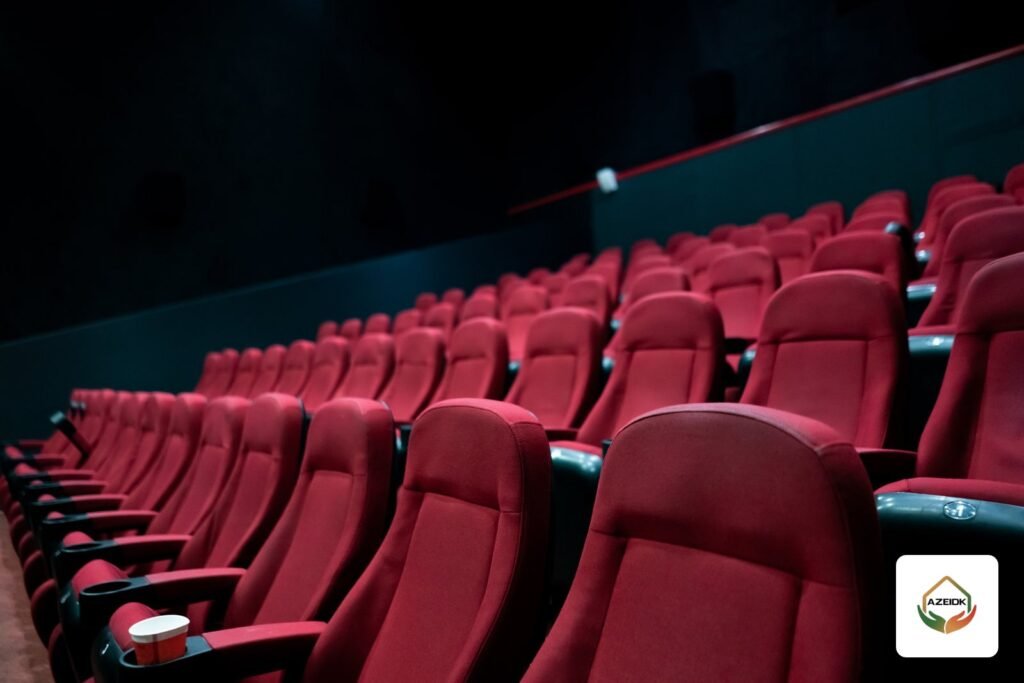
A cinema is an assembly building where hundreds of people sit in near darkness, with loud programme sound, stepped seating and narrow rows. Visitors do not know the building, and they did not notice the exits on the way in because the adverts were running and the lights were down. That makes three problems bigger than usual:
- Hearing: the film soundtrack can mask a standard sounder, so people miss the alarm in the first seconds.
- Visibility: smoke collects under the ceiling and then drops. In a dark room, exit signs disappear quickly unless the smoke is extracted.
- Movement: stepped aisles raise the risk of trips and crowd surges if everyone leaves at once without guidance.
Cinemas are therefore treated as assembly occupancies (the IBC model on which the Saudi Building Code is based places them in Group A-1; the designer confirms the classification in the adopted SBC 201 text), and their systems are designed as one package tied to the fire alarm panel, not as separate devices. AZEIDK covers this type of project under its malls and commercial buildings sector, since most Saudi cinemas sit inside shopping centres.
What do Saudi authorities require for cinemas?
There are two layers: the municipal licensing requirements, and the building and fire code the project is designed to.
Requirements for cultural buildings and cinemas
Issued by the Ministry of Municipalities and Housing, this document defines cinemas as film screening halls, standalone or attached to another facility. Its safety-related items include:
- Civil Defense approval before the licence is issued.
- All fire protection to follow the Saudi Fire Protection Code.
- Projection rooms to meet SBC 201, Chapter 4, Section 409.
- Ceilings of fire-resistant, moisture-resistant materials, and no gas-fired lighting.
- External stairs, walkways and ramps kept free of anything that blocks fast evacuation.
- CCTV installed under the Security Surveillance Cameras Law and its implementing regulations.
Saudi Fire Protection Code SBC 801
In the Arabic text of SBC 801 (2018 edition), Section 907.2.1 requires a manual fire alarm system in Group A occupancies with an occupant load of 300 or more, and Section 907.2.1.1 requires the alarm to be initiated through an emergency voice/alarm communication system at 1,000 or more. The 2024 edition of the Saudi Building Code has been mandatory since 30 June 2025, so the designer checks the figures in the edition the building permit was issued under. In a multiplex, the designer checks in the code text whether the screens count as one assembly area or separately, depending on how they are separated; when counted together, a multiplex can easily pass the voice threshold.
Voice evacuation: the core of alarm design in dark auditoriums
A voice evacuation system plays a pre-recorded message instead of a siren, for example: “Attention. Please leave the auditorium calmly by the nearest lit exit.” The message tells people what to do, which cuts the hesitation between hearing an alarm and moving.
When designing voice evacuation for a multiplex, the engineer checks:
- Zoning: each screen is its own zone, with the lobby, food court and offices as separate zones. This allows phased evacuation where the consultant approves it, and different messages per zone.
- Speech clarity: auditoriums are acoustically treated, which helps, but speakers must be laid out so front and back rows hear the message equally well.
- Muting programme sound: common practice is to programme the fire panel to cut the film audio and background music when the alarm starts, so the message does not compete with the soundtrack.
- Visual signals: strobes are needed for people with hearing loss and are very visible in a dark room.
- Live microphone: lets the duty manager give direct instructions if the situation changes.
AZEIDK supplies equipment such as the DSPPA PAVA9500 voice alarm system. The final system is chosen after zones and speaker counts are calculated at design stage.
Aisle lighting and exit signs on alarm
During a screening the house lights are low. According to a BNP Media summary of the International Building Code (IBC), on which the Saudi Building Code is based, the code allows walking-surface illumination in theatres and auditoriums to be reduced during performances, provided the required illumination is restored automatically when the building fire alarm activates. In practice the fire panel must send a command to the lighting control system, and that command must be tested at commissioning.
The auditorium also needs:
- Step lighting on stepped aisles that stays on throughout the show.
- Illuminated exit signs with battery backup at every exit and every change of direction.
- Emergency lighting in the back-of-house corridors that lead outside.
Unit selection and placement are covered in emergency lighting and exit signs in Saudi Arabia.
What does smoke extraction protect in a cinema?
Smoke extraction and emergency ventilation in a cinema keeps the smoke layer above people’s heads long enough to get out, and keeps smoke out of corridors and stairs. The solution depends on the area:
| Area | Main risk | What the design checks |
|---|---|---|
| Auditorium | Smoke building up under a high ceiling | Extract fans tied to the fire panel; shutdown of recirculating air conditioning |
| Lobby and food court | Smoke spreading between screens through shared corridors | Smoke zones and self-closing fire-rated doors |
| Stairs and back corridors | Smoke entering the escape route | Stair pressurisation or fire-rated door separation per the approved design |
| Projection room | Electrical equipment running long hours | SBC 201 Section 409, early detection, separate ventilation |
If the cinema is inside a mall with an atrium, the mall smoke control system must be coordinated with the cinema system so the two do not work against each other.
Emergency exits and fire-rated doors
A good cinema exit is visible from the seat, opens in the direction of travel and needs no key. The same inspection findings keep coming up: an exit chained shut to stop people entering without a ticket, a back corridor used as a drinks store, or a fire door wedged open with a block of wood.
The practical answer to unauthorised entry is emergency locks tied to the fire alarm, or panic bars with a local alarm on opening, not a locked door. See the fire-rated doors and emergency exit solutions AZEIDK supplies.
Projection rooms and play areas in entertainment centres
Projection room
The projection room holds projectors, servers and electrical panels running for hours. The cinema requirements refer directly to SBC 201 Section 409 for this room. For fire systems, the designer reviews the detection type, ventilation and separation from the auditorium.
Family entertainment centres
Indoor play centres fall under the Ministry’s recreational facilities requirements, which exclude cinemas from their scope. Items include Civil Defense approval before licensing, reference to SBC 801, fire-resistant ceilings, a control or monitoring room overlooking all play areas, and CCTV installed under the law. Soft-play areas contain a lot of plastic and foam, so early detection and extinguisher layout deserve care, and camera links to the control room are planned within security and surveillance systems.
Tying it together in the cause and effect matrix
Everything above ends up in one table that defines what happens for each alarm input: the fire alarm cause and effect matrix. In a cinema it typically includes:
- Smoke detector in Screen 3: evacuation message in Screen 3, alert message in the lobby, lights up, film audio off, smoke fans for that auditorium on.
- Manual call point in the lobby: evacuation message per the approved evacuation plan, magnetic door holders released.
- Sprinkler flow: alarm in the affected zone and a signal to the control room.
A common handover mistake is testing each system on its own and never testing the interfaces. The alarm sounds, but the film keeps playing, or the lights stay low. Commissioning should include a full scenario for every screen.
Frequently asked questions
What are the cinema fire safety requirements in Saudi Arabia?
Civil Defense approval before licensing, fire systems to SBC 801, projection room requirements in SBC 201 Section 409, unobstructed exits, and CCTV under the security camera law. Technical details are set in the approved design.
Is voice evacuation mandatory in a cinema?
Under SBC 801 Section 907.2.1.1 (2018 edition), alarm initiation through an emergency voice/alarm communication system is required in assembly occupancies with 1,000 or more occupants. Check the figure in the edition your permit was issued under.
Why mute the film sound on alarm?
Loud programme sound competes with the evacuation message and delays the audience response. The fire panel to audio interface is written into the cause and effect matrix and tested before handover.
Can aisle lights be switched off during a screening?
The IBC allows them to be reduced during performances provided they come back on automatically when the fire alarm activates. Exit signs and step lights stay on.
How do the cinema requirements differ from the recreational facilities requirements?
The cultural buildings and cinemas document covers film halls. The recreational facilities document covers entertainment centres and amusement parks and excludes cinemas. Both refer to SBC 801 and require Civil Defense approval.
Who designs and approves fire systems for a multiplex inside a mall?
The design engineering office prepares the drawings and coordinates with the mall systems, then approval goes through Civil Defense. AZEIDK supports supply, installation, testing and the safety equipment installation certificate as part of its Civil Defense approval support.
Conclusion
Cinema fire safety is not achieved by installing separate devices. Voice alarm, aisle lighting, smoke extraction and exits must all respond to one signal according to a written, tested matrix. Start with occupant load and licensing requirements, design the interfaces, and test them screen by screen before opening. For the approval stages see Civil Defense approval support and fire alarm systems.
Preparing to open a cinema or entertainment centre? Send the drawings with the number of screens and seats, and our engineering team will review alarm, voice evacuation and smoke extraction requirements with you. Talk to the AZEIDK team
Related guides
- Foam Fire Suppression for Saudi Industrial Facilities: Types and Applications
- Door Access Control System Cost in Saudi Arabia: Reader, Lock, Exit Button, Controller and Software
- Home Safety Tools Every House Should Have: Fire Extinguisher, Smoke Alarm and First Aid Box
- NFPA 409 Aircraft Hangar Fire Protection: Foam, Flame Detection and Fuel Drainage