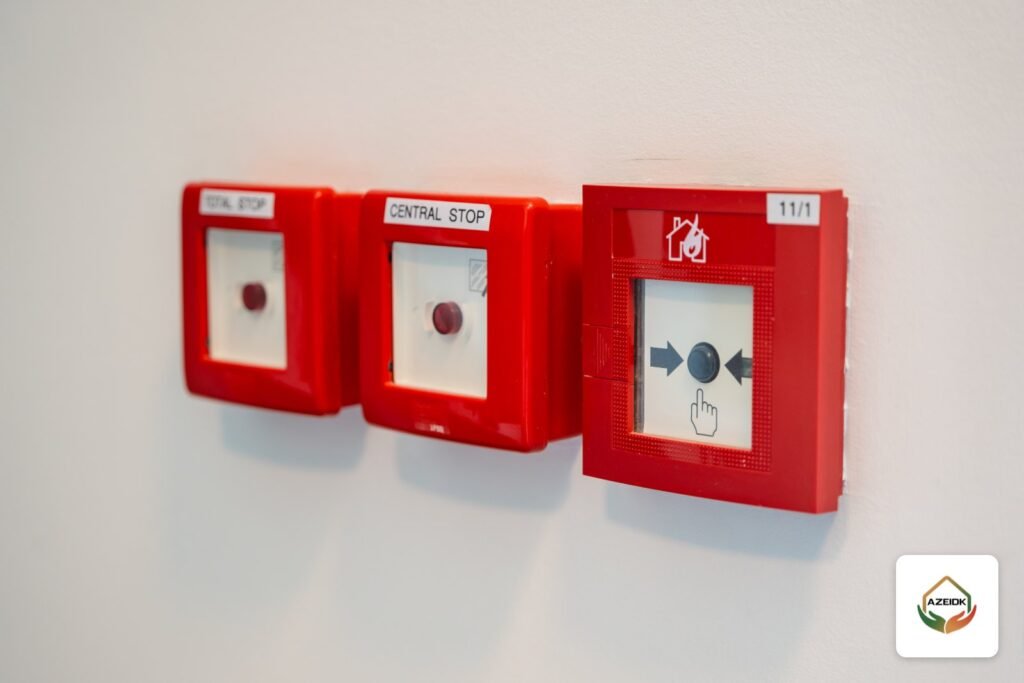
When is a fire alarm system mandatory in Saudi Arabia? For new buildings, the answer sits in Section 907.2 of the Saudi Fire Protection Code, SBC 801, and it depends mainly on the occupancy group (assembly, education, health care, mercantile, residential and so on) and the occupant load, plus special cases such as high-rise buildings, malls and deep underground floors. In assembly occupancies, for example, a manual fire alarm system is required at an occupant load of 300 or more, and an emergency voice/alarm communication system at 1,000 or more. For health care and hotels, the requirement comes from the occupancy itself, not from floor area. This guide explains what the code text actually says and what you still need to confirm in the edition that applies to your permit before you design a fire alarm system.
Key takeaways
- SBC 801 Section 907.2 covers new buildings, spreads the requirements across 907.2.1 to 907.2.23, and calls for installation to NFPA 72.
- Assembly (Group A): manual fire alarm at 300 occupants or more, emergency voice/alarm communication at 1,000 or more.
- Institutional and health care (Group I): manual fire alarm plus automatic smoke detection in the locations set for each sub-group.
- Some triggers ignore the occupancy group: high-rise buildings, atriums connecting more than two stories, malls, battery rooms and deep underground floors.
- The 2024 Saudi Building Code edition has been mandatory since 30 June 2025, so check the figures in the edition your permit was issued under.
In this article
- Where does the Saudi fire code decide whether a fire alarm is required?
- When is a fire alarm system mandatory by occupancy group?
- Requirements that do not depend on occupancy alone
- Is a fire alarm system required in every building?
- Civil Defense requirements for fire alarm systems: what happens in practice?
- Steps to work out what your building needs
- Frequently asked questions
- Conclusion
Where does the Saudi fire code decide whether a fire alarm is required?
SBC 801 follows the layout of the International Fire Code (IFC). Chapter 9 covers fire protection and life safety systems, Section 907 covers fire alarm and detection systems, and Section 907.2 deals with new buildings and structures.
The section opens with a general rule: an approved fire alarm system, installed in line with the code and NFPA 72, shall be provided in the occupancies listed in 907.2.1 through 907.2.23. It also requires at least one manual fire alarm box (manual call point or pull station), while exceptions in some occupancy sections allow manual boxes to be omitted in sprinklered buildings under specific conditions.
One point before the table. The figures below come from the public Arabic text of the 2018 edition. The 2024 edition is the one in force now, and some Arabic clauses refer to “conditions” without printing the numbers. Those numbers must be checked in the Code Requirements text (SBC 801-CR) of the edition your building permit was issued under.
When is a fire alarm system mandatory by occupancy group?
The table summarises what Section 907.2 says for each group. “Manual fire alarm” means a system started from manual call points that operates the occupant notification devices (sounders and strobes).
| Section | Occupancy | What is required | Threshold in the text |
|---|---|---|---|
| 907.2.1 | Assembly (A): halls, restaurants, mosques, event venues | Manual fire alarm that activates occupant notification | Occupant load of 300 or more |
| 907.2.1.1 | Assembly (A), large occupant load | Alarm initiated through the emergency voice/alarm communication system | 1,000 or more |
| 907.2.1.2 | Stadiums, arenas and grandstands | Voice notification audible to the public | No number stated |
| 907.2.2 | Business (B): offices | Manual fire alarm where one of the listed conditions applies; automatic smoke detection in ambulatory care facilities (907.2.2.1) | Conditions in the CR text |
| 907.2.3 | Educational (E) | Manual fire alarm that activates the voice/alarm system; sprinklers and smoke detectors, where installed, connected to the fire alarm | Threshold in the CR text |
| 907.2.4 | Factory (F) | Manual fire alarm where both conditions apply | Conditions in the CR text |
| 907.2.5 | High hazard (H) | Manual fire alarm in H-5 and organic coating manufacturing; automatic gas detection for highly toxic gases, organic peroxides and oxidizers | Per Chapters 60, 62 and 63 |
| 907.2.6 | Institutional and health care (I) | Manual fire alarm plus automatic smoke detection by sub-group I-1, I-2 and I-3 | Required by occupancy |
| 907.2.7 | Mercantile (M): shops and showrooms | Manual fire alarm box that activates notification | Threshold in the CR text |
| 907.2.8 to 907.2.10 | Residential R-1 (hotels), R-2 and R-4 | Fire alarm system and smoke alarms per the sub-sections | Thresholds in the sub-sections |
In Group I-1, for instance, the text asks for smoke detection in corridors, waiting areas open to corridors and habitable spaces other than sleeping units and kitchens. In I-3 (detention) it asks for manual boxes at staff locations, because the alarm is aimed at staff first.
Requirements that do not depend on occupancy alone
Sections 907.2.12 to 907.2.23 require alarm or detection because of the type of building or the use of part of it, even where the general occupancy would not:
- High-rise buildings (907.2.13): a separate section that must be checked for any high-rise, whatever its occupancy.
- Atriums connecting more than two stories (907.2.14): a separate section to check in the edition that applies.
- Covered and open malls (907.2.20): the Arabic text gives 4,645 m² as the area above which an emergency voice/alarm communication system is required.
- Battery rooms (907.2.23): automatic smoke detection where battery electrolyte capacity exceeds 189 litres.
- Underground buildings with smoke control (907.2.18) and deep underground buildings (907.2.19): the text refers to floor levels more than 18 m down.
- Others: special amusement buildings, high-piled combustible storage, aerosol storage, lumber and wood product facilities, aircraft hangars and airport traffic control towers.
So “how big is the building?” is never the full question. A small office building may not need a full system, yet a large UPS battery room inside it can trigger automatic detection for that room.
Is a fire alarm system required in every building?
Not a full panel-based system in every building. The code ties the requirement to occupancy, occupant load and special cases. In residential and hotel occupancies, however, it calls for smoke alarms under Section 907.2.11, listed to UL 217, so a basic level of protection exists even where a central panel is not required.
Keep the two terms apart. A “smoke alarm” detects and sounds within the same unit. A “fire alarm system” has a control panel, detectors, manual call points and notification devices spread through the building. Mixing them up causes errors in the BOQ and in the approval file.
Civil Defense requirements for fire alarm systems: what happens in practice?
The code says when the system is needed; design and installation follow NFPA 72, as Section 907.2 states. On a real project the file usually passes through three stages:
- Design: the engineering office sets the occupancy group and occupant load per floor, then selects the system type (conventional or addressable) and the locations of detectors, call points and notification devices. For the difference between the two, see our addressable fire alarm system comparison.
- Supply and installation: listed and approved devices, suitable cables, panel programming and a cause-and-effect matrix. Details are in fire alarm installation in Saudi Arabia.
- Approval and handover: testing, handover documents, then Civil Defense requirements and the Salamah platform. Our Salamah certificate guide explains the route.
Where voice communication is required (assembly of 1,000 or more, malls above the stated area), the design changes completely, because voice messages and evacuation zones become part of the system. Read voice evacuation alarm systems before the drawings are approved. For the wider code background, see our SBC 801 guide.
Steps to work out what your building needs
- Set the occupancy group for each part of the building; a mixed-use building may combine retail, offices and residential.
- Calculate the occupant load per floor and per hall, not only for the whole building.
- Check the section for each group in the SBC 801 edition your permit was issued under, especially the numeric conditions in the CR text.
- Check the special cases: building height, atriums, battery rooms, floors below ground.
- Confirm whether the building is fully sprinklered, as this can affect manual call points under the exceptions.
- Record the decision in the design report, because that is what the reviewer will ask about.
AZEIDK provides Civil Defense approval support, alongside design, supply and installation of fire alarm systems and the safety equipment installation certificate. The Salamah technical report itself comes from an approved engineering office, and AZEIDK can coordinate with that office.
Frequently asked questions
When is a fire alarm mandatory in a hall or a large restaurant?
For assembly occupancies (Group A), Section 907.2.1 requires a manual fire alarm at an occupant load of 300 or more, and 907.2.1.1 adds an emergency voice/alarm communication system at 1,000 or more.
Is a fire alarm mandatory in offices and shops?
Sections 907.2.2 (business) and 907.2.7 (mercantile) tie the requirement to conditions on the number and location of occupants. Check the figures in the Code Requirements text of your permit edition, and any special case in the building.
Do hospitals and hotels always need a fire alarm system?
Health care (Group I) requires a manual fire alarm and automatic smoke detection by sub-group. Hotels (R-1) fall under Section 907.2.8, which requires a fire alarm system and smoke alarms under its sub-sections.
Do sprinklers remove the need for a fire alarm?
Not automatically. Some provisions allow manual call points to be omitted in sprinklered buildings under specific conditions, which is not the same as removing notification. In educational occupancies, Section 907.2.3 also requires sprinklers to be connected to the fire alarm system.
What are the Civil Defense fire alarm requirements for commercial premises?
The basis is SBC 801 and the NFPA 72 reference it contains, followed by licensing requirements through the Salamah platform for the activity type. Start with the occupancy, then design and document the system before applying.
Should I apply the 2018 or the 2024 edition of SBC 801?
The 2024 Saudi Building Code edition has been mandatory since 30 June 2025. Your project is governed by the edition its permit was issued under, so confirm it with the engineering office before design.
Conclusion
In Saudi Arabia, whether a fire alarm system is mandatory is not settled by floor area alone. Start from the occupancy group and occupant load in SBC 801 Section 907.2, check the special cases, and confirm the figures in the edition that applies to your permit. Design to NFPA 72 and Civil Defense approval come next.
Not sure whether your building needs a full fire alarm system? Send the drawings, activity type and number of floors, and our engineers will review them with you. Talk to the AZEIDK team
Related guides
- AFFF Foam Concentrate in Saudi Arabia: Choosing the Brand and the 1%, 3% or 6% Rate
- Barbershop and Women’s Salon Safety Requirements in Saudi Arabia
- Fire Alarm Panel Faults (Fault Messages): What Each Message Means, What the Technician Checks and When to Call Maintenance
- Safety Shoes, Coveralls and Work Gloves: How to Choose PPE for a Work Site in Saudi Arabia