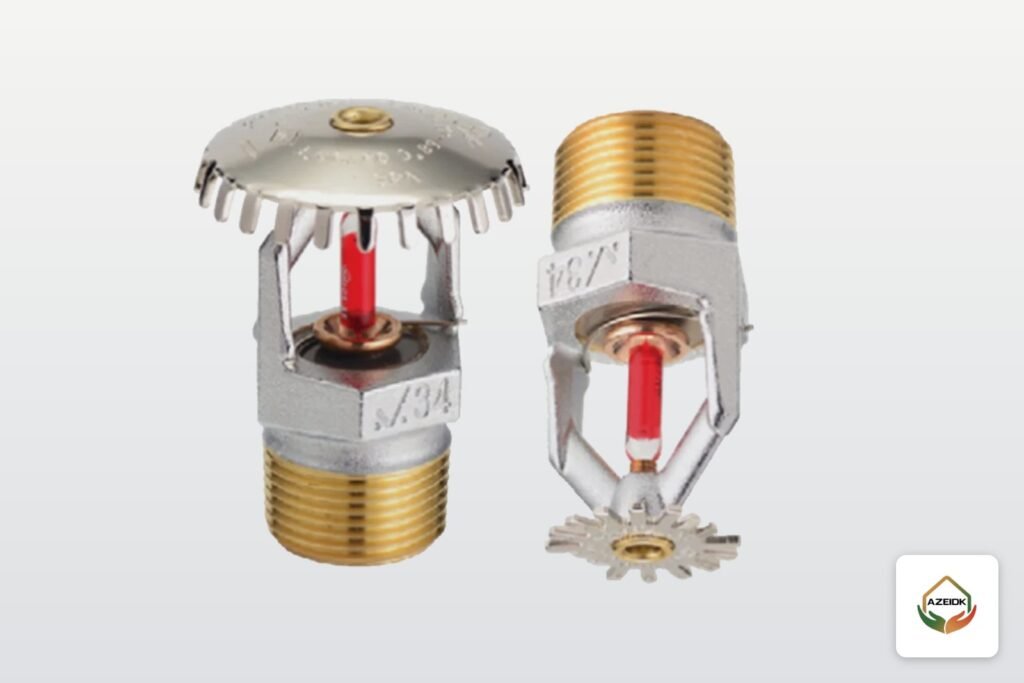
FM200 nozzles are the last point in the network and the one that most decides whether the discharge works: the agent leaves through them and must spread through the room in about 10 seconds. Nozzle size, orifice, pattern (180° or 360°) and mounting height come from the flow calculation and the manufacturer’s manual, not from judgement on site.
For how clean agent systems are designed, kept safe and maintained, see our FM-200 fire suppression system guide.
This guide explains nozzle types and installation limits as manufacturers state them, with examples from the Context Plus clean agent discharge nozzles and the American Fire Control system catalogue, both supplied by AZEIDK.
Key points
- FM200 nozzles come in two patterns: 360°, discharging in all directions, and 180°, discharging in a half circle.
- Context Plus nozzles come in six sizes from ½ in to 2 in, in both patterns.
- Nozzle size and orifice diameter are outputs of the system’s listed flow calculation software.
- The AFC catalogue gives a protected height of 0.3 to 4.5 m and a maximum nozzle distance of 0.3 m below the ceiling.
- Each protected space, such as a ceiling void or raised floor, needs its own nozzles within the calculation.
In this article
- What do FM200 nozzles do?
- FM200 nozzle 180° vs 360°
- FM200 nozzle sizes and how the orifice is set
- FM200 nozzle mounting height and ceiling distance
- Ceiling voids and raised floors
- Fixing and orienting nozzles during installation
- Common FM200 nozzle mistakes
- Supply and layout of FM200 nozzles
- What to check on FM200 nozzles at handover
- Frequently asked questions
- Summary
What do FM200 nozzles do?
The nozzle turns the pressurized liquid agent arriving through the pipework into a spray that vaporizes and mixes with room air until the design concentration is reached. Three things make that work: enough pressure at the nozzle, an orifice of the calculated diameter to pass the required quantity, and a location that covers the whole space without dead zones.
Systems are usually designed to NFPA 2001, under which halocarbon agents such as HFC-227ea are discharged within about 10 seconds; in Saudi Arabia the Saudi Building Code (SBC) and Civil Defense requirements remain binding. The Context Plus nozzle page states discharge in 10 seconds or less when installed within the design limits of the installation manual. For more on the standard, see our NFPA 2001 guide.
FM200 nozzle 180° vs 360°
| Item | 360° nozzle | 180° nozzle |
|---|---|---|
| Discharge pattern | All directions around the nozzle | Half circle in front of the nozzle |
| Usual location | Near the centre of the room or coverage zone | Near a wall, outlets facing away from it |
| When preferred | Open, regular rooms | When equipment, lighting or services block a central position |
| What to check | Distance to walls and coverage limits | Outlet direction after installation |
With a 180° nozzle, the outlets must face into the room. One fitted the wrong way round discharges onto the wall and leaves part of the room below concentration.
FM200 nozzle sizes and how the orifice is set
Context Plus nozzles come in ½, ¾, 1, 1¼, 1½ and 2 in, each in 180° and 360° versions. In the American Fire Control catalogue, nozzles run from 15A to 50A, with the orifice drilled in 0.2 or 0.5 mm increments to suit the calculation.
Nozzle size is not picked from pipe size alone. The listed software takes agent quantity, network length, branches and elevation changes, then sets each nozzle’s orifice to pass its share of agent in the required time. So:
- never swap a nozzle for a different size on site without recalculating;
- at receipt, match the drilled orifice or its marking to the calculation table;
- any change to the pipe route after calculation means running the software again.
FM200 nozzle mounting height and ceiling distance
The AFC catalogue gives a protected height of 0.3 to 4.5 m and a maximum nozzle distance of 0.3 m below the ceiling, and the same table lists the maximum coverage per nozzle for both patterns. These limits belong to the system listed in that catalogue; every manufacturer has its own tables in its design and installation manual.
Where the room is taller than allowed, the designer adds a second nozzle tier or splits the height as the manual permits. A larger nozzle does not make up for extra height.
Ceiling voids and raised floors
Where a room has a ceiling void or raised floor containing cables or equipment, each is treated as a protected space with its own volume and nozzles in the same calculation. The Context Plus nozzle page lists use in rooms, ceiling voids and raised floors, with optional reflector plates to protect sensitive ceiling tiles from discharge force.
Discharge force is considerable, so nearby ceiling tiles and light objects around the nozzle are checked and secured so they do not lift or fall during discharge.
Fixing and orienting nozzles during installation
The points below are general installation practice; the manufacturer’s design and installation manual governs the details and limits.
- Support: the pipe carrying the nozzle is supported close to it, since discharge reaction moves an unsupported nozzle.
- Orientation: check 180° nozzle outlets after installation and photograph them before the ceiling is closed.
- Obstructions: keep nozzles clear of ducts, light fittings and cable trays that block the agent path.
- Cleanliness: blow the network through before fitting nozzles so debris does not block small orifices.
The remaining installation steps, from cylinders to panel, are in FM200 installation, and the other components in FM-200 system components from Context Plus.
Common FM200 nozzle mistakes
- A 360° nozzle fitted tight to a wall, wasting part of the discharge on the surface.
- Pipe routes changed on site without recalculation, so each nozzle gets a different quantity.
- Ceiling voids or raised floors left unprotected.
- Nozzles set further below the ceiling than allowed because of clashes with other services.
- Ceiling tiles around nozzles left unsecured.
After installation, enclosure integrity decides whether the concentration holds; see room integrity test.
Supply and layout of FM200 nozzles
AZEIDK supplies Context Plus nozzles in all sizes and both patterns as part of its special fire suppression systems, with calculations and nozzle positions prepared through engineering design and calculations and coordinated with ceilings and other services in shop drawings and coordination.
What to check on FM200 nozzles at handover
Before ceilings are closed and before the handover test, the supervising engineer checks every nozzle against the calculation table. Usual checkpoints:
- Size and orifice: nozzle size and orifice diameter or marking match the table.
- Pattern: 180° or 360° as drawn.
- Orientation: 180° outlets face into the room, with a photo of each nozzle.
- Height: distance from the ceiling within the manufacturer’s limit.
- Support: a hanger close to each nozzle, with no movement by hand.
- Condition: no paint, insulation or dust on the outlets.
- Record drawings: as-built drawings updated with actual nozzle positions if they changed.
This check goes into the handover file and stays as a reference for later maintenance visits.
Frequently asked questions
What is the difference between a 180° and a 360° FM200 nozzle?
A 360° nozzle discharges in all directions and usually sits near the centre of its zone; a 180° nozzle discharges in a half circle and sits near a wall with its outlets facing inward.
What FM200 nozzle sizes are available?
Context Plus nozzles come in six sizes from ½ in to 2 in, each in 180° and 360° patterns.
How long does FM200 take to discharge through the nozzles?
Discharge is designed to finish within about 10 seconds under NFPA 2001; the Context Plus nozzle page states 10 seconds or less within design limits.
What is the maximum mounting height for an FM200 nozzle?
The AFC catalogue gives a protected height of up to 4.5 m, with the nozzle no more than 0.3 m below the ceiling. Each manufacturer sets its own limits.
Can a nozzle size be changed on site?
Not without recalculation, since the orifice is sized to pass a set quantity of agent in the required time.
Does a ceiling void need separate nozzles?
Yes, if it is a protected space with cables or equipment; its volume is calculated and it gets its own nozzles.
Do FM200 nozzles differ between manufacturers?
Yes. Each manufacturer has its own coverage tables, height limits and orifice drilling method, and one system’s nozzles are not fitted to another’s because approval covers the whole assembly.
Do FM200 nozzles need maintenance?
They are checked at routine visits to confirm position and orientation, clear outlets free of dust and paint, and sound hangers.
Summary
FM200 nozzles are chosen by calculation and installed within the manufacturer’s limits: pattern by position, size and orifice by the flow calculation, height and ceiling distance by the catalogue. Checking these before the ceiling is closed is far easier than finding them at the handover test.
Related reading: American Fire Control FM-200 System, Server Room Fire Suppression in Banks and Control Room Fire Protection.
Need a nozzle layout for a specific room? Send the room plan, height and ceiling and floor details, and AZEIDK will prepare the calculation, nozzle positions and submittal. Contact AZEIDK
Related guides
- Civil Defense Licensing on Salamah: Instant Licences vs Direct and Indirect Activities
- Standpipe Systems (NFPA 14): Classes, Wet and Dry Risers and Testing
- Safety Helmet Colours: Hard Hat Colour Code on Work Sites, Standards and When to Replace
- Access Point Controller: Hardware WLC, Cloud Management or Controller-less, and When Business Wi-Fi Needs One