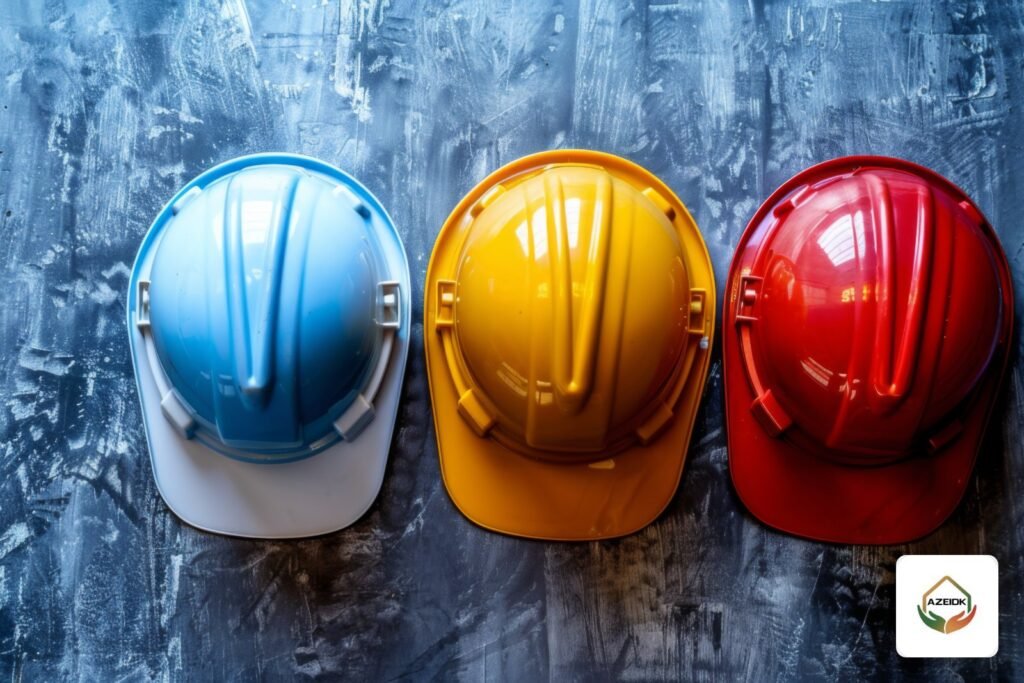
Safety helmet colours usually tell you a person’s role on site, but the hard hat colour code is a convention each company or site sets, not a single law. The protection a helmet gives depends on the standard marked inside it, such as EN 397 or ANSI/ISEA Z89.1, and on its condition and age.
This guide covers the most common hard hat colour schemes, what the helmet standards and classes mean, how to inspect a helmet before each use, and when to replace it, with attention to Saudi sun and heat. You can see PPE and occupational safety clothing at AZEIDK showrooms across Saudi Arabia.
Key takeaways
- There is no single worldwide hard hat colour code. Each company or site defines its own and briefs workers and visitors on it.
- Colour does not indicate protection level. The standard and class are marked inside the shell.
- The European standard EN 397 was reissued in April 2025, splitting helmets into Type 1 and Type 2.
- The US standard ANSI/ISEA Z89.1 sorts hard hats into Type I and Type II by impact direction, and Class G, E and C by electrical insulation.
- Replace a helmet immediately after any impact, when it shows cracks, fading or a chalky surface, and when it reaches the service life the manufacturer sets.
In this article
- What do safety helmet colours mean on a work site?
- Is there a mandatory hard hat colour code in Saudi Arabia?
- Safety helmet standards: EN 397 and ANSI/ISEA Z89.1
- Safety helmet or bump cap?
- What a hard hat does, and what it does not
- When should you replace a safety helmet?
- Safety helmet inspection checklist before each use
- Chin straps, accessories and stickers
- Occupational safety equipment at AZEIDK
- Frequently asked questions
- Summary
What do safety helmet colours mean on a work site?
Sites use colour so that supervisors, technicians and safety staff can be recognised from a distance. That helps on large sites, during emergencies and when directing heavy plant. The table below shows a widely used pattern, as listed in US supplier guides. It is common, not universal.
| Helmet colour | Common use on many sites |
|---|---|
| White | Supervisors and management |
| Yellow | Labourers and equipment operators |
| Blue | Engineers, electricians and technical specialists |
| Green | Safety personnel and safety inspectors |
| Red | Emergency and first aid responders |
| Orange | Traffic control and road workers |
| Brown | Welders and high-heat work |
The Build UK scheme: proof that colours differ
In the UK, Build UK published a different scheme in April 2016: black for supervisors; white for site managers, competent operatives and vehicle marshals; orange for slingers and signallers; and blue for everyone else on site. A green sticker marks a first aider and a red sticker a fire marshal. White means something different here than in the table above, which shows why no colour meaning can be assumed.
The practical rule: ask the site safety officer which scheme applies before assuming anything. If you run a site, write the scheme into the safety plan and explain it at induction for new staff and visitors.
Is there a mandatory hard hat colour code in Saudi Arabia?
We found no national Saudi rule in the official sources we reviewed that assigns a helmet colour to each job. The same is true abroad. The US OSHA head protection standard (1910.135) requires helmets where there is a risk of falling objects or contact with exposed electrical conductors and refers to ANSI Z89.1, but it says nothing about colour. In the UK, colour coding is good practice rather than a general legal duty.
What does apply in the Saudi market is product conformity. SASO’s Technical Regulation for Personal Protective Equipment and Clothing, approved in 2018 and amended in 2021, lists industrial safety helmets under EN 397 and industrial bump caps under EN 812, and requires the supplier to hold a certificate of conformity from a notified body. Ask your supplier for proof of conformity and the datasheet for each model.
Safety helmet standards: EN 397 and ANSI/ISEA Z89.1
You will usually meet two references: the European EN 397 and the American ANSI/ISEA Z89.1. Each has its own classification, and one helmet can carry both marks if it was tested to both.
EN 397
In the 2012 edition the basic requirements are vertical shock absorption, penetration resistance, flame resistance and chin strap anchorage. Optional claims include very low temperature (−20 or −30 °C), very high temperature (+150 °C), electrical insulation up to 440 V, molten metal splash (MM) and lateral deformation (LD).
EN 397:2025 was published in April 2025. Its main changes:
- Type 1: protection against vertical, on-crown impacts such as falling objects (49 J test energy).
- Type 2: multi-directional protection including sides, front and rear (98 J on the crown, 24.5 J off-crown), with a mandatory factory-fitted chin strap.
- The 440 V option has gone. Electrical insulation claims are now tested to EN 50365 and apply to non-vented helmets only.
- New options cover enhanced visibility, electrostatic dissipation and off-crown penetration resistance.
Helmets certified to the 2012 edition can stay on the market until their certificate expires, and a sound helmet does not need replacing just because the new edition is out, according to manufacturers such as JSP.
ANSI/ISEA Z89.1: type and class
| Marking | Meaning | Typical use |
|---|---|---|
| Type I | Impact protection to the top of the head only | Most general construction |
| Type II | Protection to the top, sides, front and rear | Sites with a lateral impact risk |
| Class G | General electrical insulation, tested at 2,200 V | General construction without high-voltage risk |
| Class E | Electrical insulation, tested at 20,000 V | Electrical and utility work |
| Class C | No electrical protection | Where there is no electrical hazard |
Extra markings may include two curved arrows if the helmet can be worn reversed, LT for low temperature (−30 °C) and HV for high visibility.
Safety helmet or bump cap?
A bump cap looks like an ordinary cap with a protective shell inside. Its standard, EN 812, covers striking hard, fixed objects such as low ceilings, racking and protruding pipes. The standard states it does not protect against falling or thrown objects or against moving or suspended loads.
AZEIDK offers the Coverguard protective safety bump cap for warehouses, workshops and low-clearance maintenance areas. It is for light knocks only and must not replace an industrial safety helmet anywhere there is a falling-object risk: under cranes, next to scaffolding or on construction sites.
What a hard hat does, and what it does not
A helmet reduces the force that reaches the head and neck when something falls, stops sharp objects from penetrating, and an insulating type reduces the shock risk from contact with a live conductor. Colour makes roles easy to spot in an emergency. But a helmet is one layer of protection. It does not replace tool tethering at height, edge protection or nets. For the rest of the site PPE kit, see our guide to safety shoes, coveralls and work gloves.
When should you replace a safety helmet?
After any impact or penetration
MSA is clear: always replace a helmet that has taken an impact or penetration, even if it looks fine. Damage inside the shell may not be visible.
At the end of the manufacturer’s service life
There is no single period for every helmet; the manufacturer’s instructions for each model decide. Two examples from official sources:
- MSA recommends replacing the shell every 5 years and the suspension every 12 months, counted from the first day of use, and notes that working conditions may call for a new shell as often as every two years.
- 3M gives its G3000 helmets a maximum recommended life of up to 5 years from the date of manufacture, as guidance rather than a warranty.
Note the difference: one maker counts from first use, the other from manufacture. The manufacture date is usually moulded under the brim.
Sun and heat in the Saudi climate
UV, high heat and chemicals weaken plastic over time. 3M gives a usage range of −30 to +50 °C for G3000 helmets and a storage range of +3 to +40 °C. So do not leave a helmet in a parked car in the sun or on the dashboard; store it in a shaded, dry place after work. Some models carry a UV indicator, such as 3M’s UVicator, which changes colour to show when replacement is due.
Safety helmet inspection checklist before each use
- Shell: no cracks, dents, holes or deep scratches.
- Colour and surface: fading or a chalky feel signals UV or chemical breakdown.
- Flexibility: flex the brim gently. Brittleness or excessive flex means a weak shell.
- Suspension: no frayed or torn straps, damaged stitching or broken clips.
- Stickers: none covering any damage.
- Labels: standard, manufacture date and size readable inside the helmet.
Any of these findings means taking the helmet out of service. Clean it with warm water and mild soap and avoid strong solvents.
Chin straps, accessories and stickers
Chin strap: under EN 397:2012 the chin strap anchorage releases at between 150 and 250 N. Under the 2025 edition a chin strap is mandatory on Type 2 helmets, with a break strength above 500 N. Use one for work at height, in wind or with frequent bending so the helmet stays on.
Accessories: face shields, ear defenders and lamps must be compatible with the helmet model as the manufacturer states. EN 397:2025 requires accessories that may affect conformity to be fitted for specified tests.
Stickers and paint: MSA does not recommend painting most of its helmets and allows non-metallic, self-adhesive stickers placed at least half an inch from the edge. Paint and stickers can hide cracks and reduce electrical insulation.
Occupational safety equipment at AZEIDK
AZEIDK branches in Saudi Arabia sell to individuals and projects, and the safety equipment range includes Coverguard safety shoes, hi-vis vests and the bump cap. Browse the safety equipment category, and for choosing workwear by job type see occupational safety clothing in Jeddah and Riyadh. When ordering helmets for your site, ask for the datasheet and check the standard and class marked on the helmet. For fire safety during construction, see fire safety on construction sites.
Frequently asked questions
What does a white hard hat mean?
On many sites white marks supervisors and management. In the UK Build UK scheme it is for site managers and competent operatives. The site’s own scheme has the final say.
Does hard hat colour show the level of protection?
No. Protection comes from the standard, type and class marked inside the helmet, such as EN 397 or ANSI/ISEA Z89.1 Class E. Colour only identifies the role.
How long does a safety helmet last?
The manufacturer sets it for each model. MSA recommends 5 years for the shell from first use and 12 months for the suspension; 3M states up to 5 years from manufacture for G3000 helmets. Replace sooner after any damage or impact.
What is the difference between Class E and Class G hard hats?
Under ANSI/ISEA Z89.1, Class G is tested at 2,200 V for general use and Class E at 20,000 V for electrical work. Class C gives no electrical protection.
Can a bump cap replace a hard hat?
No. An EN 812 bump cap is for knocks against fixed objects only and does not protect against falling objects or suspended loads. Construction sites and crane areas need an industrial safety helmet.
Can I put stickers on a hard hat or paint it?
Paint is not recommended for most helmets. Where a manufacturer allows stickers, they must be non-metallic, kept away from the edge and never cover damage. Follow the manufacturer’s instructions.
Do I need to replace my helmet because of EN 397:2025?
Not because of the new edition alone. Helmets certified to the 2012 edition remain valid until their certificate and manufacturer service life end, provided they are in good condition.
Summary
Hard hat colours are a language each site agrees on, so learn it from the safety officer rather than assuming. Protection is read from the standard inside the helmet: EN 397 with its two types in the 2025 edition, or ANSI/ISEA Z89.1 with its type and class. Inspect before every use, replace after any impact and at end of life, and keep helmets out of the summer sun. A bump cap is a different tool, for low ceilings only.
Equipping your site team with PPE? Send us the headcount and type of work, or visit your nearest branch to see the equipment in stock and the datasheet for each product. Contact the AZEIDK team