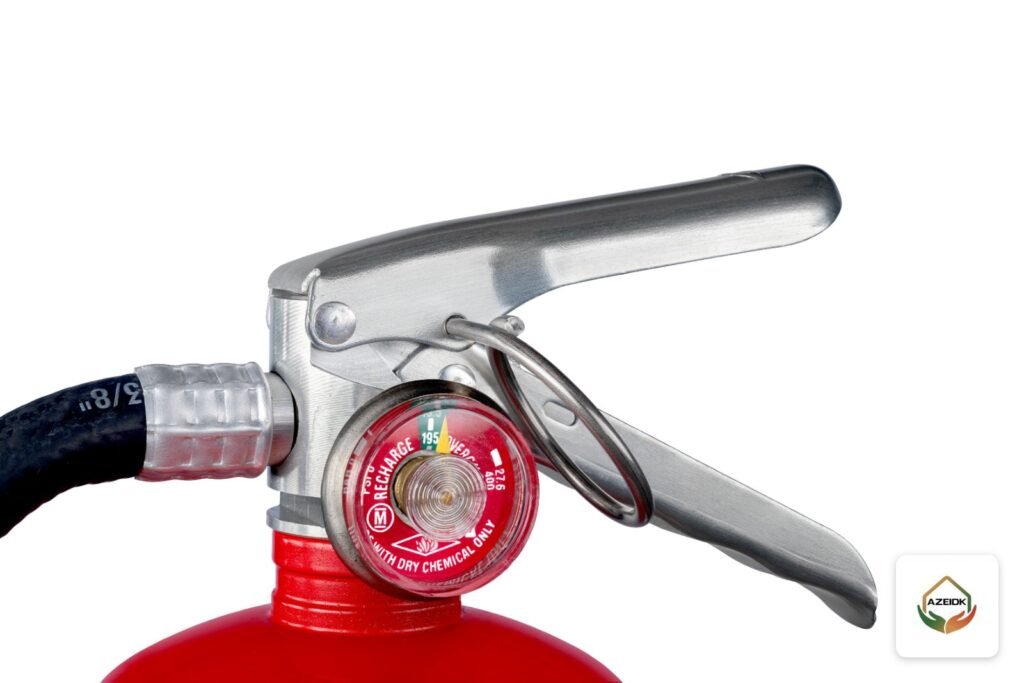
A portable extinguisher has eight main fire extinguisher parts: the cylinder that holds the agent under pressure, the valve (the head of the extinguisher), the carrying handle and operating lever, the safety pin with its tamper seal, the pressure gauge, the siphon tube inside the cylinder, and the hose with its nozzle, or a horn on a CO2 unit. Each part does one job, and one failed part can stop the extinguisher working.
Below: each part, stored-pressure versus cartridge-operated units, how CO2 differs, and when a part is enough or the unit must come out of service. If you have extinguishers that need inspection or a replacement part, the AZEIDK preventive and periodic maintenance team services extinguishers under a contract or on request.
Key takeaways
- NFPA 10 defines three types by pressure source: pressure stored in the agent cylinder itself, expellant gas in a separate cartridge, or an agent that expels itself by its own vapour pressure, such as CO2.
- A CO2 extinguisher has no gauge. Its charge is checked by weight, and it ends in a horn instead of a standard nozzle.
- The valve, gauge, pin, hose and nozzle are replaced with the manufacturer’s parts or parts listed for use on that extinguisher.
- The cylinder is never repaired. Pitting, damaged threads or fire exposure mean it is condemned, not tested.
- The current edition is NFPA 10-2026. The edition that applies to a project is set by the Saudi Fire Protection Code SBC 801 and Civil Defense.
In this article
- Fire extinguisher parts names and what each one does
- The cylinder: the one part that cannot be repaired
- The extinguisher head: valve, handle and lever
- Safety pin and gauge: covered in their own articles
- Siphon tube, hose and nozzle: the agent’s path
- Dry powder extinguisher components: stored pressure or cartridge?
- CO2 fire extinguisher parts: a horn, and weight instead of a gauge
- Repair the part or replace the extinguisher?
- Frequently asked questions
- Conclusion
Fire extinguisher parts names and what each one does
| Part | Function | What to check | If damaged |
|---|---|---|---|
| Cylinder (shell) | Holds the agent and withstands operating pressure | Rust, corrosion, dents, legible nameplate | Hydrostatic test or condemn; never repair |
| Valve (head) | Holds pressure and opens when the lever is squeezed | Leaks around the collar and O-ring | Replace the O-ring or valve stem with factory parts |
| Handle and lever | Carrying and operating by hand | Cracks, bending, free movement | Replace with a genuine part |
| Safety pin and tamper seal | Prevents accidental discharge and shows use or tampering | Pin in place, seal intact | Inspect the unit, then fit a new pin and seal |
| Pressure gauge | Shows pressure on stored-pressure units | Needle in the green zone, lens intact | Depressurise and fit a matching gauge |
| Siphon tube (downtube) | Carries agent from the bottom of the cylinder to the valve | Checked when the head is removed during maintenance | Replace with the valve assembly |
| Hose | Directs the agent away from the user’s body | Cracks, stiffness, tight couplings | Replace with a factory hose |
| Nozzle or horn | Shapes the discharge and its range | Blockage by dust or insects | Clean or replace |
The cylinder: the one part that cannot be repaired
The cylinder is the pressure vessel, and its material depends on the type. The Falcon Gold 6 kg dry powder extinguisher (FDP6) has a cold-rolled steel cylinder, 15 bar operating pressure and 30 bar test pressure, according to its product page. The Falcon Gold 6 kg CO2 extinguisher (FCD6) has an St52 steel cylinder tested at 250 bar.
Under NFPA 10, a cylinder with dents, mechanical injury or corrosion indicating weakness is hydrostatically retested or condemned. It is condemned without testing when it has:
- Worn, corroded, broken, cracked or nicked neck threads.
- Pitting, including pitting under a removable nameplate or band.
- Been exposed to excessive heat, flame or fire.
Kidde’s service manual permits no cylinder repairs; a repaired cylinder is removed from service. Test intervals are in our article on fire extinguisher maintenance and recharging.
The extinguisher head: valve, handle and lever
The head is one assembly threaded onto the cylinder neck and sealed by a collar O-ring. Inside, a spring holds the valve stem on its seat. Squeezing the lever pushes the stem down and pressure drives the agent up the siphon tube to the hose; releasing it lets the spring close the valve.
Valve materials vary: the FDP6 page lists a nickel-plated valve, the FCD6 page a hot-forged brass valve.
The most common head fault is a slow leak. Amerex recommends finding it with soapy water around the collar, O-ring and gauge. The fix: empty the unit, replace the O-ring or valve stem, recharge. This is workshop work, never done on a pressurised unit.
Safety pin and gauge: covered in their own articles
The safety pin stops the lever being squeezed by accident, and the plastic tamper seal through it breaks when the pin is pulled, showing possible use. Details are in fire extinguisher safety pin and tamper seal.
The pressure gauge is fitted only on stored-pressure extinguishers. The Amerex manual says a bent, damaged or incorrect gauge is replaced after the unit is depressurised. The NFPA 10 annex adds that a replacement gauge must suit the charging pressure on the nameplate and be compatible with the valve body material. Colour zones and pressure in bar are explained in fire extinguisher pressure gauge.
Siphon tube, hose and nozzle: the agent’s path
Siphon tube
The siphon tube is fixed under the valve and runs almost to the bottom of the cylinder. It draws agent from the bottom while the expellant gas sits above it and pushes down. That is why an extinguisher is operated upright. Amerex calls it the “downtube” and supplies it with the valve assembly.
Hose and nozzle
The hose lets the user aim the agent with one hand while holding the extinguisher in the other. On very small units, the nozzle may be fitted directly to the valve with no hose. Dust and insects can block a nozzle, so NFPA 10 includes nozzle blockage in the annual external examination, and Amerex asks technicians to blow air through the nozzle or hose during maintenance.
NFPA 10 also requires hydrostatic testing of hoses with a shutoff nozzle, at the extinguisher’s test interval.
Dry powder extinguisher components: stored pressure or cartridge?
NFPA 10 defines a stored-pressure extinguisher as one where the agent and expellant gas are kept in a single container. In a cartridge-operated extinguisher, the expellant gas is in a separate container from the agent. The difference shows directly in the parts:
| Item | Stored pressure | Cartridge-operated |
|---|---|---|
| Pressure source | Gas inside the cylinder with the powder | Separate gas cartridge; the agent cylinder is not pressurised before use |
| Monthly fullness check | Read the gauge | Weigh or heft the unit, per NFPA 10 |
| Internal examination | Emptied and examined internally every 6 years for units on a 12-year hydrostatic test, per NFPA 10 | Agent examined internally every year, per NFPA 10 |
The Falcon Gold 1, 6 and 50 kg powder extinguishers in the AZEIDK fire extinguishers range are listed with a 15 bar operating pressure, which indicates the pressure is held in the cylinder itself. Read the nameplate to confirm the type, because the internal examination schedule differs.
CO2 fire extinguisher parts: a horn, and weight instead of a gauge
Under NFPA 10, CO2 is “self-expelling”: its own vapour pressure discharges it, with no separate expellant gas. Its parts differ in three ways:
- No gauge: the Amerex CO2 parts lists include no gauge. Fullness is checked by weighing the unit and comparing it with the limits on the nameplate.
- A horn instead of a nozzle: a wide cone that slows the gas. The Amerex manual warns against holding the horn or discharge tube, because the gas is extremely cold and can cause cold burns. Hold the hand grip only.
- Safety disc: a part in the valve body that protects the cylinder against excess pressure. The Amerex manual has it inspected for obstruction or damage during maintenance and, if needed, replaced with a complete factory assembly, with no substitutes.
Fittings vary by model. On the SFFECO portable CO2 extinguishers offered by AZEIDK, a 1220 mm hose is fitted on models CD 5-G, CD 6-G and CD 10-L, while CD 3-G and CD 5-L come with a horn only. The cylinders are steel with no welded seam and a 250 bar test pressure. NFPA 10 requires an annual conductivity test on all CO2 hose assemblies, and a hose that fails is replaced. For CO2 uses and hazards, see our CO2 fire extinguisher guide.
Repair the part or replace the extinguisher?
Rule of thumb: most parts above the neck are replaceable; the cylinder is never repaired. NFPA 10 requires manufacturer’s replacement parts or parts listed for that extinguisher, and Amerex states substitute parts void the warranty and UL listing.
| Condition | Usual action |
|---|---|
| Broken seal or missing pin | Inspect and recharge if needed, then fit a new pin and seal |
| Broken or bent gauge | Depressurise and fit a matching gauge |
| Leak at the head | Empty, replace the O-ring or valve stem, recharge |
| Cracked hose or blocked nozzle | Clean the nozzle or replace the hose with a genuine part |
| CO2 hose fails the conductivity test | Replace the hose |
| Dents, mechanical damage or corrosion on the cylinder | Hydrostatic test or condemn |
| Damaged threads, pitting, or fire exposure | Condemn the cylinder without testing |
On small units, part plus labour can approach the price of a new extinguisher; that is the owner’s call, not a rule in the standard. Either way, NFPA 10 requires an extinguisher removed from service to be replaced immediately with one suitable for the hazard and of at least equal rating. In Saudi Arabia, firefighting equipment falls under the SASO Technical Regulation for Fire Control Materials and Equipment, which requires a certificate of conformity through the SABER platform.
Frequently asked questions
What are the parts of a fire extinguisher, in short?
The cylinder, the valve (head), the handle and lever, the safety pin and tamper seal, the pressure gauge, the siphon tube, the hose, and the nozzle or horn.
Why does a CO2 extinguisher have no gauge?
CO2 expels itself by its own vapour pressure, and that pressure does not show how much gas is left. Its charge is checked by weight against the nameplate.
What does the siphon tube do?
It carries the agent from the bottom of the cylinder to the valve while the expellant gas stays above it. That is why the extinguisher is used upright.
Can a rusty extinguisher cylinder be repaired?
No. A cylinder with corrosion that indicates weakness is hydrostatically tested or condemned, and pitting corrosion means it is condemned without testing.
Can I buy a gauge or pin from any shop and fit it myself?
It is not recommended. NFPA 10 calls for manufacturer’s parts or parts listed for that extinguisher, and a gauge is only changed after depressurising the unit in a service workshop.
How do dry powder and CO2 extinguisher components differ?
A stored-pressure powder extinguisher has a gauge, a nozzle and a lighter cylinder. A CO2 extinguisher has no gauge, ends in a horn, and has a thicker cylinder because its test pressure is much higher.
Conclusion
A gauge out of the green zone, a broken seal or a cracked hose are faults fixed with a genuine part. A corroded or fire-exposed cylinder is the end of the extinguisher’s life. Work that needs the head removed or pressure released belongs in a workshop.
Extinguishers that need inspection or a replacement part? Send us types, sizes, quantities and location, and our maintenance team will tell you what to repair and what to replace. Talk to the AZEIDK team
AZEIDK supplies fire extinguishers of all common types and sells them to individuals and businesses from its branches in Saudi Arabia.
Related guides
- Fire Extinguishers in Riyadh: How to Buy the Right Extinguisher for Home, Shop and Facility
- Fire Hose Cabinet Maintenance: Monthly and Annual Checks of Hose, Reel, Valve and Glazing, and What the Technician Records
- Safety Companies in Saudi Arabia: Types and How to Verify an Approved Safety Establishment
- Sprinkler Hazard Classification Under NFPA 13: Light, Ordinary (Groups 1 and 2) and Extra Hazard, and Their Effect on Density and Pump Size