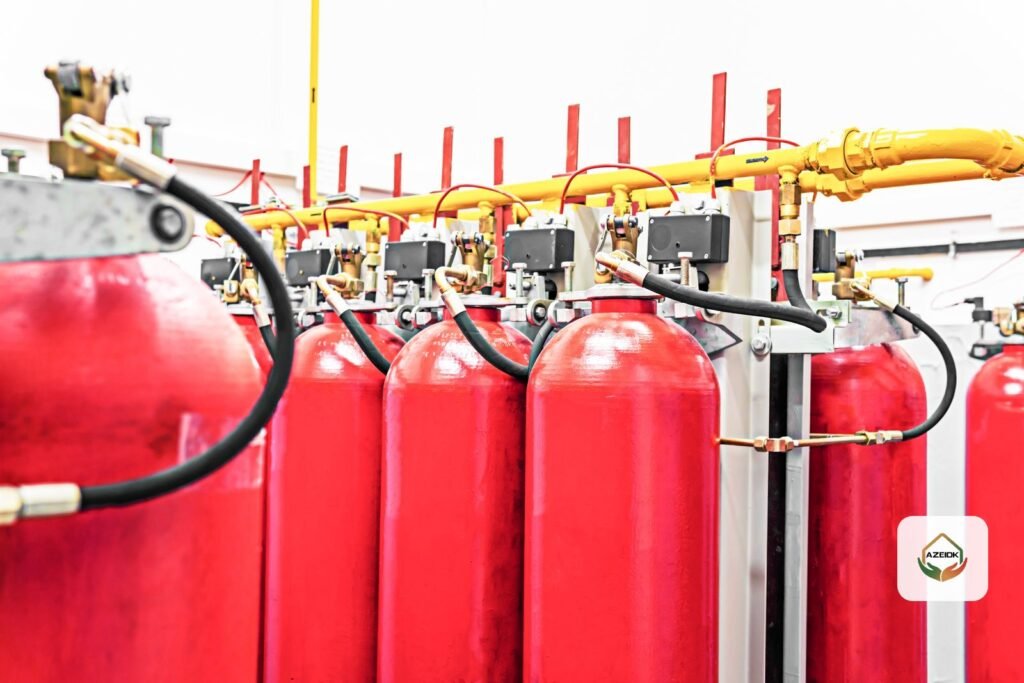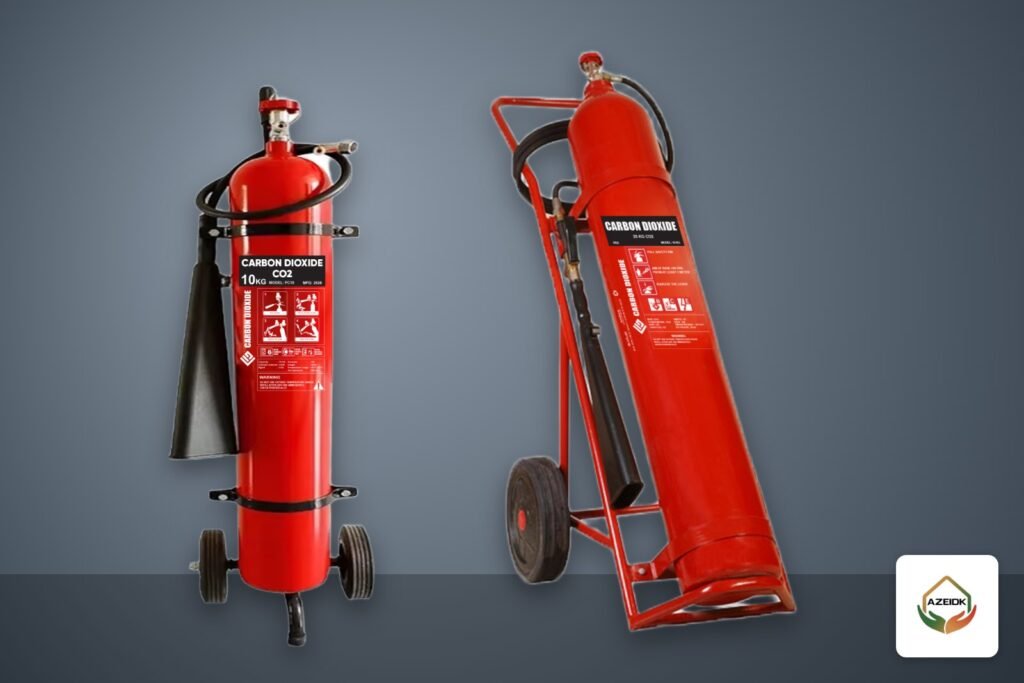
A wheeled CO2 fire extinguisher (trolley CO2 extinguisher) is a large-capacity carbon dioxide unit on a cart, used for flammable liquid fires (Class B) and fires in electrical equipment in switchrooms, generator rooms and workshops. It does not conduct electricity and leaves no residue. Its key limit: it is not safe to discharge in a small, closed room with people inside.
This guide compares the 10 kg and 25 kg FG trolley units AZEIDK GROUP supplies in Saudi Arabia, explains placement under NFPA 10, the asphyxiation and cold-burn hazards, and the inspection and hydrostatic test intervals for CO2 cylinders.
Key takeaways
- A trolley CO2 extinguisher is for Class B and electrical fires. It is not rated for wood, paper or cardboard (Class A).
- AZEIDK GROUP supplies FG trolley CO2 units in 10 kg and 25 kg, with CK45 steel cylinders, a 250 bar test pressure and a -30 to +55 °C operating range per the datasheet.
- NFPA 10 limits travel distance to a Class B extinguisher to 30 or 50 ft (about 9 or 15 m), depending on hazard level and extinguisher rating.
- CO2 cylinders are hydrostatically tested every 5 years, and the hose assembly on the same interval.
- After a discharge in a closed room, do not re-enter until the space is ventilated and oxygen is confirmed.
In this article
- What is a wheeled CO2 extinguisher and how does it differ from a portable one?
- Where is a trolley CO2 extinguisher used?
- When is a wheeled CO2 extinguisher the wrong choice?
- Why is discharging CO2 in a closed room a hazard?
- Wheeled CO2 extinguisher 10 kg or 25 kg: how to choose the capacity
- Wheeled CO2 or wheeled dry powder?
- Where should a trolley CO2 extinguisher be placed under NFPA 10?
- How often is a wheeled CO2 extinguisher hydrostatically tested?
- What to ask the supplier before you buy
- Frequently asked questions
- Summary
What is a wheeled CO2 extinguisher and how does it differ from a portable one?
It is a large CO2 cylinder on a two-wheel cart. One person pulls it to the fire, then directs the discharge horn at the base of the flames through the hose. The gas leaves the horn extremely cold and displaces oxygen from the combustion zone.
The difference from a hand-held 6 kg or 10 kg CO2 unit is the amount of agent available at once and how easily it moves. A CO2 cylinder is much heavier than a powder cylinder of the same capacity because it holds high pressure, so 25 kg is not practical to carry. The FG 25 kg unit has a gross weight of 75 kg with carton per its datasheet. For how portable CO2 extinguishers work, see the CO2 fire extinguisher guide. For wheeled units in general, including powder and foam from 25 to 150 kg, see the wheeled fire extinguisher guide.
Where is a trolley CO2 extinguisher used?
It suits areas that combine an electrical hazard with flammable liquids, where damage from the extinguishing agent would be costly. AZEIDK GROUP’s product page lists warehouses, factories, generator rooms, transformer areas and workshops.
Switchrooms and distribution boards
Main distribution rooms (MDB) and sub-distribution boards are a typical CO2 location: the gas is non-conductive and leaves no powder in breakers and terminations. Johnson Controls describes CO2 extinguishers as used almost exclusively on fires in electrical equipment and live cables. For full protection of these rooms, including detection and fixed suppression, see electrical room fire protection.
Generator rooms and diesel areas
A generator room combines diesel fuel with control panels and cabling. A trolley CO2 unit can deal with a small fuel leak fire or a generator panel fire without contaminating the engine with powder. A large spill fire, or one fed by a pressurised fuel line, belongs in the review of the room’s fixed protection.
Workshops
Maintenance workshops with oils, solvents and electrical machines benefit from the larger quantity. CO2 is preferred where cleaning powder out of precision machines would stop production.
When is a wheeled CO2 extinguisher the wrong choice?
- Class A fires: wood, paper, cardboard and textiles. Johnson Controls notes that CO2 does not cool the burning material enough and the fire can re-ignite once the gas disperses.
- Cooking oils and fats: not for deep fat fryer fires.
- Outdoors in wind: the gas disperses quickly in open air, so it is less effective than powder.
- Small, closed, occupied rooms: the most important limit, covered next.
Why is discharging CO2 in a closed room a hazard?
Carbon dioxide puts a fire out by reducing oxygen, which is also what makes it dangerous to people. The UK Fire Protection Association advises against CO2 extinguishers in confined spaces: the sudden rise in gas concentration can overwhelm the user, and oxygen is displaced much faster in an enclosed area.
A trolley unit makes this worse: 10 or 25 kg of gas is far more than a hand-held extinguisher releases. Wormald’s CO2 extinguisher Safety Data Sheet warns that high concentrations may cause asphyxiation without warning, and says not to enter a confined space where gas may have collected until oxygen is confirmed at no less than 19.5%. The gas has a relative density of 1.52 (air = 1), so watch trenches, basements and low cable ducts.
- Keep the trolley at the entrance of a large room and operate it with the exit behind you.
- Do not empty a full 25 kg unit inside a small, unventilated switchroom.
- After extinguishment, get everyone out and ventilate before re-entry.
- Train the people who will use it on these points.
Cold burns from the horn
The Wormald SDS gives carbon dioxide a boiling point of -78.5 °C (it sublimes at that temperature) and warns of frostbite from uncontrolled release of the compressed gas. Hold the horn by its insulated handle, never by the horn body, and never point it at anyone. For a cold burn, flush with lukewarm (not hot) water and get medical attention immediately.
Wheeled CO2 extinguisher 10 kg or 25 kg: how to choose the capacity
AZEIDK GROUP supplies two FG units: the FG trolley CO2 extinguisher 10 kg and the FG trolley CO2 extinguisher 25 kg. The data below comes from the datasheets published on both product pages.
| Item | FG trolley 10 kg | FG trolley 25 kg |
|---|---|---|
| Agent | CO2 | CO2 |
| Cylinder material | CK45 steel | CK45 steel |
| Cylinder diameter | 152 mm | 219 mm |
| Height | 1000 mm | 1310 mm |
| Test pressure | 250 bar | 250 bar |
| Operating temperature | -30 to +55 °C | -30 to +55 °C |
| Gross weight with carton | Not published | 75 kg |
The datasheets do not publish discharge time, throw range, hose length or a performance rating (such as 10-B:C) for these models. Ask for these values in writing with the submittal: under NFPA 10 it is the rating, not the kilograms alone, that sets the permitted travel distance.
When 10 kg is enough
- A medium switchroom or a single generator room, where you need more agent than a portable unit with easy movement.
- Narrow corridors or standard doors: 1000 mm high and 152 mm in diameter is easier to manoeuvre.
When you need 25 kg
- Large substations, generator banks, or workshops with larger quantities of oils and solvents.
- Where a second extinguisher is far away and you need enough gas to succeed on the first attempt.
- Only where the route from the unit to the hazard is level with no steps: gross weight is about 75 kg with carton.
Wheeled CO2 or wheeled dry powder?
| Criterion | Wheeled CO2 | Wheeled powder |
|---|---|---|
| Fire classes | B and electrical equipment | A, B and electrical equipment (ABC powder) |
| Effect on equipment | No residue | Powder needs cleaning and can harm sensitive equipment |
| Open areas | Less effective in wind | Better suited |
| Closed, occupied rooms | Asphyxiation hazard | Does not work by lowering oxygen, but the cloud cuts visibility |
| Typical choice | Switchrooms, generator rooms, workshops with sensitive equipment | Warehouses, fuel stations, outdoor areas, mixed fires |
Many facilities combine both: CO2 next to electrical and generator rooms, powder in yards and warehouses, as part of the project’s fire fighting systems design.
Where should a trolley CO2 extinguisher be placed under NFPA 10?
The Saudi Fire Protection Code SBC 801 and Civil Defense requirements are the binding references in the Kingdom. NFPA 10 is the technical reference for selecting and distributing extinguishers, and the edition applied on a project follows what the code and the authority accept. The Class B distribution table in NFPA 10 (2026 edition, as reproduced by Amerex) reads:
| Hazard level | Expected flammable liquids | Minimum rating | Maximum travel distance |
|---|---|---|---|
| Light | Up to 1 gal | 5-B / 10-B | 30 ft / 50 ft |
| Ordinary | 1 to 5 gal | 10-B / 20-B | 30 ft / 50 ft |
| Extra | 5 gal or more | 40-B / 80-B | 30 ft / 50 ft |
A higher-rated extinguisher may be placed further away (50 ft, about 15.2 m) than a lower-rated one (30 ft, about 9.1 m). Extinguishers for electrical equipment (Class C in the US system) are distributed on the pattern of the existing Class A or Class B hazards, as OSHA 1910.157 states.
- Place the unit outside the room or right at its door, not deep inside behind the panels.
- Keep a level route free of thresholds, steps or stored material.
- Secure the trolley and mount a clear sign above it.
- Shade it from direct sun outdoors and respect the datasheet temperature range (up to +55 °C for the FG units).
- It does not replace the portable extinguishers distributed through the building.
How often is a wheeled CO2 extinguisher hydrostatically tested?
OSHA 1910.157 sets a 5-year hydrostatic test interval for CO2 extinguishers, and requires CO2 and nitrogen cylinders used with wheeled extinguishers to be tested every 5 years at 5/3 of the service pressure stamped on the cylinder. CO2 hose assemblies with a shut-off nozzle are tested at 1,250 psi inside a protective cage, on the same interval as the extinguisher they are fitted to.
| Item | Action | Frequency |
|---|---|---|
| Visual inspection | Location, access, seal, wheels, hose, horn and inspection tag | Monthly |
| Maintenance | Certified technician check, cylinder weighed to confirm agent, hose and horn checked | Annually |
| Cylinder hydrostatic test | At 5/3 of stamped service pressure | Every 5 years |
| Hose with shut-off nozzle | 1,250 psi inside a protective cage | Same interval as the extinguisher |
The code requirement reference guide from Orr Protection lists a conductivity test of all CO2 hose assemblies among the annual items for NFPA 10 extinguishers, and a hose that fails the test is replaced. Any unit that has been discharged, even partly, is recharged at once. For the wider maintenance programme, see fire extinguisher maintenance and recharging.
What to ask the supplier before you buy
- The full datasheet, including discharge time, throw range, hose length and performance rating.
- The product certificate of conformity through the SABER platform: the SASO Technical Regulation for Fire Control Materials and Equipment requires one for extinguishing equipment.
- The cylinder manufacturing date and stamped service pressure, to schedule the next hydrostatic test.
- Who will maintain and recharge the units after delivery.
Frequently asked questions
Can a wheeled CO2 extinguisher be used on an electrical fire?
Yes. Carbon dioxide is non-conductive and leaves no residue, so it is used on panel and electrical equipment fires, following the operating instructions and safe distance.
Can I use a CO2 extinguisher inside a small closed server room or switchroom?
Only with great care. A large discharge in a small room can drop oxygen to a dangerous level. Operate from the doorway and do not go back in before ventilating.
What is the difference between a 10 kg portable and a 10 kg trolley CO2 unit?
The agent quantity is the same, but the trolley is easier to move over a longer distance. Choose the trolley when carrying is hard for the users or the hazard is far away.
How often is a CO2 extinguisher hydrostatically tested?
Every 5 years for the cylinder, at 5/3 of its stamped service pressure. A hose with a shut-off nozzle is tested on the same interval.
Will a CO2 extinguisher put out a wood or cardboard fire?
It is not rated for that. The gas does not cool the burning material, so the fire can re-ignite. Use water or ABC powder for Class A fires.
What is the maximum distance between a Class B extinguisher and the hazard?
Under the NFPA 10 table, travel distance must not exceed 30 or 50 ft (about 9 or 15 m), depending on hazard level and extinguisher rating.
Summary
A wheeled CO2 extinguisher is a tool for a specific hazard: electricity, flammable liquids and equipment that cannot take powder. Choose 10 kg where movement is restricted and 25 kg where the hazard is larger and the route is level, place it at the entrance, and keep to the 5-year hydrostatic test.
Need trolley CO2 extinguishers for switchrooms or generator rooms? Send us the type of space, its size and the number of panels or generators, and we will propose the capacity and quantity with datasheets. AZEIDK GROUP’s maintenance team inspects and services the units after supply. Contact AZEIDK GROUP
Related guides
- Mixed-Use Building Fire Safety: Shops Below, Apartments Above
- Hotel Fire Maintenance Contract: Servicing Without Disturbing Guests, Room Schedules, Kitchens and the Safety Log
- Kitchen Fire Suppression for Fuel Station Restaurants and Highway Service Centres in Saudi Arabia
- MDF IDF Room Design for New Buildings: Space, Cooling, Power and Risers