A wedding hall fire alarm system works under conditions an office building never sees: hundreds of guests arrive within an hour, music runs loud, haze machines and stage lighting operate all evening, and the venue is usually split into a men’s hall, a women’s hall and a large catering kitchen. The system therefore has to detect a real fire early without nuisance alarms, and it has to be heard and seen in every section while the music is playing.
For how conventional and addressable systems compare, see our guide to choosing a fire alarm system for Saudi projects.
This article covers detector selection per area, sounder and strobe layout, the interface with the sound and lighting systems, and what to test before handover. For the general venue requirements and the Salamah licensing steps, see our guide to wedding hall and event hall safety requirements. For the alarm systems AZEIDK supplies and installs, see Fire Alarm Systems.
Key points
- Each area of the hall needs its own detection approach: smoke detection in halls and corridors, heat detection in the kitchen and steam areas, with haze machines considered from day one.
- As a reference value, NFPA 72 (2016 edition, section 18.4.3.1) calls for audible signals 15 dB above the average ambient sound level, or 5 dB above the maximum level lasting at least 60 seconds, whichever is greater.
- Where the average ambient level exceeds 105 dBA, NFPA 72 (2025 edition) requires visible notification.
- Linking the fire alarm panel to the sound system so music stops on alarm makes the signal audible and shortens response time.
- An addressable panel shows the exact device location, which matters in a large, divided venue.
In this article
- Which code governs a wedding hall fire alarm system?
- Choosing detectors for each area
- Sounders and strobes: making the alarm heard over the music
- Linking the fire alarm to sound and lighting
- Addressable or conventional panel?
- What to test before handover
- Common mistakes in event hall alarm systems
- Frequently asked questions
- Summary
Which code governs a wedding hall fire alarm system?
The binding reference in the Kingdom is the Saudi Fire Protection Code SBC 801 within the Saudi Building Code; its 2024 edition has been mandatory since 30 June 2025. Alongside it come the requirements of the General Directorate of Civil Defense through the Salamah platform and the drawings approved by the engineering office. NFPA 72 is the technical standard designers use for detection, notification and testing details, applied to the extent the approved drawings and project documents adopt it.
In practice, procurement should not start before the drawings are approved. Detector quantities, notification appliance locations and panel type all come from the approved design, and changing them after installation costs far more than correcting them on paper.
Choosing detectors for each area
Main hall and women’s hall
Smoke detectors are the usual choice for enclosed halls, corridors and entrances. Wedding venues, however, use haze, fog and incense heavily, and those particles can trigger optical smoke detectors. The answer is not to isolate detectors during events. It is to plan for it: fix the positions of effects machines, keep them away from detectors where possible, and select detector type and sensitivity with the designer and in line with the manufacturer’s instructions.
High ceilings and domes
Many halls have high ceilings, domes or suspended ceilings with deep voids. Ceiling height affects how smoke reaches the detector and the spacing between detectors, and a void containing cables or equipment may need its own detection. These are design decisions settled during engineering design and calculations, not on site.
Kitchen, hot buffet and service rooms
Kitchens, hot buffet lines and dishwashing rooms produce steam and normal cooking smoke, so heat detectors usually replace smoke detectors there. Electrical rooms, stores and audio equipment rooms are each treated according to their use on the drawing.
| Area | Typical device | What to check |
|---|---|---|
| Main hall and women’s hall | Smoke detector | Haze machine positions, ceiling height, detector spacing |
| Corridors, entrances, waiting areas | Smoke detector | Full coverage of exit routes |
| Kitchen and hot buffet | Heat detector | Distance from direct steam; interface with hood suppression |
| Electrical and audio rooms | Per design | Electrical load and room ventilation |
| Exits and corridors | Manual call points | Close to exit doors and clearly visible to guests |
Sounders and strobes: making the alarm heard over the music
NFPA 72 (section 18.4.3.1 of the 2016 edition, as quoted by Consulting-Specifying Engineer) sets the public-mode rule: the alarm must be 15 dB above the average ambient sound level, or 5 dB above the maximum sound level lasting at least 60 seconds, whichever is greater. Check the figure against the NFPA 72 edition adopted in the project documents; the approved drawings under SBC 801 have the final say. In a hall with loud music this is hard to achieve with audible devices alone.
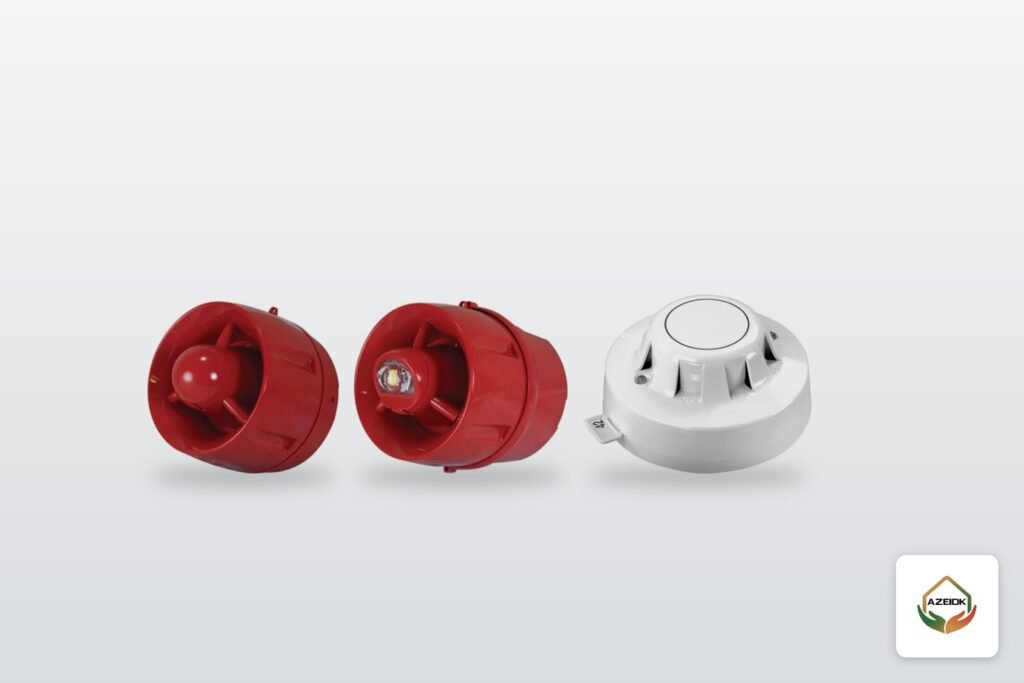
NFPA 72-2025 (section 18.4.1.1) states that an average ambient sound level above 105 dBA requires visible notification appliances. Venues therefore use combined sounder strobes, laid out so a guest can see a flash from anywhere in the section, not only in the corridor. Device types are covered in our article on manual call points and audible and visual notification appliances.
Give the women’s hall the same attention. The alarm must reach it just as clearly, with devices inside the section rather than at its door, because the section may be closed off by doors, curtains and its own music.
Linking the fire alarm to sound and lighting
The most effective way to make the alarm audible is to stop the noise source. EC&M notes that shutting down equipment producing high ambient noise on alarm is an accepted option in loud spaces. Some authorities make it mandatory for entertainment venues: the City of Raleigh bulletin TB-15, for example, requires amplified sound equipment to be interconnected with the fire alarm for automatic shutdown, and special effect lighting to be turned off, except for fire alarm notification devices.
In a hall this is done with a relay output from the alarm panel to the amplifiers or to their dedicated supply breaker, and, where the lighting control allows it, by raising general lighting to full so guests can see the exits. If the venue has a public address or voice evacuation system, it is programmed to broadcast the evacuation message instead of the music. See DSPPA public address systems and their link to the fire alarm.
The interface is built and tested under programming and systems integration and documented in a cause and effect matrix, so any technician knows exactly what happens on each alarm.
Addressable or conventional panel?
A conventional panel splits the building into zones, so it tells you the alarm is in the main hall zone without naming the device. An addressable panel gives every device an address and shows the exact location, for example “Women’s hall, north side”. In a large, crowded, divided venue that saves the supervisor valuable minutes. AZEIDK supplies addressable and conventional panels and detectors from Context Plus; the choice depends on hall size, layout and the approved drawing.
What to test before handover
Testing a wedding hall system is more than triggering each detector once. It should reproduce event conditions, as part of testing, commissioning and handover:
- Operate every detector and manual call point and confirm the correct location text on the panel.
- Measure alarm sound levels in each section with the music at its normal level, not only in an empty, silent hall.
- Check strobes are visible from the furthest tables and from the stage.
- Prove the interface: does the music stop, does the lighting rise, is the evacuation message broadcast where provided?
- Test the link with kitchen hood suppression and gas shut-off where the drawing requires it.
- Hand the owner the cause and effect matrix, as-built drawings and the test record.
Routine maintenance then follows NFPA 72 and the manufacturer’s instructions; see fire alarm periodic inspection and maintenance.
Common mistakes in event hall alarm systems
- Bagging detectors or disabling zones during events to avoid nuisance alarms, then forgetting to restore them.
- Notification devices at the doors only, inaudible inside the section once music starts.
- No link between the sound system and the panel, so the party carries on while the alarm sounds.
- Decorations or temporary ceilings added after handover that block detectors or strobes.
- Drawings not updated after the hall layout changes or two sections are merged.
Frequently asked questions
Is one alarm bell enough for a wedding hall?
Usually not. The required sound level must be reached in every part of every section, and with loud music visible devices are also needed. The quantity comes from the design.
Why does the alarm go off with the haze machine?
Smoke detectors respond to particles in the air. The fix is in detector type and position and in where effects machines are placed, not in disabling the system.
Should music stop automatically on alarm?
It is a recommended engineering measure because it makes the alarm audible, and some authorities worldwide require it. Implement it according to the approved drawing and the engineering office’s requirements.
What detector suits the hall kitchen?
Usually a heat detector, because steam and normal cooking smoke cause nuisance alarms on smoke detectors.
Does a small hall need an addressable panel?
Not always. A conventional panel with a few zones may suit a small hall; the design and approved drawing decide.
Summary
A wedding hall alarm succeeds on three counts: it detects fire without nuisance alarms from effects, it reaches every guest in every section despite the music, and it stops the event automatically and directs people to the exits. All three are settled in design, interfacing and testing before opening. For more on the sector, see Entertainment and Event Halls.
Fitting out a wedding hall or upgrading its system? Send us the drawing and section areas, and we will review detector and notification layout and the sound system interface. Contact the AZEIDK team
Related guides
- Fire Systems Maintenance Companies in Buraydah and Qassim: Contracts for Date Warehouses, Factories and Shops
- Fire Alarm Systems in Khamis Mushait and Abha: Choosing a System for Shops, Schools, Hotels and Rest Houses
- Fire System Preventive Maintenance Plan (PPM): Building the Annual Schedule, Visits and Work Orders
- Cla-Val Fire Pump Valves: 50B Relief Valve, 134-05 Deluge Valve and WC-1 Waste Cone