A linear heat detection cable (LHD, also called line-type heat detector) is a cable that works as a heat sensor along its whole length. When the temperature at any point reaches its rating, it signals a fire alarm. It suits cable trays, conveyors, car parks, tunnels and cold rooms, where point detectors are hard to fit or prone to false alarms.
This article explains how the Context Plus FirePlus-LHD digital linear heat detection cable works, how to pick its temperature grade, and how it connects to the fire alarm panel through the LHD-DIU interface unit and the LHD-EOL and LHD-JP-5T boxes. Every figure comes from the manufacturer’s official datasheet.
Key takeaways
- FirePlus-LHD comes in four alarm ratings: 68, 88 and 105°C with a PVC jacket, and 185°C with a nylon outer sheath.
- Maximum ambient for reliable operation per the datasheet: 45°C for the 68°C cable, 65°C for the 88 and 105°C cables, 125°C for the 185°C cable.
- One zone can run up to 3,000 m (10,000 ft), and the cable works with conventional and addressable fire alarm panels and building management systems.
- The cable is UL 521 approved, CE marked and RoHS compliant; the LHD-DIU interface unit is approved to UL 864 10th Edition.
- The LHD-DIU displays the distance to the alarm point along the cable and monitors two zones.
In this article
- How does a digital linear heat detector work?
- Linear heat detection cable grades and maximum ambient temperature
- Jacket options: when do you need them?
- Where does LHD beat point detectors?
- Panel connection: LHD-DIU, LHD-EOL and LHD-JP-5T
- Comparison: linear heat vs spot heat vs beam detector
- Installation, testing and maintenance
- Common mistakes on LHD projects
- Frequently asked questions
- Conclusion
How does a digital linear heat detector work?
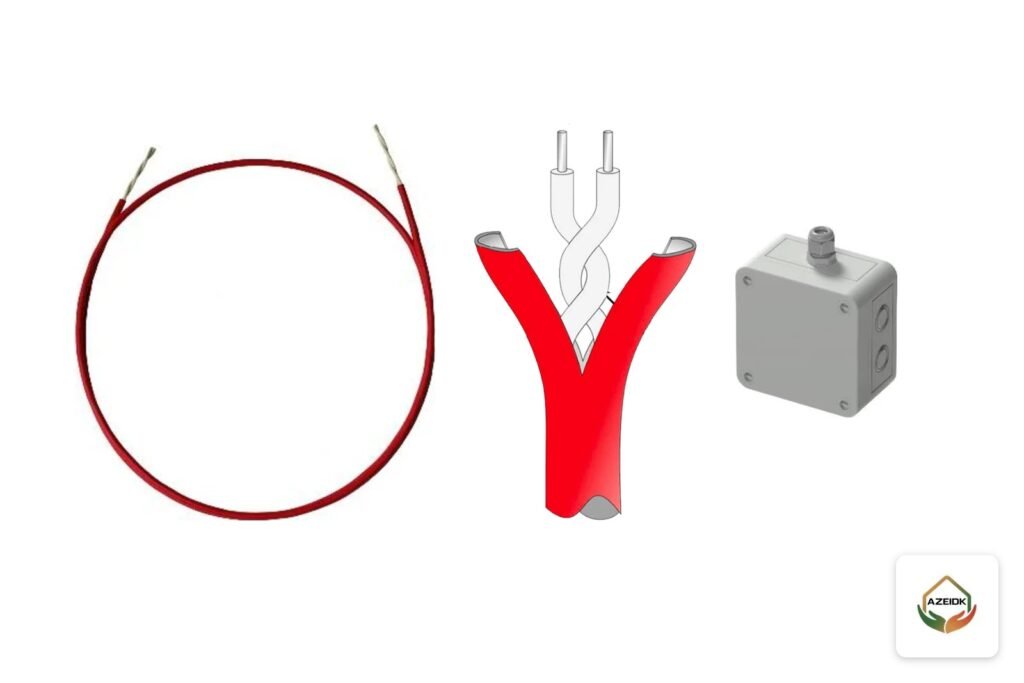
FirePlus-LHD is an insulated twisted pair of tri-metallic cores under a protective outer jacket. When the temperature around the cable reaches the activation rating, the two cores come into contact, and the panel reads it as a fire alarm.
Unlike a spot heat detector, which measures at one point on the ceiling, a linear cable senses along its full length and can be run right at the hazard: on top of the cables in a tray, beside conveyor rollers or around a tank rim. Because it responds only to heat, dust, passing smoke and vehicle exhaust do not trigger it, which is a common cause of false alarms with smoke detectors.
NFPA 72 treats these devices as line-type heat detectors and the scope of UL 521, the heat detector standard, includes detectors that consist of a heat-sensitive cable. UL 521 is the approval the FirePlus-LHD datasheet states for the cable. For spot-type fixed temperature and rate-of-rise detectors, see our guide to heat detector types and installation.
Linear heat detection cable grades and maximum ambient temperature
Grade selection is the key design decision. A lower rating responds sooner but needs normal temperatures well clear of the trip point, so the manufacturer gives a maximum ambient for each grade. The designer should compare it with the highest expected summer temperature on site, not the average. Saudi open roofs, car parks and unconditioned plant rooms get very hot in summer.
| Alarm rating | Jacket | Cable colour | Max ambient | Order code (100 m reel) |
|---|---|---|---|---|
| 68°C | PVC | Red | 45°C | LHD-68-P/100m |
| 88°C | PVC | White | 65°C | LHD-88-P/100m |
| 105°C | PVC | White | 65°C | LHD-105-P/100m |
| 185°C | Nylon | Red | 125°C | LHD-185-N/100m |
Minimum ambient for all grades is -40°C, with humidity from 0 to 100% RH. Each grade is listed in 50, 100, 500 and 1,000 m reels in the datasheet order codes. An added nylon coating is always black; an added polypropylene coating is transparent.
Electrical and mechanical data
- Maximum voltage: 30 V AC or 42 V DC.
- Resistance: about 100 ohm per km per leg.
- Overall diameter: 3.60 to 5.08 mm; minimum bend radius 50 mm.
- Insulation: protective outer coat, 1 kV tested.
- Warranty: 3 years per the datasheet; made in the UK.
Jacket options: when do you need them?
The datasheet lists three optional coverings, chosen by environment:
- Nylon coating: UV protection and better durability for exposed runs. The datasheet recommends nylon-coated cable for car parks.
- Polypropylene coating: higher chemical protection in plants and areas with fumes or chemicals.
- Stainless-steel over-braiding: mechanical protection against abrasion and impact; the datasheet recommends it for escalators, where the cable is exposed to wear.
Where does LHD beat point detectors?
Cable trays and cable tunnels
Per the datasheet, a single run protects a tray up to 0.6 m wide; wider trays and multi-tier trays use multiple runs. Fixed on the tray itself, it picks up overheating from overload or poor terminations before heat reaches the ceiling.
Conveyors
Conveyors are long and dusty, and the risk sits at rollers and bearings that heat up by friction. The cable runs along the conveyor on dedicated clips, and the LHD-DIU tells the team where along a long run the hot spot is.
Car parks
The datasheet describes nylon-coated cable as a low-maintenance option for car parks, unaffected by exhaust fumes and other environmental factors. For the full car park picture, including sprinklers and ventilation, read car park fire protection.
Tunnels, cold rooms and tanks
In tunnels the cable can be split into separate zones so responders know which section is affected. It operates down to -40°C, and the datasheet cites it for freezer warehouses, dense shelving, fixed-roof tanks near vents and flanges, and rim seals on floating-roof tanks.
Panel connection: LHD-DIU, LHD-EOL and LHD-JP-5T
The datasheet states the cable is compatible with any conventional or addressable fire alarm panel or BMS, with up to 3,000 m per zone. On a conventional panel the cable is wired as a zone; on an addressable system it connects through a suitable input according to the manufacturer’s instructions and the system design. Three accessories complete the system.
LHD-DIU digital interface unit
The LHD-DIU sits between the cable and the panel and monitors two zones at once. On alarm it calculates and displays the distance to the hot spot, and switches its alarm output to signal the panel. The two zones can run independently or in interlock (coincidence) mode, where both cables must trigger before an alarm is sent; the datasheet presents this as a way to avoid false alarms.
- Volt-free fire and fault outputs per zone, power, fault and alarm LEDs, and a built-in sounder.
- Two-wire RS485 Modbus RTU output for industrial process control systems.
- Zone fault on a broken cable, a ground fault, loss of power or a microprocessor failure.
- UL 864 10th Edition approved and UL listed; can be retrofitted to existing installations.
End-of-line and junction boxes
The LHD-JP-5T has two cable glands and five DIN-rail terminal blocks and serves as an end-of-line or in-line junction box for one or two zones, in a polycarbonate enclosure. The LHD-EOL is an end-of-line box for one or two zones with a built-in test facility.
Fixing accessories
The fixing accessories include 50 and 100 mm L-clips, 200 mm L-brackets, channel, pipe and beam clips, with a silicone pad for each clip. Clips come in Zintec for general use or stainless steel for chemical exposure, with heat-stabilised ties rated 110°C and 170°C and a stainless tie rated to 815°C.
Comparison: linear heat vs spot heat vs beam detector
| Item | Linear heat cable | Spot heat detector | Beam smoke detector |
|---|---|---|---|
| Senses | Heat along the cable | Heat at the mounting point | Smoke along the beam path |
| Mounting | At the hazard: tray, conveyor, rack, tank | Usually the ceiling | Wall to wall or with a reflector in large open spaces |
| Dust and exhaust | Not affected; heat only | Usually not affected | Can cause false alarms or obscure the path |
| Long runs | Up to 3,000 m per zone | Many detectors and more wiring | Fixed range per device |
| Locating the fire | By distance via LHD-DIU | By device address on an addressable panel | By device or zone |
| Speed | When heat reaches the rating | When heat reaches the rating | Earlier for smouldering fires |
Linear heat does not replace smoke detection in ordinary spaces; it fits long, defined hazards and dusty, cold or fume-filled areas. For more on nuisance alarms, see causes of fire alarm false alarms.
Installation, testing and maintenance
- Before ordering: establish the highest ambient temperature in each zone, pick a grade whose maximum ambient covers it, then the jacket for the environment.
- Routing: run the cable close to the hazard, keep bends at 50 mm radius or more, and fix it with the dedicated metal clips at the spacing given in the installation guide.
- Zoning: split long runs into zones that let you locate a fire, with no zone over 3,000 m.
- Testing: use the LHD-EOL test facility to confirm alarm and fault signals reach the panel, and record results in the commissioning report.
- Maintenance: inspect the cable for cuts or mechanical damage, and test circuits per NFPA 72 Chapter 14, the manufacturer’s instructions and the maintenance contract.
According to Electrical Contractor magazine, line-type heat detectors are nonrestorable, but the affected portion can be cut out and replaced. The FirePlus-LHD datasheet does not cover this point, so follow the manufacturer’s installation guide for replacement and jointing, and retest the line after the repair.
Common mistakes on LHD projects
- Specifying 68°C cable where summer ambient exceeds 45°C, such as an exposed roof or an unconditioned plant room.
- Fixing the cable to the ceiling away from the tray or conveyor, losing the benefit of detection at the hazard.
- Using standard plastic ties instead of metal clips and heat-stabilised ties.
- One long zone for a whole building without an LHD-DIU, so finding the alarm point takes time.
- Ignoring the jacket: standard cable in direct sun, near chemicals or where it rubs against moving parts.
- Leaving the cable route and junction box positions off the as-built drawings, which makes later maintenance harder.
Frequently asked questions
What is a linear heat detection cable?
A cable that senses heat along its whole length. At the rated temperature its two inner cores touch and signal a fire alarm to the panel.
What temperature grades does FirePlus-LHD come in?
68, 88 and 105°C in PVC, and 185°C in nylon, with maximum ambients of 45, 65, 65 and 125°C respectively.
How long can one linear heat detection zone be?
Up to 3,000 m (10,000 ft) per zone, per the datasheet.
Does it work with an addressable panel?
Yes. The datasheet states compatibility with conventional and addressable panels and BMS; it is connected per the manufacturer’s instructions, directly or through the LHD-DIU.
Can the cable be reused after an alarm?
According to Electrical Contractor magazine, line-type detectors are nonrestorable, but the heat-affected portion can be cut out and replaced. Check the replacement method in the manufacturer’s installation guide, then retest the line.
Which approvals are on the datasheet?
Cable: UL 521 approved, UL listed, CE marked, RoHS compliant. LHD-DIU: UL 864 10th Edition approved and UL listed.
Conclusion
Linear heat detection suits a long hazard in a dirty, cold or hard-to-reach space. Get three things right: the grade, the jacket, and a route close to the hazard split into zones. It is designed as part of the fire alarm system to SBC 801 and the NFPA 72 provisions the designer adopts.
Cable trays, conveyors or a car park that need heat detection? Send us the drawings and the expected ambient in each area, and we will prepare the grade, jacket and accessory selection with datasheets. Talk to the AZEIDK GROUP team
Related guides
- Smoke Detector Sensitivity Testing and Cleaning on Addressable Systems (NFPA 72)
- Relocate Sprinkler Heads During a Mall Shop Fit-Out: Detectors, Drawings and Approval
- Fingerprint Door Access Device for One Door: When a Standalone ZKTeco F34 Lite, X100, MK2 or Dahua ASI1212F Is Enough and When You Need a Controller
- Notifier NFS2-640 Addressable Fire Alarm Panel in Saudi Arabia: Components, Wiring and Detector Selection