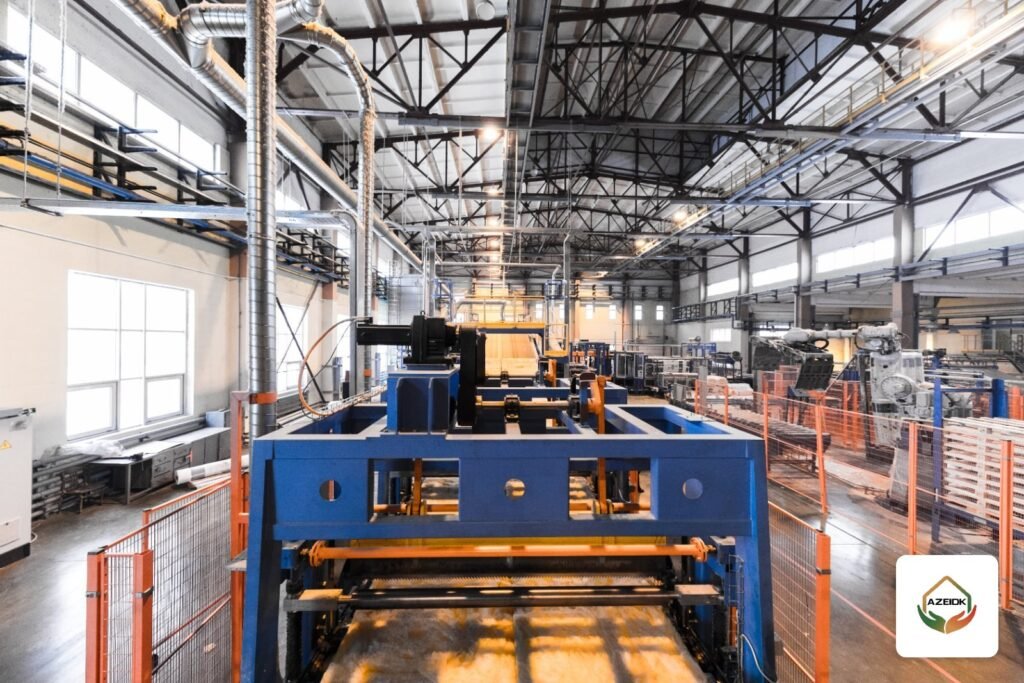
Low current systems for factories differ from office or hotel systems because a factory runs continuous shifts, has wide production halls with noise, dust and heat, warehouses, truck yards and long perimeter fences, and a large workforce entering and leaving at the same times. The network, CCTV, access control, attendance and PA in a factory should therefore be designed as one set that serves production, security and safety together, managed from one control room.
AZEIDK designs, supplies and installs low current systems for industrial facilities, from site assessment and system selection to cabling, installation, configuration and testing.
Key points
- The network comes first: fibre between buildings, industrial switches or protected cabinets in production halls, and VLANs separating security from admin and production.
- Cameras cover gates, fences, loading yards, warehouses and production lines, with protection suited to dust and heat.
- Gates and attendance terminals are sized for the workforce and shift changeover.
- PA in noisy halls needs higher output speakers and zoning.
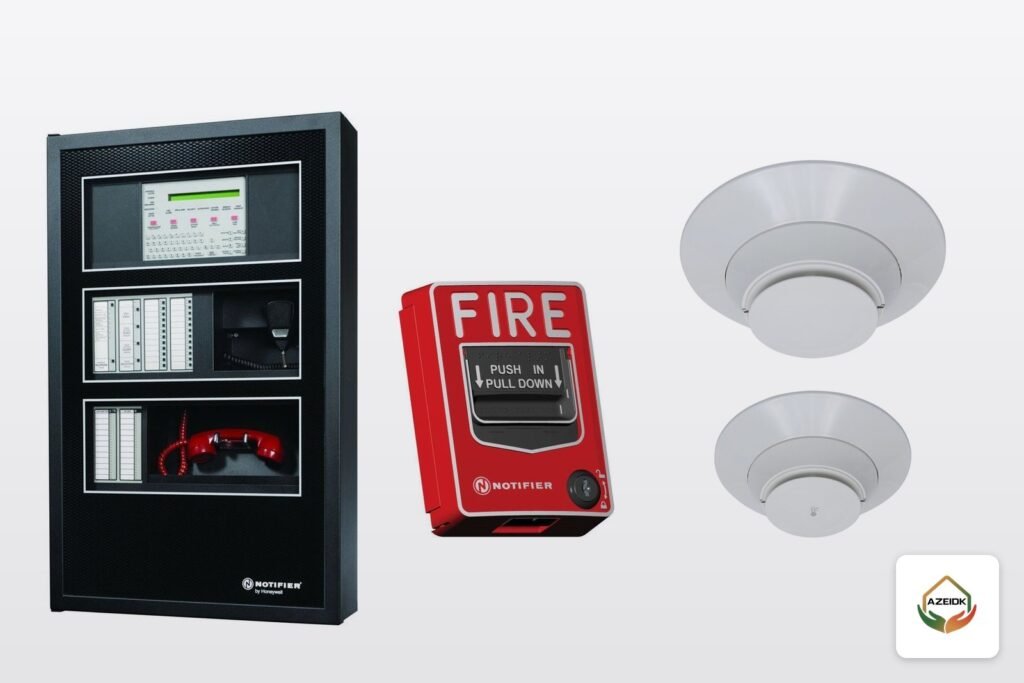
- The fire alarm stays an independent safety system, linked to PA and gates through the cause and effect matrix.
The systems in a factory
| System | Role in the factory | Detailed guide |
|---|---|---|
| Network and industrial Wi-Fi | Links buildings, warehouses and control rooms and carries camera and device traffic | Factory and warehouse networks |
| CCTV | Gates, fences, loading yards, production lines and stores | CCTV for factories |
| Time attendance | Recording workers per shift by face, card or fingerprint | Time attendance for factories |
| Access control | Electrical and server rooms, labs and sensitive stores | What is an access control system |
| Public address | Paging departments, alerts and voice evacuation | Public address systems |
| Fire alarm | Independent system linked to PA and gate release | Industrial fire alarm systems |
The factory network: distances and environment
Distance drives the design. Copper network cable is limited to 90 m for the permanent link and 100 m for the full channel under TIA-568, while factories stretch hundreds of metres between offices, halls, warehouses and the gate. Buildings are therefore linked by fibre, with floor or zone cabinets close to the devices. In production halls dust, heat and vibration call for sealed cabinets or industrial switches, and cable routes are kept away from power cables and motors. The ELV network VLAN design guide explains how one network is shared between cameras, gates, phones and the admin network.
CCTV: fences, loading yards and production lines
Factory cameras fall into three zones: the perimeter (gates, fences, truck parking), movement (loading yards and warehouses) and operations (production lines and control rooms). Outside, night vision and resistance to dust and heat matter, and a plate recognition camera at the gate helps log trucks. Inside, angles are chosen so racks and cranes do not block the view. Storage is sized by the number of cameras and the retention days required.
Attendance, gates and shift changeover
Shift changeover is the hardest moment, with many workers passing in minutes. The number of attendance terminals and turnstiles follows the headcount per shift, and the recognition method (face, card or fingerprint) follows the work: dirty hands or gloves make fingerprints less practical in some halls. One rule does not change: emergency exits stay free and gates release automatically on fire alarm.
PA in noisy halls
Paging in a production hall is not paging in an office. Machine noise calls for higher output horn or projector speakers and a layout that keeps messages intelligible, not just audible. PA is zoned (production, warehouses, offices, yards) so each message reaches the right people. If it is used for evacuation it must meet voice evacuation requirements; otherwise the fire alarm sounders and strobes remain the evacuation means.
Control room and timing
An industrial site needs a cooled main telecom room for the core switch, recorders and servers, and a security room at the main gate to view cameras and follow attendance. In new factories low current is coordinated with the contractor during construction for conduits, trays and risers, as explained in preparing a building for low current systems. In running factories work is scheduled in shutdown windows or in phases so production is not affected.
Frequently asked questions
Is one network enough for the whole factory?
The physical infrastructure can be shared, with logical separation between the security network (cameras and gates), admin and production, and rules that block unneeded traffic between them.
Which attendance device suits factory workers?
It depends on headcount and the work. Face recognition is faster in queues and touch free, while cards suit areas where hands are dirty. The shift headcount drives the choice.
How many cameras does a factory need?
There is no fixed number. Fence length, gates, loading yards, production lines and warehouses set the count, starting from a site survey.
Does AZEIDK deliver both fire and low current systems for the same factory?
Yes. AZEIDK provides fire alarm and fire fighting systems as well as low current systems, which makes the links between alarm, PA and gates easier to coordinate from the start.
Building a new factory or upgrading an existing one? The AZEIDK team surveys the site and designs the network, CCTV, attendance and PA as one design. Contact AZEIDK
See AZEIDK CCTV solutions: supply, installation and maintenance.
Related guides
- Civil Defense Technical Affairs: How Fire Safety Drawings Are Reviewed and Approved in Saudi Arabia
- Small Fire Extinguisher, 1 kg and 2 kg: Where It Fits and When It Is Not Enough
- WIKA in Saudi Arabia: 111.10SP Sprinkler Gauge and PSM-520 Pressure Switch Datasheets
- FM200 Testing Procedure Before Handover: Sequence of Operation, Abort Switch and Interfaces