Designing CCTV cameras for factories is a different job from covering an office block or a shop. A factory runs production lines in shifts, keeps raw material and finished goods stores, has loading docks, a long perimeter fence and rooms for electrical gear, fire pumps and gas cylinders. Each zone needs its own viewing objective and often its own camera.
Below: zoning, the Saudi rules, environmental ratings and fire alarm integration. The systems we supply and install are on the AZEIDK security and surveillance systems page and the industrial facilities page.
Short answer: Give every camera a purpose on the site plan: identification at gates, overview of production lines, and coverage of stores, loading areas, fire equipment and electrical and gas rooms as the regulations list. Use outdoor cameras rated IP67 and IK10 with a suitable operating temperature, and wire a fire alarm relay output to a recorder alarm input so the affected area appears on screen at once.
For the full picture of the fire and security systems factories and warehouses need and the Civil Defense requirements that apply, see our safety systems guide for factories and warehouses.
Key Takeaways
- The executive regulations require coverage of stores, loading areas, emergency exits, fire equipment locations, electrical and gas rooms and fuel stations.
- Thermal cameras and audio recording are not allowed without approval from the General Directorate of Public Security.
- Cameras may not be installed in changing rooms or toilets, including workers’ facilities inside the plant.
- Storage media must serve the CCTV system only, and any connection to another network needs Ministry approval and must follow National Cybersecurity Authority requirements.
- Linking CCTV to the fire alarm helps the control room verify an event, but it never replaces approved fire detectors.
In this article
- Why CCTV cameras for factories differ from other buildings
- What Saudi regulations require from a factory
- Splitting the plant into surveillance zones
- Production lines and stores
- Fences and gates: do you need thermal cameras?
- The industrial environment: heat, dust and vibration
- Integration with the fire alarm system
- Recording, network and power
- What a quotation should include
- Common mistakes
- Frequently Asked Questions
- Conclusion
Why CCTV cameras for factories differ from other buildings
In a shop the risk sits at the entrances and tills. In a factory it is spread across the site: theft from the store, entry over the fence at night, an accident on a line, or a fire starting in an electrical room nobody walks past. The environment is harsher too: a plant in the Eastern Province or an industrial city in Riyadh means direct sun, fine dust, humidity and vibration, and office-grade cameras do not last there. And distances are long, with fences running hundreds of metres and cables crossing between buildings, so network and power design matters as much as the camera.
What Saudi regulations require from a factory
The Law on the Use of Security Surveillance Cameras was issued by Royal Decree No. (M/34) dated 7/3/1444 AH, and its executive regulations were published in Umm Al-Qura. Article 2 of the regulations lists locations that must be covered, several of which apply directly to factories:
- Entrances and reception desks, at a quality that allows people to be identified.
- Stores and warehouses, goods loading and unloading zones and service areas.
- Emergency exit doors, assembly points and fire equipment locations.
- Gas cylinder rooms, electrical rooms and the areas around them.
- Fuel stations including pumps and tanks, which can apply to diesel tanks inside some plants.
Article 3 requires recorders to sit in a secure, clean, continuously monitored location, storage media to be dedicated to the cameras, and an access log for authorised staff. Article 8 bans thermal cameras and audio recording unless the Directorate approves them, and requires privacy masking for PTZ cameras and cameras whose view extends beyond the site boundary. The law itself, in Article 6, bans cameras inside changing rooms and toilets.
Plants supervised by the High Commission for Industrial Security (HCIS), in sectors such as petrochemicals, chemicals and mining, also follow HCIS directives, so confirm with your consultant what applies. The full legal picture is in our article on the Saudi security cameras law and facility obligations.
Splitting the plant into surveillance zones
Do not start from a camera count. Start from the site plan and decide what you need to see in each zone. IEC 62676-4 (2025 edition) links the objective to pixel density on target: 20 pixels per metre for an overview and 250 pixels per metre to characterise a person. It is a design reference, not a legal requirement.
| Zone | Objective | Typical camera | Installation note |
|---|---|---|---|
| Main gate and staff entrance | Identify people and read plates | Fixed varifocal camera plus a plate-reading camera | Fairly low angle, front lighting rather than backlight |
| Fence and perimeter | Detect movement and direction | Outdoor camera with intrusion analytics and night vision | Spacing based on real night-time detection range |
| Production lines | Overview of operations and incidents | Dome or panoramic camera at ceiling level | Avoid mounting directly above heat or steam sources |
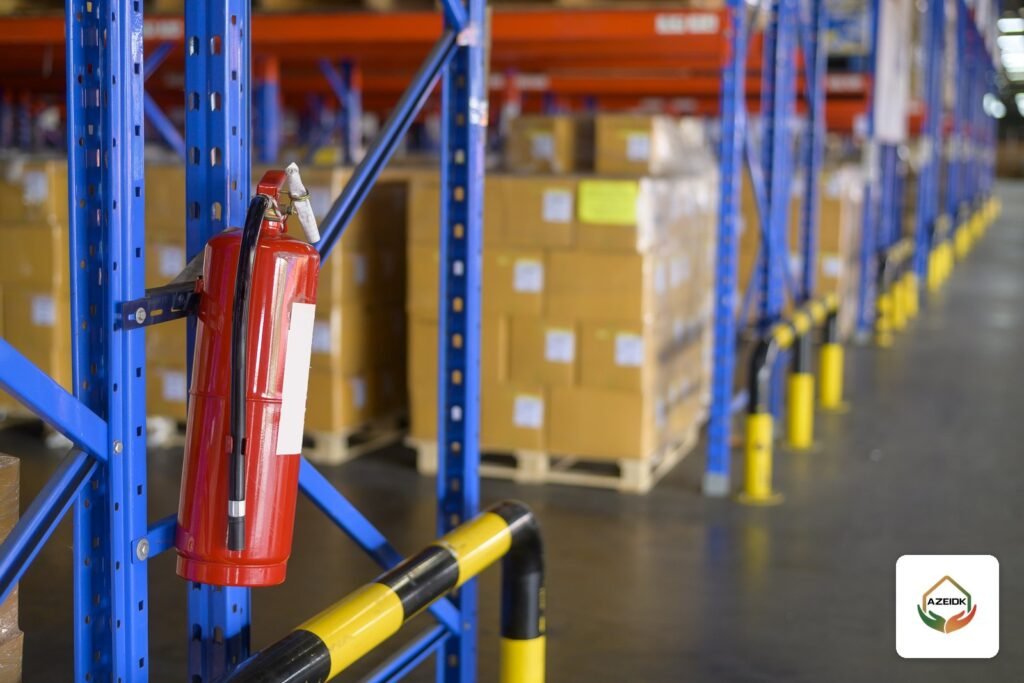
| Raw material and finished goods stores | Aisle and forklift activity | Camera in Corridor Mode | Mount at the aisle end, not above the racks |
| Loading dock | Record loading and unloading | Fixed camera per door, or panoramic | Cover the trailer interior when the door opens |
| Electrical, pump and gas rooms, diesel tank | Cover the room and surrounding area | Weather-resistant fixed camera | Classified hazardous areas need equipment certified for them |
Production lines and stores
Above production lines the goal is overview, not face identification. A wide-angle dome or a panoramic camera at ceiling level covers a large area with fewer points. Keep clear of steam, ovens and welding fumes. Some cameras add workplace analytics: our product page for the Hikvision iDS-2CD7A46G0/S-IZHSY lists Hard Hat Detection, which is useful at the entrance to production halls.
Stores inside a plant follow warehouse logic: camera at the aisle end in a vertical image format, and coverage of dock doors. See CCTV for warehouses and logistics centres, and panoramic and multi-lens CCTV cameras for wide yards.
Fences and gates: do you need thermal cameras?
Thermal cameras see people in darkness and dust, so they are often proposed for long fences. The regulations, however, ban them without Directorate approval, so if the consultant needs them, schedule the approval before procurement.
The usual alternative is outdoor cameras with line-crossing and intrusion analytics, human and vehicle classification to cut false alarms, and infrared or white-light night vision. These analytics are available on Hikvision and Dahua cameras. Both list IR range on the datasheet, but space the cameras on the detection range you actually test on site at night.
The industrial environment: heat, dust and vibration
Read three values on the datasheet first:
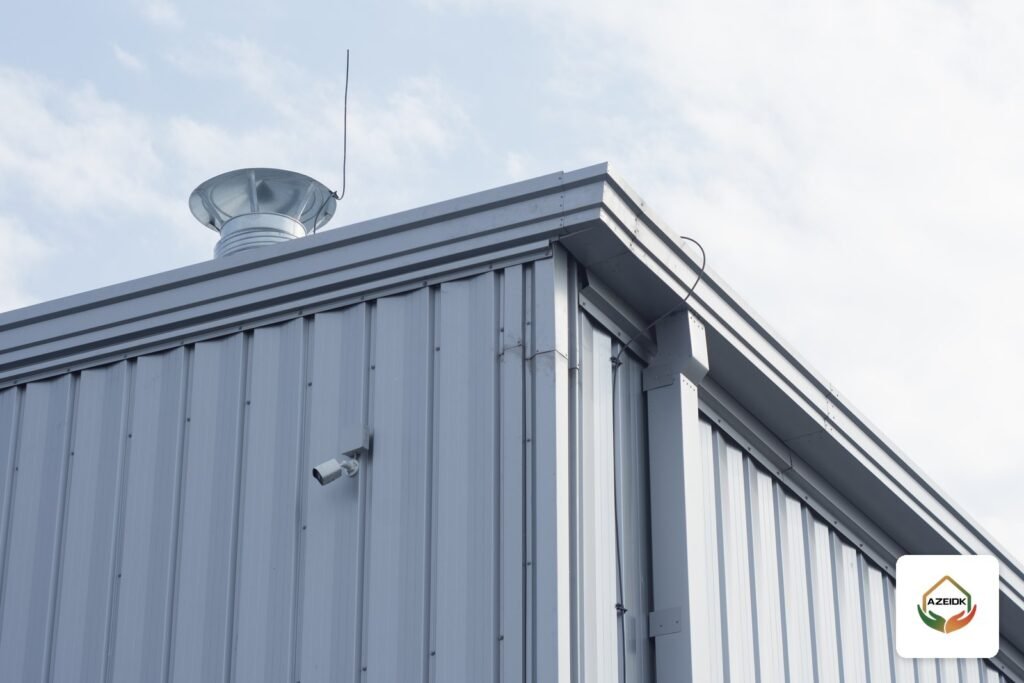
- IP rating: under IEC 60529 the first digit covers dust and the second water. Outdoor camera datasheets usually state IP66 or IP67, and a 6 in the first position means fully dust-tight.
- IK impact rating: under IEC 62262, IK10 is the highest grade and suits cameras near forklift and equipment traffic.
- Operating temperature: it varies by model, so take it from the official datasheet of that exact model and compare it with real site conditions, especially in unconditioned hangars and on metal roofs.
The iDS-2CD7A46G0/S-IZHSY page, for example, states IP67 to IEC 60529 and IK10 to IEC 62262; take its operating temperature from the attached datasheet.
Hazardous areas with flammable vapours, as in chemical or paint plants, need equipment certified for their classification, set by the facility’s safety consultant, not standard cameras.
Integration with the fire alarm system
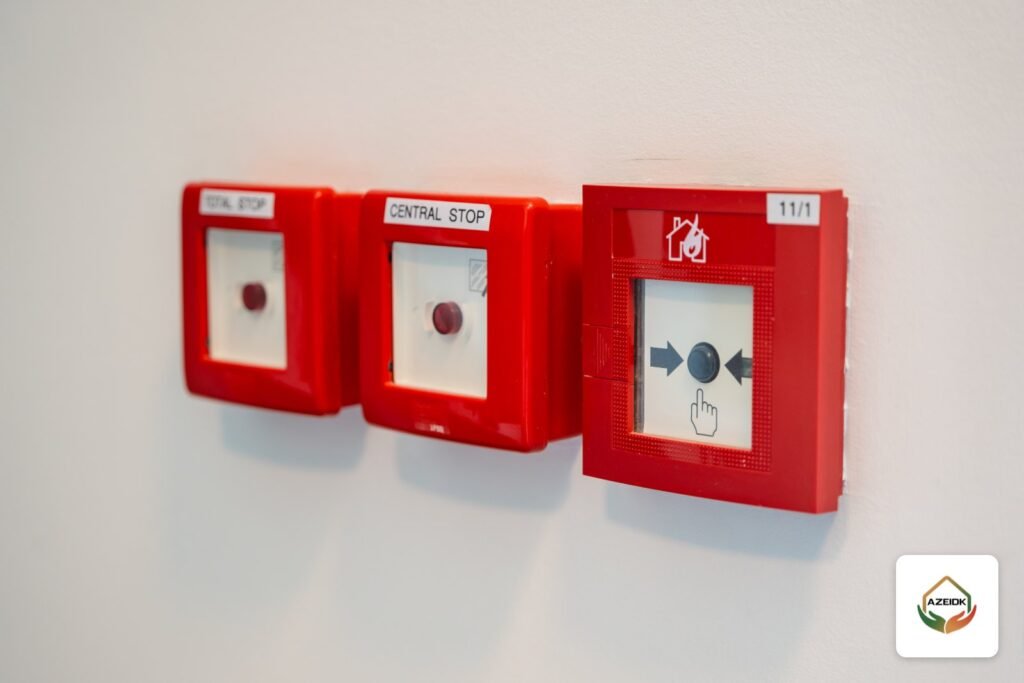
The fire alarm panel provides programmable relay outputs, and one of them is wired to an alarm input on the recorder or camera. On an alarm, the video management software brings up nearby cameras in the control room and raises recording quality, so the operator can verify and direct the emergency team.
Before installation, check the recorder’s alarm inputs on its datasheet, keep the link one way (fire alarm to cameras) so a CCTV fault cannot affect the alarm circuit, and write it into the cause and effect matrix and test it at handover.
A camera remains a verification tool, not a fire detector. Fire detection is designed and approved under the Saudi Fire Protection Code SBC 801 and the standards the designer adopts. We discussed when thermal cameras and video detection count as detection devices in smart detection and thermal cameras, and the alarm side is covered on our fire alarm systems page.
Recording, network and power
Between separate buildings the backbone is normally fibre, with PoE switches near the cameras within the allowed copper length. Recorders go in a secure room as Article 3 requires, with storage dedicated to the cameras.
Storage capacity follows from camera count, resolution, frame rate, compression and the required retention period. The retention period is set in the conditions document (وثيقة الشروط) referred to in the regulations, so get it from the consultant or the competent authority before sizing disks. Add a UPS for recorders and core switches so recording does not stop during a power cut.
What a quotation should include
Cost depends on camera count and type, fence length, distances, storage and whether a control room is needed. To compare offers fairly, ask every bidder for:
- A camera layout with each camera’s purpose and field of view.
- Camera, recorder and switch models with datasheets.
- A storage calculation on the required retention period.
- Cable and fibre routes, trenching and poles.
- The fire alarm and access control interface.
- Programming, testing, training, warranty and a maintenance option.
Common mistakes
- Indoor cameras in unconditioned hangars or above ovens.
- Perimeter spacing based on catalogue IR range.
- Thermal cameras on the fence without Directorate approval.
- Cameras overlooking changing rooms or toilets.
- Recorders on the office network without approval or separation.
- A fire alarm link never tested at handover.
Frequently Asked Questions
How many cameras does a factory need?
There is no fixed number. It comes from the site plan: the zones the regulations require, the purpose of each camera, and each model’s field of view at real distances.
Which cameras suit a hot, dusty industrial environment?
Outdoor cameras rated IP66 or IP67 with IK10 impact resistance, and a datasheet operating temperature that covers real site conditions. Classified hazardous areas need equipment certified for them.
Do perimeter fences need thermal cameras?
Not always. Thermal cameras need approval from the General Directorate of Public Security. The common alternative is outdoor cameras with intrusion analytics and night vision, spaced on tested night-time performance.
How long must CCTV recordings be kept under Saudi rules?
The period is set in the conditions document referred to in the executive regulations; the regulations text itself gives no figure. After an incident, recordings are kept until the investigation ends or for that period, whichever is longer.
Where should CCTV cameras not be installed?
Changing rooms and toilets, under Article 6 of the law. Privacy masking must be enabled on cameras whose view extends beyond the plant boundary.
Do CCTV cameras work during a power cut?
Only if backup power is designed in. Fit a UPS to the recorders and the switches that power cameras over PoE, and size its runtime on the actual load.
How do you protect a CCTV system from hacking?
Separate the camera network from the office network, change default passwords, update firmware, and restrict permissions with an access log. Any link to another network needs approval and must follow National Cybersecurity Authority requirements.
Conclusion
Start with a zone map and a purpose for every camera, choose cameras that survive the site, and size network, storage and power for the distances and retention period. A tested fire alarm link lets the control room verify an event in seconds. Before procurement, check what needs approval, such as thermal cameras and audio recording.
Planning surveillance for a new plant or an expansion? Send us the site plan and the nature of the operation, and we will propose a camera layout and equipment with datasheets and the fire alarm interface. Contact the AZEIDK team
Related guides
- FM-200 Fire Suppression System: Design, Safety and Kigali Status
- CCTV Installation in Saudi Arabia: Step by Step from Survey to Handover
- CCTV Certificate of Conformity: Which SABER Regulations Cover Cameras and Recorders
- Water Mist Fire Suppression in Saudi Arabia: Applications and Technical Considerations