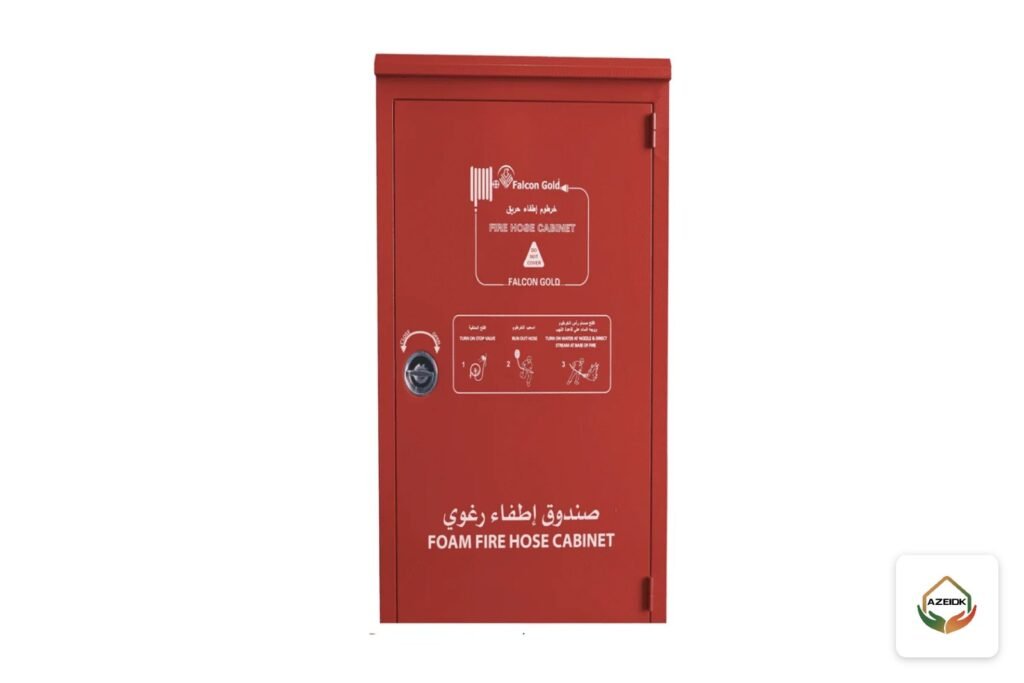
A foam fire hose cabinet such as the Falcon Gold FG4001RF combines a water hose reel, a foam inductor and two foam concentrate containers in one cabinet, so one person can fight a solid-material fire with water or a flammable-liquid fire with foam from the same unit. The hose is 30 m long in 1.5 or 2.5 inch, and the primary arrangement holds two 20 L containers. This article covers its components, when designers specify it and how to inspect it.
Key takeaways
- The FG4001RF is a surface-mounted cabinet combining a low-expansion foam system and a water hose system for Class A (solids) and Class B (flammable liquids) fires.
- Approximate sizes: about 700 x 1120 x 300 mm for 1.5 inch and about 800 x 1300 x 350 mm for 2.5 inch.
- Two 20 L foam containers in the primary arrangement, with a 25 L option to confirm at order; compatible with AFFF 3%, AR-AFFF 3×3% and FP foam.
- Aluminium foam branch pipe with shut-off; foam throw about 15 to 20 m depending on line pressure; it also works as a water jet.
- Location, foam type and concentration are design decisions approved by the consultant for the hazard.
In this article
- What is a foam fire hose cabinet?
- Falcon Gold FG4001RF components
- When do you need a foam cabinet instead of a standard one?
- Which foam should go in the containers?
- Installation and operation
- Inspection and maintenance
- What to check in the technical submittal before ordering
- Frequently asked questions
- Conclusion
What is a foam fire hose cabinet?
A standard hose cabinet holds a water hose reel and valve and suits paper, wood and fabric fires. Water alone is not right for fuel, oil and solvent fires, because it can spread the burning liquid. A foam cabinet adds an inductor that draws concentrate from the container and mixes it into the water stream, so the branch pipe delivers foam solution that blankets the liquid surface and cuts off oxygen.
Because it runs on the same water network, the cabinet stays part of the building’s fire fighting system, fed from the hose system or riser like any other hose cabinet. For standard cabinet types see fire hose cabinet types, sizes and components.
Falcon Gold FG4001RF components
Values below are from the AZEIDK product page and the Falcon Gold material submittal:
| Component | Description |
|---|---|
| Cabinet | Wall surface mounted, cold-rolled or electro-galvanized steel depending on arrangement, 1.2 mm in the arrangement shown; stainless steel optional |
| Finish | Red powder coat over zinc phosphate pretreatment; operating instructions printed in Arabic and English inside the doors |
| Approximate size | About 700 x 1120 x 300 mm (1.5 in), about 800 x 1300 x 350 mm (2.5 in) |
| Hose | 1.5 or 2.5 in, 30 m, synthetic outer jacket, rubber or TPU lining, on a swinging reel or support |
| Angle valve | Shown in the submittal drawing without a stated size; confirm the size for the ordered arrangement |
| Inductor | In-line inductor with pick-up tube into the foam container; no model number or fixed ratio given on the page |
| Foam containers | Two 20 L containers in the primary arrangement; optional 25 L arrangement to confirm at order |
| Foam branch pipe | Aluminium body, hard rubber grip, shut-off valve; foam throw about 15 to 20 m depending on pressure; also usable as a water jet |
| Couplings | BS 336, Storz, NH or others to project requirements |
Note: the page shows two container sizes (20 L and 25 L), so the final capacity is fixed in the quotation and the approved submittal.
When do you need a foam cabinet instead of a standard one?
The decision belongs to the designer and consultant after classifying the hazard under the Saudi Fire Protection Code SBC 801 and the standards adopted on the project. Foam cabinets typically appear in specifications for areas with flammable liquids in quantities that call for foam, such as:
- Generator rooms and the day tanks next to them.
- Maintenance workshops using oils and solvents.
- Stores for oils, paints and liquid chemicals.
- Fuel tanker loading and unloading areas in industrial facilities.
- Factory areas with paint lines or liquid filling.
In these areas the cabinet is a first manual response and does not replace a fixed suppression system where the design requires one.
Which foam should go in the containers?
The page lists compatibility with three concentrate types:
| Type | General use |
|---|---|
| AFFF 3% | Hydrocarbon fuels such as diesel, petrol and oils |
| AR-AFFF 3×3% | Where polar solvents such as alcohols are present alongside ordinary fuels |
| FP (fluoroprotein) | Some fuel applications, per project specification |
3% means the inductor mixes roughly 3 litres of concentrate with 97 litres of water, so the concentrate in the container must match the inductor setting. Concentrates available from AZEIDK include Safe Guard AFFF 3% in 20 L. The final foam type is approved by the consultant for the liquid on site.
Installation and operation
- Fix the cabinet to a wall that can carry its full weight with hose and containers.
- Connect the angle valve to the water network and confirm the pressure at the cabinet suits the inductor and branch pipe per the datasheet.
- Place the pick-up tube in the foam container and make sure the cap does not obstruct it.
- In a fire: open the valve, run out the hose and direct the foam onto a wall or surface behind the burning liquid so it flows over it, rather than striking the liquid directly.
- After use: flush the inductor and branch pipe with clean water and replace the used container.
Inspection and maintenance
The cabinet is inspected with the rest of the standpipe and hose systems under the fire systems maintenance contract. Items specific to a foam cabinet:
- Concentrate level in both containers, with no leaks or crusting around the cap.
- Foam shelf life per the manufacturer’s certificate, with sample testing when needed.
- Pick-up tube and inductor free of blockage.
- Hose, reel and valve condition as in any hose cabinet.
- Arabic and English instructions inside the door still legible.
These items can be included in an annual preventive maintenance contract together with hose cabinets and extinguishers.
What to check in the technical submittal before ordering
A foam cabinet has more components than a water cabinet, so the consultant checks more in its submittal:
- Model number and arrangement: hose size, cabinet material and container capacity.
- Inductor datasheet, proportioning ratio and its operating pressure.
- Foam concentrate type and concentration, with the manufacturer’s certificate and production date.
- Hose coupling type and match with the couplings used on the project.
- Actual dimensions to confirm the space on the wall or column.
- Certificates for the model itself, not general company certificates.
This review is part of our technical supply service before shipping, so the cabinet that reaches site matches the approved arrangement.
Frequently asked questions
What is the difference between a foam cabinet and a foam extinguisher?
A foam extinguisher holds a limited charge in a portable cylinder. A foam cabinet takes water continuously from the network and mixes in concentrate, giving longer operation and reach with a 30 m hose.
How long does a foam fire hose cabinet run?
It depends on the concentrate in the two containers, the branch pipe flow and line pressure; the page gives no figure. The designer calculates it from the datasheet.
Can a standard hose cabinet be converted to a foam cabinet?
Not recommended. A foam cabinet is built with space for containers, a pick-up tube route and an inductor matched to the branch pipe. Use a purpose-made cabinet.
Can a foam cabinet be used on electrical fires?
No. Foam solution is water-based and conducts electricity. Electrical panel fires need suitable means such as CO2 extinguishers or special suppression systems.
Is the FG4001RF approved?
The product page does not tie a specific approval to this model. Ask for the technical submittal and certificates for the exact model and arrangement to be supplied before material approval.
Where can I see other Falcon Gold cabinets?
In the fire cabinet category and our article on selecting Falcon Gold fire cabinets.
Can the foam cabinet be used with water only?
Yes. The FG4001RF branch pipe also works as a water jet, so it can be used on solid-material fires without drawing foam, provided the user knows how to stop the pick-up per the cabinet instructions.
Conclusion
The FG4001RF foam cabinet combines water and foam in one unit for solid and flammable-liquid fires. Before ordering, agree with the consultant on location, foam type and concentration, hose size and container capacity, confirm network pressure at the cabinet, then add it to periodic maintenance with concentrate level and shelf-life checks.
Does your project have a generator room, workshop or oil store? Send the drawings and specification to the AZEIDK team to select suitable Falcon Gold cabinets, including the FG4001RF foam cabinet, with foam concentrate and the technical submittal. Talk to the AZEIDK team
Related guides
- Car Park Carbon Monoxide Detection and Extraction Fan Control: Komttech VCO800 and VSO-800
- Nursery Requirements in Saudi Arabia: Fire Safety, Alarms, Exits and CCTV
- Pharmacy Civil Defense Requirements in Saudi Arabia: Extinguishers, Storage and CCTV
- Paradox Hybrid Alarm System: When to Choose a Wired and Wireless Panel Such as the X45 or M25 for Warehouses and Large Buildings, and How to Place Detectors and Sirens