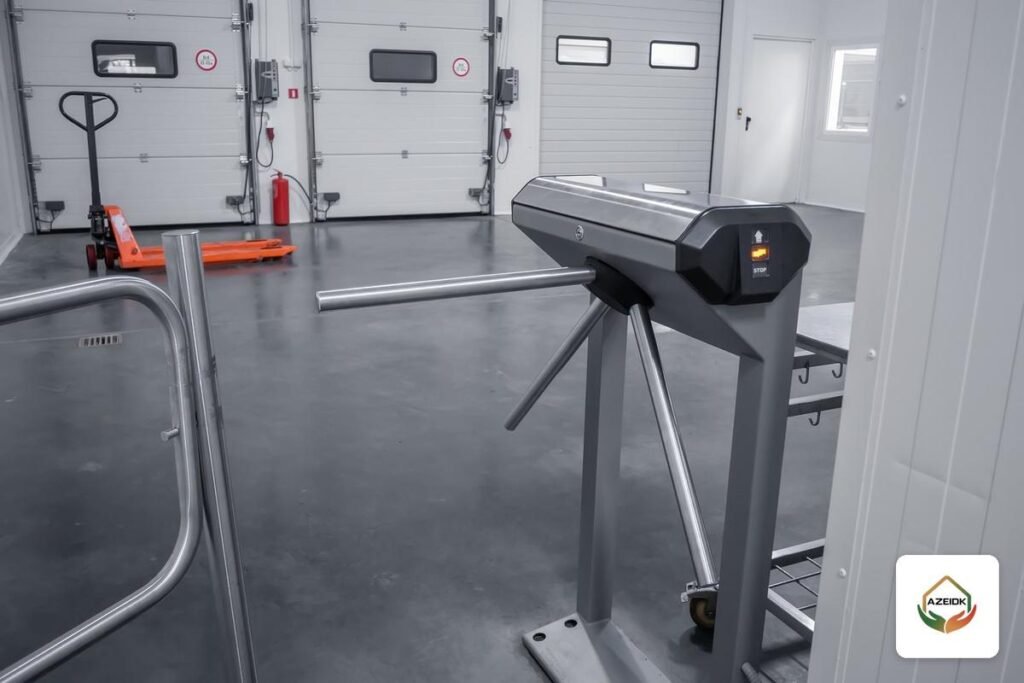
In a factory or warehouse with hundreds of workers on several shifts, a time attendance system has to do more than record punches accurately. It must clear the shift-change peak without queues, work with dirty or gloved hands, and calculate night shifts and overtime without errors. The practical answer on most sites: face terminals at busy entrances, fingerprint or card as the backup method, and turnstiles at the control points.
This article covers scale. For the basics of choosing an attendance device and the models, see our guide to time attendance devices. AZEIDK supplies attendance terminals and turnstiles as part of its security and surveillance solutions.
Key takeaways
- Size the terminals on the shift-change peak and on how many people are enrolled on each device, not just on total headcount.
- Face recognition suits dirty or gloved hands; keep fingerprint or card as a backup for every worker.
- Capacities vary widely: ZKTeco lists 10,000 faces for the FaceDepot-7B, but 100 faces for the standard MB10-VL.
- Most attendance terminals are indoor devices. An outdoor gate needs a canopy, a guard room or a gate rated for it, such as the IP54 FHT2400D.
- Night-shift, grace-time and overtime rules are set in the software before go-live, based on HR policy and the Labor Law.
In this article
- Why is a factory time attendance system different from an office one?
- Fingerprint, face or card in a factory environment?
- How many faces, fingerprints and records must a terminal hold?
- How many terminals do you need at shift change?
- Can an attendance terminal work at an outdoor gate?
- How are shift rules set up in ZKBio Time?
- How does attendance link with turnstiles?
- Common mistakes in factories and warehouses
- Frequently asked questions
- Conclusion
Why is a factory time attendance system different from an office one?
Office staff arrive over an hour with clean hands. In a factory a whole shift arrives within minutes while the previous one leaves. Some wear gloves or helmets; others handle loading, welding or cement, which wears down fingerprints.
Add subcontractor and seasonal labour, several gates (workers, trucks, administration) and shifts that start in the evening and end the next morning.
The Saudi Labor Law makes accurate calculation matter even more. According to the Ministry of Human Resources and Social Development page on actual working hours, Article 98 limits actual work to 8 hours a day or 48 hours a week, reduced in Ramadan for Muslim workers to 6 hours a day or 36 a week. Article 107 sets overtime pay at the hourly wage plus 50% of basic pay. Article 100 allows the employer, with Ministry approval, to extend working hours where the work requires rotating shifts, provided the average stays within the legal limit when calculated over three weeks or less. In practice, the software must produce actual and overtime hours that can be audited and relied on.
Fingerprint, face or card in a factory environment?
No single method fits every worker:
| Criterion | Fingerprint | Face | Card |
|---|---|---|---|
| Dirty or wet hands | Reading suffers; repeated rejections | Not affected (touchless) | Not affected |
| Gloves | Glove off at every punch | No need to remove | No need to remove |
| Helmets, safety glasses, masks | No effect | May affect recognition; trial on site first | No effect |
| Stopping buddy punching | Strong | Strong | Weak, cards can be lent |
| Running cost | Low | Low | Replacement cards when lost |
| Best location | Relatively clean indoor area | Busy indoor or shaded entrances | Reader on the turnstile |
Our recommended rule: one primary method for the whole shift and an enrolled backup for every worker. For example, face as the primary method and a card for anyone the terminal cannot recognise because of their work. With fingerprint, enrol at least two fingers per worker so one injured finger does not stop them punching in.
How many faces, fingerprints and records must a terminal hold?
A common mistake is enrolling 700 workers on a terminal sized for a small office. Capacities of three ZKTeco terminals available from AZEIDK, per the manufacturer’s official pages:
| Model | Method | Capacity | Records | Operating temperature | Software listed by ZKTeco |
|---|---|---|---|---|---|
| FaceDepot-7B | Face, optional fingerprint and card | 10,000 faces | 100,000 | -10 to 45 °C (indoor device) | ZKBio CVSecurity |
| MB10-VL | Face, fingerprint, card | 100 faces, 500 fingerprints, 500 cards (up to 800 each optional) | 50,000 (up to 150,000 optional) | 0 to 45 °C | ZKBio CVAccess (T&A) |
| UA400 | Fingerprint, optional card | 3,000 fingerprints | 100,000 | 0 to 45 °C | ZKBio Time and ZKBio Time.Net |
A plant with 600 workers enrolling two fingers each needs 1,200 fingerprint templates, which is within the UA400’s capacity. The MB10-VL (100 faces as standard) suits a small group such as office staff, and even its optional 800-face version leaves a thin margin for this headcount. The FaceDepot-7B covers it with a wide margin.
Two points to watch. First, every terminal must hold everyone who may use it: if a worker can use any of three gates, their templates go to all three terminals. Second, the software ZKTeco lists differs by model, so confirm that the terminal works with the software you plan to run before you buy. For sites standardised on Hikvision, Hikvision fingerprint and face terminals are listed in our time attendance products; check their capacities in the official datasheet.
How many terminals do you need at shift change?
Terminal count comes from how many people pass in the tightest window, not from headcount:
- Find the largest number entering or leaving at once, usually at shift handover.
- Set the acceptable window, for example the 15 minutes before the shift starts.
- Measure in a site trial how many workers one terminal handles per minute, including retries. Published verification speed (0.5 seconds or less for the UA400) is not the full time at the terminal.
- Divide the arrival rate by what one terminal handles, then add a spare.
Worked example: 600 workers arriving in 15 minutes means 40 workers per minute. If the trial shows one terminal handles 10 workers a minute (an assumed figure for illustration only), you need at least four entry terminals, with exit terminals kept separate so the queues do not cross.
Can an attendance terminal work at an outdoor gate?
The published operating limit for the UA400 and MB10-VL is 45 °C, and ZKTeco describes the FaceDepot-7B as an indoor station. At exposed gates in summer, the device surface can go beyond these limits, and direct sun degrades face recognition.
Practical options:
- Install the terminal in the guard room or a covered walkway, out of direct sun.
- Move verification to the gate itself: the ZKTeco FHT2400D full-height turnstile is rated IP54 for indoor and outdoor use, with an operating range of -28 to 60 °C per the manufacturer, and comes in card (FHT2411D) or fingerprint plus card (FHT2422D) versions.
- The ZKTeco TS1200 Pro tripod turnstile suits indoor or sheltered outdoor locations, with an operating range of -20 to 70 °C.
How are shift rules set up in ZKBio Time?
ZKTeco states that ZKBio Time supports flexible and smart shift scheduling with multiple kinds of shifts, overtime calculation, multi-level approvals with e-mail alerts, automatic export of attendance reports, payroll management, a mobile app, automatic synchronisation of biometric templates by area, and up to 500 devices (expandable on request). Area synchronisation means a worker enrolled once is pushed to every terminal in their area.
Before go-live, agree these rules with HR and enter them in the software:
- Night shift: a shift from 10 pm to 6 am must belong to the day it starts, or the worker shows as absent one day and on half a shift the next.
- Punch window: the accepted period for clock-in and clock-out, and the grace time for lateness.
- Breaks: whether they are deducted from working hours and whether they need a punch.
- Rotating shifts: a cycle (morning, evening, night) assigned to groups rather than individuals.
- Ramadan timetable: different hours activated for a set period.
- Overtime: when it starts counting and whether a supervisor must approve it first.
These are management decisions; test them on a real month of records before linking to payroll. For reports and exports, see our article on attendance software for fingerprint devices.
How does attendance link with turnstiles?
A turnstile ensures each worker punches for themselves. Lane count follows from the published throughput: ZKTeco gives about 25 passes a minute with RFID and 20 with fingerprint for the TS1200 Pro (dual lane, bi-directional), and up to 20 with RFID and 15 with fingerprint for the FHT2400D.
Back to the example of 40 workers a minute: taking the published rate as per lane, you need at least two lanes with card, or three with fingerprint, before counting exit lanes.
Points to settle at design stage:
- Source of the attendance record: will turnstile reader events count as attendance in the software, or will a separate terminal stand before the gate? This depends on the controller and the chosen software; confirm it in the datasheet.
- Fire evacuation: ZKTeco states the TS1200 Pro arm drops on power loss and its main board has a fire alarm port. Wiring that port to the fire alarm panel and defining the escape route must be coordinated with the fire alarm designer and Civil Defense requirements.
- Turnstile type: tripod for indoor entrances, full height for perimeter fences. Choose the type by gate location and the level of control needed.
Common mistakes in factories and warehouses
- One terminal at the workers’ gate for a shift of several hundred people, creating queues and lost shift time.
- Fingerprint only for workers who wear gloves or handle materials that damage skin, with no backup method.
- Mounting an indoor terminal in direct sun at the perimeter fence.
- Enrolling workers only on the main-gate terminal, then finding the second gate does not recognise them.
- Running payroll before testing night-shift and Ramadan rules on real records.
- Leaving the turnstiles out of the fire alarm interface and the evacuation route.
Frequently asked questions
Which attendance terminal suits a large workforce?
One whose capacity covers everyone enrolled on it, such as the FaceDepot-7B (10,000 faces) or UA400 (3,000 fingerprints), with terminal count sized on the shift-change peak.
Is fingerprint suitable for factory environments?
It suits relatively clean areas. With gloves or dirty or worn hands, face or card works better, and every worker should have a backup method enrolled.
How are shifts managed in a time attendance system?
In the software: define shifts, punch windows, breaks and overtime, assign rotating schedules to groups, and attach a night shift to the day it starts.
Can several branches or warehouses be connected?
Yes, with central networked software. ZKTeco states that ZKBio Time supports up to 500 devices and template synchronisation by area.
What is the price difference between face and fingerprint terminals?
A high-capacity face terminal usually costs more, but total cost depends on capacity, terminal count, gates, software and installation. Compare quotes on the same scope.
Do power or internet outages affect the records?
The terminal stores logs locally (100,000 records on the UA400) and uploads them when the network returns. A power cut stops the terminal, so use a backup supply.
Can the attendance software link with payroll or an ERP?
ZKTeco states that ZKBio Time includes payroll management and automatic report export. Confirm the integration format with your system and test it on real data before relying on it.
Conclusion
Start from the shift-change peak, choose a primary and a backup method, check each terminal’s capacity, keep indoor terminals out of the sun, and test shift rules before payroll. With turnstiles, size the lanes and tie them into evacuation from the start.
Planning attendance for a multi-shift factory or warehouse? Send us the size of your largest shift, the number of gates and the type of work, and we will propose suitable terminals and turnstiles from ZKTeco and Hikvision. Talk to the AZEIDK team