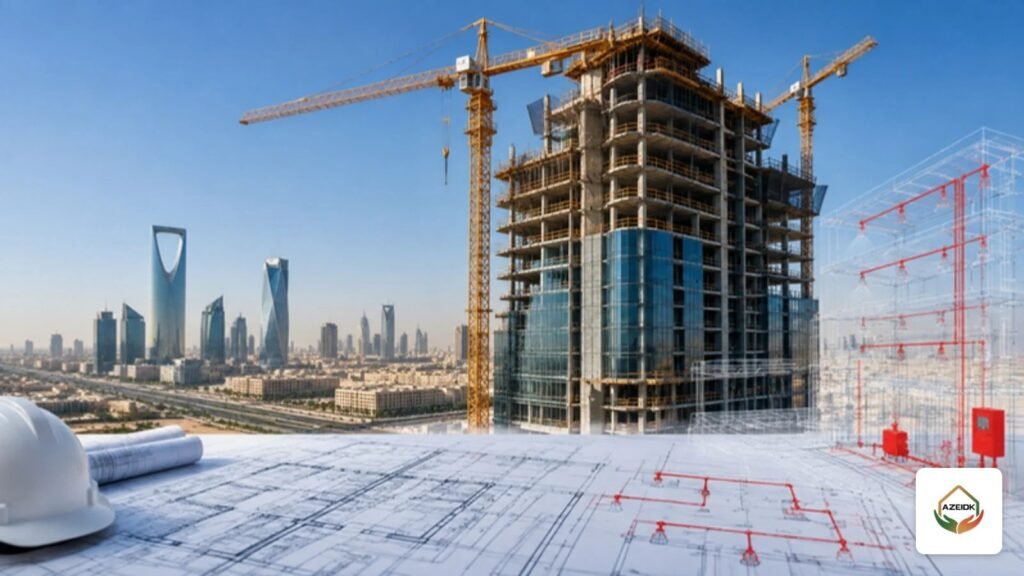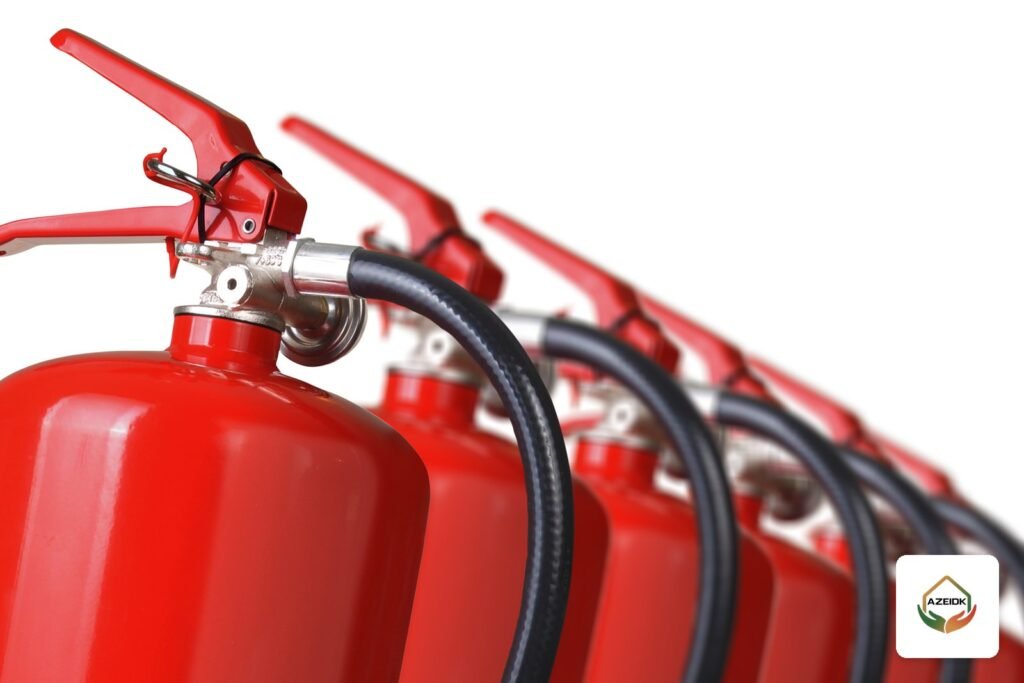
A 6 kg fire extinguisher with ABC dry powder is one of the most widely used sizes in shops, offices and small warehouses, because it combines useful fire-fighting capacity with a weight most people can carry in one hand. The small sizes (1, 2 and 3 kg) suit cars and light domestic use, 9 kg and 12 kg units are chosen for workshops, warehouses and areas with flammable liquids, and anything larger becomes a wheeled extinguisher. The deciding factor is not the kilogram figure, though: it is the fire rating printed on the unit and the travel distance to reach it.
This article explains how to read size and rating, when 6 kg is enough and when you need more, and where and at what height to mount the unit. AZEIDK supplies dry powder, CO2, foam and wet chemical extinguishers in a range of sizes through its technical supply service, with the datasheet for every model. If your question is how many fire extinguishers a shop or warehouse needs, the section on extinguisher numbers below walks through the calculation by floor area, travel distance and hazard, with a worked example.
Key takeaways
- The kilogram figure is the weight of extinguishing agent, not the total weight: the Falcon Gold 6 kg powder unit (FDP6) weighs 8.5 kg in total according to its datasheet.
- Two units of the same size can differ in capacity: the FG 6 kg powder extinguisher is rated 27A 144BC, while the SFFECO PD6D is rated 34A 183B C.
- NFPA 10 (2026 edition) limits travel distance to a Class A extinguisher to 22.9 m and requires at least 2-A in light and ordinary hazard and 4-A in high hazard.
- Units up to 18.14 kg gross weight are mounted with the top no higher than 1.5 m; heavier units no higher than 1.07 m, with at least 102 mm clearance below.
- The SASO Technical Regulation for Fire Control Materials and Equipment requires a certificate of conformity for extinguishing equipment, so ask for it whatever the size.
- The required number of fire extinguishers is found by dividing the floor area by the area one unit covers for its rating and hazard level, then checking on the drawing that travel distance to the nearest unit does not exceed 22.9 m.
In this article
- What does a 6 kg fire extinguisher mean? Agent weight versus fire rating
- Comparing sizes: 2, 6, 9 or 12 kg?
- How do you choose extinguisher size by space and hazard?
- Required number of fire extinguishers: how many does a shop or warehouse need?
- 6 kg dry powder or 6 kg CO2?
- Where should the extinguisher be mounted, and how high?
- Common mistakes when choosing extinguisher size
- Frequently asked questions
- Summary
What does a 6 kg fire extinguisher mean? Agent weight versus fire rating
When a customer asks for a “6 kg extinguisher” they usually mean an ABC dry powder unit holding 6 kg of powder. That figure sets the quantity of agent and the discharge time, but on its own it does not tell you how large a fire the unit can put out. That is set by the fire rating on the label and the datasheet, for example 27A 144BC.
Under the European and international ratings (EN 3 and ISO 7165), the number before A reflects the size of the solid-fuel test fire the unit extinguished, and the number before B the size of the liquid test fire. The larger the number, the larger the test fire. Units tested to the US system (UL 711) carry a different format such as 2-A:10-B:C, and that is the format NFPA 10 distribution tables are built on. The two systems use different test methods, so do not assume a number in one equals a number in the other.
The table below collects sizes and ratings from the manufacturer datasheets published on AZEIDK’s Saudi product pages. It shows why extinguishers should be compared by rating, not by kilograms:
| Size and type | Model | Rating per datasheet | Datasheet note |
|---|---|---|---|
| Powder 1 kg | FG | 5A 34BC | Cylinder height 260 mm |
| Powder 2 kg | FG | 13A 70BC | Cylinder height 300 mm |
| Powder 3 kg | FG | 13A 89BC | Cylinder height 345 mm |
| Powder 6 kg | FG | 27A 144BC | Cylinder height 420 mm |
| Powder 6 kg | SFFECO PD6D | 34A 183B C | Working pressure 14 bar |
| Powder 9 kg | SFFECO PD9D | 43A 233B C | Working pressure 14 bar |
| Powder 12 kg | SFFECO PD12D | 55A 233B C | Working pressure 14 bar |
| Powder 25 kg wheeled | FG | 34A 183B | Mobile unit on wheels |
| CO2 2 kg | FG | 34B | No Class A rating |
| CO2 6 kg | FG | 89B | Cylinder height 740 mm |
| Wet chemical 6 kg | FG | 13A 75B | For cooking oil fires (K/F) |
Note that a 6 kg unit from one manufacturer can match the rating of a 25 kg wheeled unit from another. Ask for the rating in every quotation rather than accepting “6 kg” as the specification.
Comparing sizes: 2, 6, 9 or 12 kg?
1, 2 and 3 kg: vehicles and light use
These sizes are light and easy to handle, and work as a first response in cars, boats and small rooms. They empty quickly and their rating is limited: the FG 1 kg powder unit is rated only 5A 34BC. Do not make one the only extinguisher in a shop or store. For homes, see our home fire extinguisher guide, which covers type and size room by room.
6 kg: the practical size for shops and offices
The 6 kg size is the balance point. The Falcon Gold FDP6, for example, has an 8 m range and a 15 second discharge time per its datasheet, and weighs 8.5 kg in total, so a shop assistant or building guard can carry it to the fire without strain. That is why it is common in shops, offices, building corridors, villas and small stores. Specifications are on the Falcon Gold 6 kg dry powder extinguisher page.
9 and 12 kg: workshops, warehouses and liquid hazards
Where the fire load is higher or flammable liquids are present, a higher B rating matters. In the SFFECO range, the rating rises from 34A 183B C at 6 kg to 43A 233B C at 9 kg and 55A 233B C at 12 kg. The trade-off is weight: a heavier unit is harder for an untrained person to carry, and it may exceed the 18.14 kg threshold that changes the mounting height, so check the gross weight on the datasheet.
25 kg and above: wheeled extinguishers
Large warehouses, fuel stations and loading areas use mobile units on wheels: 25 and 50 kg powder, 25 and 50 litre foam, or trolley-mounted CO2. When you need one, hose length and placement are covered in our wheeled fire extinguisher article.
How do you choose extinguisher size by space and hazard?
The binding framework in Saudi Arabia is the Saudi Fire Code SBC 801 together with the General Directorate of Civil Defense requirements for the facility’s activity. Designers use NFPA 10 as the technical reference for portable extinguisher distribution, covered in our NFPA 10 guide. The practical steps:
- Identify the expected fire class: ordinary combustibles (A), flammable liquids (B), energised electrical equipment (C), cooking oils (K). Type comes before size.
- Set the hazard level: light (offices, classrooms), ordinary (shops, small stores, light workshops), high (workshops with flammable liquids and dense storage).
- Apply the minimum rating and area: under the NFPA 10 Class A table, each A unit covers up to 3,000 sq ft (about 279 m²) in light hazard, 1,500 sq ft (about 139 m²) in ordinary and 1,000 sq ft (about 93 m²) in high hazard, with no more than 11,250 sq ft (about 1,045 m²) per extinguisher.
- Check travel distance: no more than 22.9 m for Class A. For shallow flammable liquids it is 9.1 m or 15.25 m depending on the unit’s B rating and the hazard level.
- Consider weight and the user: a trained warehouse operative is not the same as a receptionist or a resident.
Travel distance often decides the outcome. A long warehouse aisle may be covered by one 12 kg unit on area alone, but two 6 kg units at either end bring an extinguisher closer to every point and are easier to carry. A small shop divided by shelving may need one unit near the entrance and another by the back store, even if the floor area is small.
One caution: NFPA 10 tables are based on UL ratings, while many extinguishers on the market show EN ratings. If the project is designed to NFPA 10, ask the supplier for the rating under the test system the consultant has adopted, and do not calculate quantities from a rating in a different system.
Required number of fire extinguishers: how many does a shop or warehouse need?
The number of extinguishers is not set by kilograms. It depends on three things: the hazard level of the space, the rating of the extinguisher (the number of A units on its label), and the travel distance from the farthest point to the nearest unit. Start with the count by floor area, raise it wherever travel distance fails on the drawing, then add units for special hazards such as flammable liquids and cooking equipment.
How the rule applies in Saudi Arabia
The 2018 Saudi Building Code was developed on the basis of the 2015 International Codes, and the Saudi Fire Code SBC 801 follows the structure of the International Fire Code (IFC) model. In that model, Section 906 covers portable extinguishers: it lists the buildings where they are required, including assembly, business, educational, factory, mercantile and storage occupancies and some residential groups, and requires extinguishers to be selected, installed and maintained in accordance with the section and with NFPA 10, with distribution tables that match the NFPA 10 values. Designers therefore start from the NFPA 10 tables, then check them against the adopted SBC 801 text and the General Directorate of Civil Defense requirements for the activity. For how the code and the authority requirements relate, see our Saudi Fire Code SBC 801 article.
Number of fire extinguishers by floor area (Class A)
The Class A table in NFPA 10 (Table 906.3(1) in the IFC model) links hazard level to the area each A unit may cover:
| Item | Light hazard | Ordinary hazard | Extra hazard |
|---|---|---|---|
| Minimum rated single extinguisher | 2-A | 2-A | 4-A |
| Maximum floor area per unit of A | 3,000 sq ft (about 279 m²) | 1,500 sq ft (about 139 m²) | 1,000 sq ft (about 93 m²) |
| Maximum floor area per extinguisher | 11,250 sq ft (about 1,045 m²) | 11,250 sq ft (about 1,045 m²) | 11,250 sq ft (about 1,045 m²) |
| Maximum travel distance to extinguisher | 75 ft (22.9 m) | 75 ft (22.9 m) | 75 ft (22.9 m) |
The method: the area one unit covers equals the number of A units in its rating multiplied by the area per unit, capped at 11,250 sq ft. In ordinary hazard a 2-A unit covers 3,000 sq ft (about 279 m²), a 4-A unit covers 6,000 sq ft (about 557 m²), and a 10-A unit reaches the 11,250 sq ft cap and goes no further however high its rating. Divide the floor area by that figure and round up.
The calculation uses UL ratings written as 2-A or 4-A. An EN rating such as 27A is not a count of A units in the same sense, so do not plug it into the formula. Ask the supplier for the rating that matches the test system the consultant works to.
Flammable liquids (Class B) and kitchens (Class K)
For flammable liquids no deeper than 0.25 in (about 6 mm), such as workshop spills and paint areas, the table sets travel distance by the unit’s B rating:
| Hazard level | Minimum B rating | Maximum travel distance |
|---|---|---|
| Light | 5-B | 30 ft (9.1 m) |
| Light | 10-B | 50 ft (15.2 m) |
| Ordinary | 10-B | 30 ft (9.1 m) |
| Ordinary | 20-B | 50 ft (15.2 m) |
| Extra | 40-B | 30 ft (9.1 m) |
| Extra | 80-B | 50 ft (15.2 m) |
A higher rating allows a longer distance. Deeper liquid hazards such as tanks have separate NFPA 10 requirements that the designer applies. In commercial kitchens a Class K rated unit must be within 30 ft (9.1 m) travel distance of cooking equipment that uses oils and fats; see our wet chemical kitchen extinguisher article. CO2 units next to electrical panels are added on top of the Class A count, not counted in it, because they carry no rating for solid combustibles.
Worked example: a shop, a warehouse and a workshop
The figures below are minimums by floor area only, assuming the hazard level shown for each case and UL ratings for the extinguishers:
| Case | Floor area | Hazard | Rating | Area per unit | Count by area |
|---|---|---|---|---|---|
| Retail shop | 250 m² (about 2,691 sq ft) | Ordinary | 2-A | 3,000 sq ft | 1 |
| General goods warehouse | 1,200 m² (about 12,917 sq ft) | Ordinary | 2-A | 3,000 sq ft | 5 (result 4.3) |
| Same warehouse | 1,200 m² | Ordinary | 4-A | 6,000 sq ft | 3 (result 2.15) |
| Same warehouse | 1,200 m² | Ordinary | 10-A | 11,250 sq ft | 2 (result 1.15) |
| Workshop with flammable liquids | 500 m² (about 5,382 sq ft) | Extra | 4-A | 4,000 sq ft | 2 (result 1.35), plus Class B units within 9.1 m or 15.2 m |
After the area count comes the step that decides many cases: drawing the actual travel distance on the layout. Racks, walls and aisles make the walking route longer than a straight line, so if any point is more than 22.9 m of walking from the nearest unit, add one, even when the area count is met. The shop in the example needs one unit on paper, but a back store or a long corridor can call for a second. The warehouse that needs two 10-A units on paper may need more if it is long and split by rack aisles, and spreading 4-A units along the aisles brings a unit closer to every point and keeps each one easy to carry.
Who sets the final number?
This calculation is a tool for estimating and for checking a supplier’s quote. The final number and positions are set by the designer on the fire protection drawings under SBC 801 and the Civil Defense requirements for the occupancy, and the authority may ask for extra units for special hazards or a higher rating. For warehouses see the warehouse Salamah licence requirements, and for distribution in buildings generally see our fire extinguishers building safety guide. The AZEIDK team can fix the count and positions on the drawing through its engineering design and calculations service and follow the file through Civil Defense approval support.
6 kg dry powder or 6 kg CO2?
ABC powder covers solids, liquids and electrical fires, so it is the default 6 kg choice for most spaces. The FG 6 kg CO2 unit is rated 89B only, which means no Class A rating, and its cylinder is taller (740 mm against 420 mm for the FG 6 kg powder unit) with a thicker wall (4.3 mm) because it works at 167 bar. Its advantage is that it leaves no residue, so it is placed next to electrical panels and equipment rooms. The working rule: powder for general area coverage, plus CO2 beside the electrical hazard. For a detailed comparison of types and the brands available, see fire extinguisher types and brands in Saudi Arabia.
Where should the extinguisher be mounted, and how high?
NFPA 10 links mounting height to the gross weight of the unit:
- Gross weight up to 40 lb (18.14 kg): top of the unit no higher than 1.5 m above the floor. A 6 kg powder unit falls here.
- Heavier units: top no higher than 1.07 m.
- In both cases, at least 102 mm between the bottom of the unit and the floor.
Place extinguishers along exit routes and near doors, clearly visible and not blocked by stock or furniture, on a wall bracket or in an extinguisher cabinet. Do not mount them right next to the hazard itself, where the fire could cut off access.
Common mistakes when choosing extinguisher size
- Buying by weight alone: comparing two quotes for “6 kg” without comparing ratings hides a real difference in capacity.
- A 1 or 2 kg unit for a shop: a vehicle size is not enough for a shelving or stock fire.
- One large unit instead of two: the effective coverage drops because travel distance increases.
- CO2 to cover a paper or carton store: it carries no Class A rating.
- Mounting heavy units high: they are hard to lift down in a fire and break the height limits.
- Skipping the conformity certificate and datasheet: without them you know neither the actual rating nor whether the unit conforms.
Frequently asked questions
Is a 6 kg fire extinguisher enough for a shop?
In many small ordinary-hazard shops a 6 kg ABC powder unit covers the floor area, provided travel distance does not exceed 22.9 m and the rating is adequate. A shop with partitions or a back store usually needs more than one, in addition to the Civil Defense requirements for its activity.
How many extinguishers does a shop need by floor area?
Under NFPA 10 each A unit covers about 139 m² in ordinary hazard, so a 2-A unit covers about 279 m², after which travel distance is checked. The final number is set by the designer and Civil Defense requirements, not by area alone.
Which extinguisher is right for electrical fires?
CO2, because it leaves no residue on equipment. ABC powder also works but leaves powder behind. Never use water or foam on energised equipment.
How long does a fire extinguisher last?
NFPA 10 does not set a single expiry date. It sets monthly inspection, annual maintenance and periodic hydrostatic testing: every 12 years for stored-pressure powder units with steel cylinders, every 5 years for CO2 and every 5 years for foam. Details are in our fire extinguisher maintenance article.
How do I check the gauge?
On stored-pressure powder units the needle should sit in the green zone, with the safety pin, hose and cylinder intact and free of rust or dents. CO2 units usually have no pressure gauge and are checked by weight during maintenance.
Does an extinguisher need a SASO certificate of conformity?
The Technical Regulation for Fire Control Materials and Equipment requires a certificate of conformity for extinguishing equipment, issued through the SABER platform. Ask the supplier for proof of conformity for the model before buying.
What does a 6 kg extinguisher cost?
Price depends on type, rating, brand, approvals and quantity, and two prices mean little without comparing ratings. The factors are explained in our fire extinguisher price in Saudi Arabia article.
How many fire extinguishers does a warehouse need?
For a 1,200 m² warehouse classed as ordinary hazard, the minimum by floor area is five 2-A units, three 4-A units or two 10-A units. Travel distance between the racks (22.9 m maximum) is then checked, units are added for any flammable liquids, and the final number follows the Civil Defense requirements for the warehouse activity.
Summary
Choosing extinguisher size starts with the fire class and hazard level, then the required rating and travel distance, and only then the weight the user can handle. A 6 kg ABC powder extinguisher suits most shops and offices, larger sizes suit workshops and warehouses, and small sizes suit vehicles and light use. Always compare the rating on the datasheet, and mount the unit at the correct height where it is visible from the exit route. Browse the available sizes in the fire extinguishers category.
Fitting out a shop or warehouse and need specific quantities and sizes? Send us the floor area, the type of activity and the layout if you have it, and we will propose extinguisher types and sizes with the datasheet for each model. Contact the AZEIDK team
See the fire extinguishers and fire fighting systems AZEIDK supplies.
Related guides
- Bosch CCTV Cameras in Saudi Arabia: DINION 5100i, FLEXIDOME 5100i and DIVAR IP all-in-one 4000, and When Consultants Specify Them
- CCTV and Security System Maintenance: Periodic Checks and Contract Scope
- Fire Hose Types and Sizes: Rack, Reel, Lay-Flat, Couplings and Inspection
- CCTV Company in Dammam and Khobar: Technician or Company, and What to Ask Each