A car fire extinguisher has to be small enough to fit the cabin, mounted where the driver can reach it in seconds, and kept out of the sun, because a car parked in a Saudi summer can get hotter in places than the extinguisher’s datasheet allows.
Every figure below comes from the datasheets on AZEIDK product pages or from the sources listed at the end. If you are equipping company cars or service vehicles, extinguishers and brackets are supplied through AZEIDK’s technical supply service.
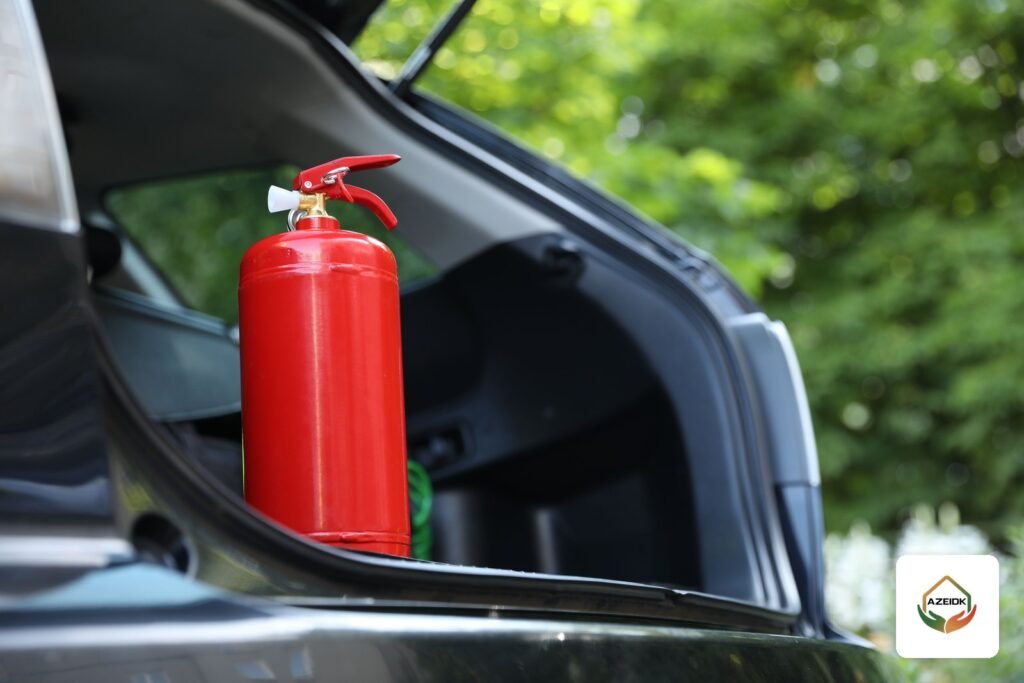
Short answer: For a small car, the best fit is a 1 kg or 2 kg ABC dry powder extinguisher, held in a bracket bolted to the vehicle floor within the driver’s reach, not loose in the boot or on the dashboard. Check the pressure gauge once a month, recharge it after any use, however short, and keep it out of direct sunlight: the upper temperature limit on these datasheets is 60 °C.
Key takeaways
- An ABC dry powder extinguisher is the practical choice for a car: one unit covers solid materials, flammable liquids and electrical fires.
- The Falcon Gold 1 kg powder extinguisher (model FDP1) empties in about 6 seconds according to its datasheet, so it is for a fire that has only just started.
- The FG 2 kg powder extinguisher is rated 13A 70BC, against 5A 34BC for the 1 kg size: clearly more firefighting capacity.
- In an Arizona State University study, the dashboard of a car parked in the sun reached about 69 °C within an hour, above the 60 °C datasheet limit.
- If smoke comes from under the bonnet, do not open it: switch off, get everyone out, move away and call emergency services on 911 or 998.
In this article
- Which car fire extinguisher type should you choose?
- Car fire extinguisher size: 1 kg or 2 kg?
- Why a car fire extinguisher should never sit in the sun
- Where to mount the extinguisher in a car
- If the car catches fire: use the extinguisher or walk away?
- Car fire extinguisher inspection and maintenance
- Extinguishers for company cars and fleets
- Common mistakes with car fire extinguishers
- Frequently asked questions
- Conclusion
Which car fire extinguisher type should you choose?
A car carries fuel and oil, electrical wiring, and seats and trim that will burn. You need one extinguisher that handles all three classes, which is what an ABC dry powder extinguisher does.
| Type | Classes per datasheet | Temperature range | Suitable for a car? |
|---|---|---|---|
| ABC powder 1 kg (Falcon Gold FDP1) | A, B, C and E | -30 to +60 °C | Yes, for small and private cars |
| ABC powder 2 kg (FG) | 13A 70BC | -30 to +60 °C | Yes, and the better option if it fits |
| CO2 2 kg (FG) | 34B only, no A rating | -30 to +55 °C | Not recommended as the only car extinguisher |
Why not a CO2 extinguisher?
The FG 2 kg CO2 extinguisher is rated 34B only, so it is not rated for solid-material fires such as seats and upholstery. It is a high-pressure cylinder with a working pressure of 167 bar, and its upper temperature limit is 55 °C, lower than the powder units. CO2 discharged in a small cabin also displaces oxygen; see our CO2 extinguisher guide. CO2 belongs in electrical and equipment rooms, not in the cabin.
Car fire extinguisher size: 1 kg or 2 kg?
The number on the label is the weight of the extinguishing agent. The real decision rests on the fire rating and on the space you have for mounting. These figures come from the published datasheets:
- Falcon Gold 1 kg powder (FDP1): gross weight 1.7 kg, discharge range 5 m, discharge time 6 seconds, supplied with a wall bracket and no hose. The product page lists cars and small offices among its uses: Falcon Gold 1 kg dry powder extinguisher.
- FG 1 kg powder: rated 5A 34BC, 80 mm diameter, 260 mm cylinder height.
- FG 2 kg powder: rated 13A 70BC, 110 mm diameter, 300 mm cylinder height. Its product page lists vehicles among its uses.
Rule of thumb: if the mounting spot takes a 110 mm cylinder, choose 2 kg. Its rating is more than double in both class A and class B. A 1 kg unit is acceptable in a very small car or as a second extinguisher. Trucks, buses and vehicles carrying flammable goods have requirements set by the operator or the contract, and should not be sized by the private-car rule.
Why a car fire extinguisher should never sit in the sun
Every extinguisher has an operating temperature range on its datasheet: -30 to +60 °C for the powder units above, and up to +55 °C for the FG CO2 unit. That is the range in which the manufacturer states the unit will work as designed.
The trouble is that parts of a car parked in the sun go beyond it. In a study published by Arizona State University in 2018, run on summer days with outside temperatures above 100 °F (about 38 °C), cars left in the sun for an hour averaged a dashboard temperature of about 157 °F (around 69 °C), a steering wheel of about 53 °C, seats of about 51 °C and cabin air of about 47 °C.
In practice:
- Never put the extinguisher on the dashboard, on the rear parcel shelf or anywhere that takes direct sunlight.
- The coolest spots are low and shaded: the cabin floor, or the boot floor away from the glass.
Where to mount the extinguisher in a car
A loose extinguisher is a hazard in its own right: a pressurised steel cylinder that flies forward under hard braking. Mount it in a bracket with quick-release straps or clips; the technical detail is in our fire extinguisher bracket guide. When choosing the spot:
- Within the driver’s reach: the floor in front of the front passenger seat is a common choice, as long as it does not block the passenger’s feet or seat travel.
- Bolted to the body or floor: not taped, and not fixed to the carpet or trim.
- In the boot only if it stays visible: the boot floor of a family car is fine if the bracket is fixed and luggage never covers it.
- Out of the sun: as explained above.
- Never loose under a seat: it can roll under the pedals or vanish when you need it.
The NFPA 10 mounting heights for buildings do not apply to vehicles. What matters is that it is secure, visible and out in one movement.
If the car catches fire: use the extinguisher or walk away?
The U.S. Fire Administration (USFA) sets out clear steps for a vehicle fire: pull over safely, turn off the engine, get everyone out, never go back in and do not try to fight the fire yourself, and move at least 100 feet (about 30 m) away and clear of traffic. If you think the fire is under the bonnet or in the boot, do not open it.
So where does the extinguisher fit in? Only when the fire is tiny, in its first moments and in plain view inside the cabin, the passengers are already out, and you have a clear escape route behind you. Pull the safety pin, aim at the base of the flames rather than the top, squeeze the handle and sweep from side to side. If the fire is not out within seconds, step back and call 911 or 998.
Car fire extinguisher inspection and maintenance
A car extinguisher lives a harder life than an office one: daily vibration, heat and dust. Give it a simple monthly check. NFPA 10 sets a visual inspection about every 30 days, annual maintenance by a qualified technician, and a hydrostatic test every 12 years for stored-pressure dry chemical extinguishers with steel shells. Details are in our fire extinguisher maintenance and recharging guide.
| Check | Good condition | Act when |
|---|---|---|
| Pressure gauge | Needle in the green zone | Needle in the red, left (low) or right (overcharged) |
| Safety pin and tamper seal | In place, seal intact | Missing or broken: the unit may have been used |
| Body | No rust, dents or cracked paint | Any visible damage: have a technician check it |
| Nozzle | Clean and clear | Dust or insects inside |
| Bracket | Fixed, extinguisher does not move | Loose bolt or worn strap |
| Label | Readable, with last service date | Unreadable or undated |
After any use, even one second, have the extinguisher recharged. A partly discharged powder unit can lose pressure over time.
Extinguishers for company cars and fleets
Fleets tend to have the same problem: extinguishers bought with the vehicles and never checked again. The fix is administrative before it is technical:
- Standardise one type and size per vehicle category, with the bracket made for that extinguisher.
- Add the gauge and pin check to the driver’s daily or weekly vehicle checklist.
- Tie annual extinguisher servicing to the vehicle service schedule, and record each extinguisher against the plate number.
- Buy extinguishers with a valid certificate of conformity. The SASO Technical Regulation for Fire Control Materials and Equipment requires one for extinguishers, issued through the SABER platform.
AZEIDK has its own extinguisher maintenance team within its preventive and periodic maintenance service, and a contract can cover vehicle extinguishers alongside those in your offices and warehouses.
Common mistakes with car fire extinguishers
- Throwing the extinguisher in the boot under the bags, where nobody can reach it in time.
- Mounting it on the dashboard or by the rear window, where heat exceeds the datasheet limit.
- Buying a CO2 unit because it seems cleaner, even though it is not rated for solid-material fires.
- Opening the bonnet to fight an engine fire.
Frequently asked questions
What is the best fire extinguisher for a car?
A 1 kg or 2 kg ABC dry powder extinguisher, because it covers solid, liquid and electrical fires. Choose 2 kg if the mounting space allows.
Dry powder or CO2 for a car?
ABC powder covers classes A, B and C. The FG 2 kg CO2 unit is rated 34B only and is limited to 55 °C, so powder is the better choice for a car.
How do I know from the gauge that the extinguisher is OK?
If the needle sits in the green zone, the pressure is within range. If it is in the red on either side, or the safety pin is missing, have a technician check it.
When should a car extinguisher be recharged?
After any use, however short, when the gauge leaves the green zone, or when the technician calls for it at the annual service.
How long does a fire extinguisher last?
There is no single printed expiry date: service life depends on inspection and maintenance. NFPA 10 sets a 12-year hydrostatic test for stored-pressure dry chemical units with steel shells, plus annual maintenance, and the manufacturer’s label comes first.
Does an extinguisher need a SASO certificate of conformity?
Yes. The technical regulation for fire control equipment requires a certificate of conformity for extinguishers, so ask the seller for proof through SABER.
How much does a fire extinguisher cost in Saudi Arabia?
Price depends on type, capacity, manufacturer, approvals and whether a bracket is included. There is no single price that holds for every unit, so ask for a quote that names the model and rating.
Conclusion
A good car fire extinguisher is a small ABC powder unit, held in a bracket in a low, shaded spot the driver can reach, with its gauge in the green every month. An engine fire or a large fire calls for walking away and calling for help.
Equipping a private car or a company fleet? Send us the number and type of vehicles, and we will propose the size and bracket and set up periodic maintenance. Talk to the AZEIDK team
To buy an extinguisher or book its maintenance, see AZEIDK fire extinguishers.
Related guides
- Safety and Fire Fighting Company in Makkah: Fire Alarm, Fire Fighting, Extinguishers and Civil Defense Procedures
- CCTV Field of View: 2.8 vs 4 vs 6 mm Lens and DORI Distance Calculation
- Fire Alarm Companies in Jeddah: Comparing Distributors, Consultants and Contractors
- CCTV Installation in Saudi Arabia: Step by Step from Survey to Handover