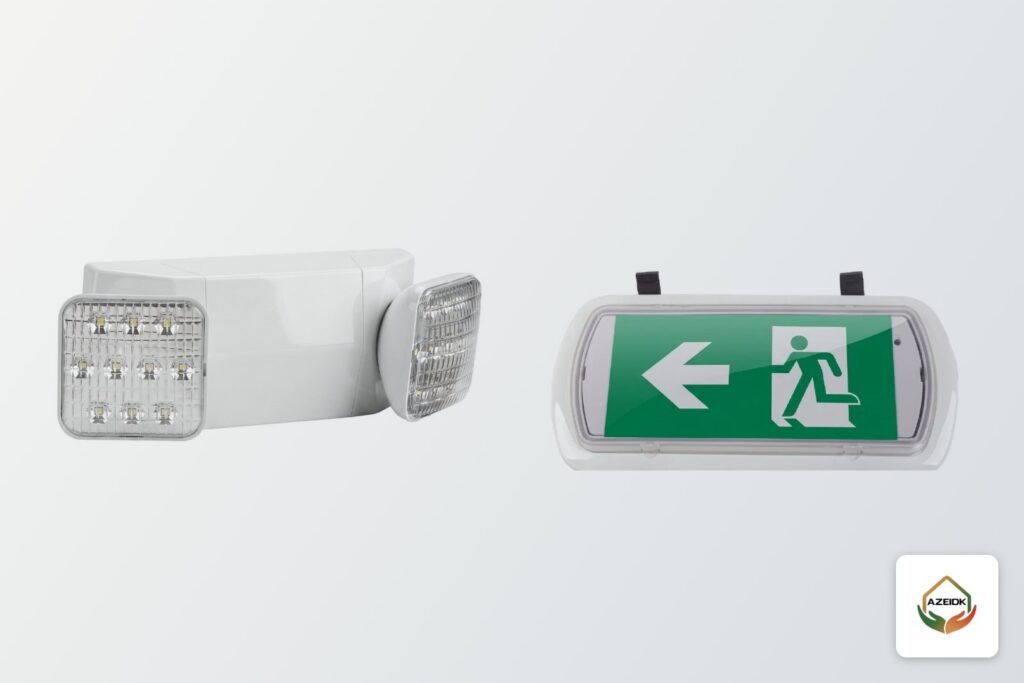
Emergency lighting and exit sign maintenance is one of the items whose faults are usually found on the day they are needed: the battery has weakened, the fitting only works on mains power, or an exit sign is dark behind a new fit-out. The cause is almost always that the tests were never scheduled or recorded. This guide is written for facility managers and safety officers in Saudi Arabia and sets out a practical monthly and annual checklist and what goes into the log.
For the fittings themselves (maintained and non-maintained, self-contained and central battery, sizes and locations) see the emergency lighting and exit signs guide. This article focuses on inspection, testing and maintenance once the system is in service.
Key points
- NFPA 101 (section 7.9.3) requires a monthly functional test of at least 30 seconds and an annual full-duration test of 90 minutes, with written records.
- Illuminated exit signs are tested the same way, as part of the emergency lighting system.
- Self-test units reduce the effort but do not remove the visual round or the log.
- A unit that does not last the annual test is a fault: replace the battery or the unit, then test again.
What does the code require?
The NFPA 101 Life Safety Code is the common international reference for emergency lighting tests, and the Saudi Fire Code SBC 801 requires emergency and standby power systems, including emergency lighting, to be maintained and tested periodically. The NFPA 101 requirements come down to three points:
| Test | Frequency | Duration | Usually done by |
|---|---|---|---|
| Functional test | Monthly | At least 30 seconds | Facility team or maintenance contractor |
| Full-duration test | Annually | 90 minutes | Licensed maintenance contractor |
| Written record | Every test | Kept for inspection | Safety officer |
Where emergency lighting is fed from a standby generator instead of batteries, its testing is tied to the generator and transfer switch maintenance programme, and the requirement stays the same: escape routes must light up automatically when normal supply fails.
Monthly checklist (30 seconds)
- Cut normal supply to the circuit or press the test button on each unit.
- Confirm every unit lights within moments and stays lit for 30 seconds without obvious dimming.
- Exit signs: the legend or pictogram is fully lit and readable from the escape route.
- The charge indicator (usually green) comes back on after supply is restored.
- No unit is covered by signage, decor or shelving, and none has a broken diffuser or has been removed.
- Exit sign arrows still point the right way after any change to corridors or doors.
- Record each unit number or location, the result (pass / fault), the date and the name.
Annual checklist (90 minutes)
- Choose a time that does not disrupt operations, as batteries need hours to recharge afterwards.
- Cut normal supply to the circuits and leave the units running for the full 90 minutes.
- At the end, check every unit: is it still lit with enough light for the route?
- Units that went out or dimmed clearly before the end are logged as faults.
- On central battery systems, check the central battery, the charger and its alarm panel.
- Close the test with a signed report attached to the safety log.
Self-test units: what changes?
Self-test units run their periodic test automatically and show the result on an indicator. This saves technician time, but the facility still has to walk the units, read the indicators, record the results and deal with any unit showing a battery or lamp fault. In large buildings, addressable central monitoring can be more efficient, as it collects the results of every unit on one screen.
Common faults and how to fix them
| Fault | Usual cause | Action |
|---|---|---|
| Unit does not light when supply is cut | Failed or disconnected battery, or faulty charger board | Check connections, then replace the battery or the unit |
| Goes out before 90 minutes | Battery has lost capacity with age and heat | Replace with the battery type the manufacturer specifies and retest |
| Exit sign always dark | Circuit off or failed LED module | Restore supply and replace the unit if needed |
| Charge indicator off | Circuit breaker off or charger fault | Check the breaker, then repair the charger |
| Units hidden after a fit-out | Impact on escape routes was not reviewed | Relocate or add units with the designer’s approval |
Heat in the Saudi climate, especially in warehouses, car parks and unconditioned corridors, shortens battery life, so the annual full-duration test is the only reliable way to find units that need a new battery before they fail in a real outage.
What goes into the log?
- A list of all units and exit signs with fixed numbers or locations on the layout drawing.
- The date and result of each monthly test for each unit.
- The date of the annual test, its actual duration and the units that failed.
- The repair made, when, and the retest result.
- The name and signature of the person testing, and the contractor if any.
This record is part of the fire safety log book and maintenance records asked for during a Civil Defense inspection visit.
When to replace the unit instead of repairing it
If a unit keeps failing after a battery change, the diffuser is cracked, or the space is now used differently and needs more light or an IP65 unit, replacement is the better option. Units AZEIDK supplies in Saudi Arabia include the Eclipse Edge EM0701 exit light, the Arabic/English XST Streem EM0730 exit sign and the EvacBright EM0721 twin-head emergency light; the emergency and exit lighting range lists the other models and their datasheets.
Frequently asked questions
How often should emergency lighting be tested?
Under NFPA 101, a monthly functional test of at least 30 seconds and an annual full-duration test of 90 minutes, with a written record of each test.
Can the facility team do the monthly test?
Usually yes, as it is a simple check with the test button or by cutting the circuit, provided it is recorded. The annual test and fault repairs are better left to the maintenance contractor.
Do exit signs need testing like emergency lights?
Yes. Illuminated exit signs are part of the emergency lighting system and are tested monthly and annually in the same way.
Why do batteries fail quickly at some sites?
High temperatures in unconditioned spaces shorten battery life, and units that are never tested only reveal a weak battery during a real outage.
Does a self-test system replace the log?
No. Self-test makes testing easier, but reading the indicators, recording the results and fixing faults remain the facility’s responsibility.
Need an annual emergency lighting test or a maintenance contract that covers it? AZEIDK carries out the tests, records and replacements under its annual maintenance contracts. Request a quote
Related guides
- Connect CCTV to TV: HDMI from the Recorder, Wireless Options and Without a DVR
- Network Installation (Structured Cabling) for Offices in Saudi Arabia: How to Choose the Contractor and What to Ask in the Offer
- Hospital Fire Extinguishers: Which Type for Wards, Equipment Rooms, Laboratories and Kitchens
- ZKTeco in Saudi Arabia: Access Control, Time Attendance and Turnstiles