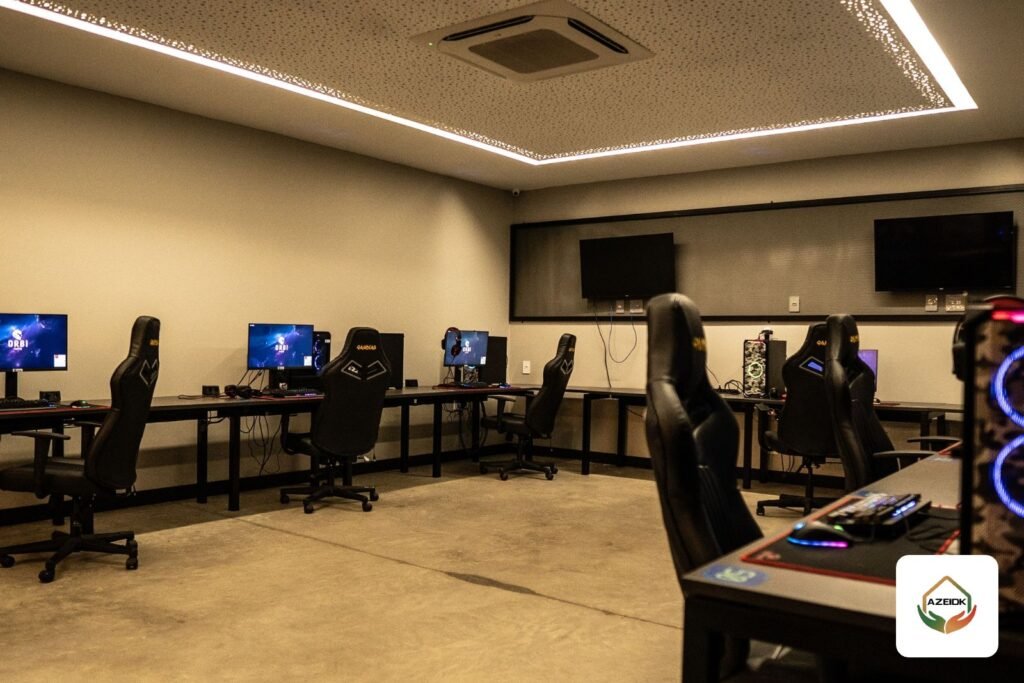
Gaming lounges put dozens of consoles, PCs and screens running for hours into one room, with dim lighting, foam gaming chairs and mostly young visitors late into the night. Their protection rests on four systems: a fire alarm that detects smoke early, CO2 extinguishers for the equipment, emergency lighting and exit signs that work in the dark, and CCTV in line with the law.
For camera types, resolution, night vision and storage, see our CCTV cameras guide for Saudi Arabia.
This article covers the fire sources in a gaming lounge, the Saudi regulatory frame and how to design each system for this specific use. It belongs to our entertainment venues and event halls sector page.
Key Points
- The first risk in a gaming lounge is electrical: heavy loads on few circuits, daisy-chained power strips, UPS units and batteries.
- A gaming lounge produces no smoke in normal use, so smoke detectors suit it well and catch an electrical fire early.
- CO2 extinguishers suit electronic equipment best because they leave no residue.
- Dim lighting makes emergency lighting and illuminated exit signs a priority, not a detail.
- If the lounge is licensed as an entertainment center, the Recreational Facilities Requirements apply; they refer to SBC 801 and require security cameras.
What regulatory frame applies to gaming lounges?
The licence sets the activity classification. If the lounge is licensed as an entertainment center, the Recreational Facilities Requirements of the Ministry of Municipalities and Housing (update announced 14 May 2025) apply to recreational facility buildings, including entertainment centers and their play corners, and exclude cinemas and theaters. Relevant clauses include:
- Compliance with the Saudi Fire Code (SBC 801).
- Compliance with the Saudi Building Code, including its electrical requirements (clause 4.1.1).
- Ceilings of fire-resistant materials (clause 4.6.1).
- Security cameras under the Security Surveillance Cameras Law and its implementing regulations (clause 5.3).
- Stairs and external walkways kept clear for fast evacuation (clause 4.4.6).
Either way, the lounge needs a Civil Defense safety certificate within its municipal licence; see our article on the Salamah certificate for shops.
Where do fires start in a gaming lounge?
| Source | How it happens | Prevention |
|---|---|---|
| Electrical load | Gaming rigs and large screens on circuits not designed for them, so cables and breakers overheat | Load calculation before opening; dedicated circuits per group of stations |
| Daisy-chained power strips | One strip plugged into another under the desks, out of sight | Enough fixed sockets at every station |
| UPS units and batteries | Batteries in a closed space without ventilation, or old swollen batteries | A ventilated dedicated space; batteries replaced as the manufacturer advises |
| Network and server room | Network gear and game servers in an unventilated cupboard | A properly prepared network room with a smoke detector |
| Controller and phone charging | Cheap chargers and lithium batteries left on charge | A visible charging station away from seating |
| Snack corner | Microwaves, heaters and fridges | A nearby extinguisher and separate circuits from the gaming floor |
For technical rooms see our guide to server and network room preparation and our article on lithium battery risks in shops.
Fire alarm for gaming lounges
Unlike restaurants or shisha cafes, a gaming lounge is a clean space with no smoke in normal use. That makes the optical smoke detector the natural choice, because an electrical fire usually produces smoke well before flame. What the designer reviews:
- Main floor coverage with ceiling smoke detectors sized to area and height; tall partitions between private VIP rooms may need their own detectors.
- Network and UPS rooms with a smoke detector in each.
- False ceilings with dense wiring above them, where the designer decides whether detection is needed in the void.
- Sounders with strobes, because many players wear noise-isolating headsets and a strobe reaches them when a bell does not.
- Manual call points at exits and next to reception.
A medium lounge in a single unit is usually served by a conventional panel with zones separating the main floor, private rooms and technical rooms, such as Context Plus conventional panels. Large lounges or those inside an entertainment complex may need an addressable panel or an interface to the building panel. It also helps to link the alarm to cut power to gaming stations, stop the music and switch on general lighting; these interfaces are designed and tested at handover.
Extinguishers: why CO2 first?
Dry powder works, but it spreads everywhere, gets into the vents of consoles and screens and is expensive to clean up. So:
| Area | Usual extinguisher |
|---|---|
| Gaming floor and private rooms | CO2 |
| Network room, UPS and electrical board | CO2 |
| Seating, furniture and store | ABC dry powder for solid-material fires |
| Snack corner | CO2 or ABC powder depending on appliances |
Within its fire extinguisher range, AZEIDK supplies Falcon Gold CO2 units of 2, 6 and 10 kg and dry powder units from 1 to 6 kg. For more on CO2 units and their limits, see our CO2 fire extinguisher guide. The approved design sets numbers and travel distances.
Emergency lighting and exit signs in a dark room
Gaming lounges are usually designed with low and coloured lighting to keep the focus on the screens. If power fails or smoke thickens, visitors find themselves in total darkness among chairs, desks and cables. So:
- Illuminated exit signs visible from every station, not hidden by large screens or decor.
- Emergency lighting in the aisles between rows and in private rooms.
- Aisles not narrowed by movable chairs or visitors’ bags.
- Cables routed in trays under desks or in the floor, not across the exit route.
Requirements are covered in our article on emergency lighting and exit signs.
CCTV in gaming lounges
Cameras in a gaming lounge serve safety and security together: watching the floor, private rooms and entrances, protecting expensive equipment and recording any incident. Typical coverage: entrance, reception and cashier; the main floor at an angle covering the aisles; private room corridors from outside; the network room and store. Choose cameras for the actual light level in the lounge; AZEIDK supplies Hikvision and Dahua network cameras, including low-light models such as the Hikvision DarkFighter series. The obligations of the Security Surveillance Cameras Law are covered in our article on CCTV law obligations. If members use cards to enter private rooms, any electrically locked door on an exit route must release on alarm.
Pre-opening checklist
- Electrical load calculated for every device, with enough fixed sockets at each station.
- No daisy-chained power strips under desks.
- A ventilated network and UPS room with a smoke detector and a CO2 extinguisher.
- Smoke detectors covering the floor and private rooms, with strobe sounders.
- CO2 extinguishers visible and tagged.
- Exit signs and emergency lighting working on mains failure.
- Cameras recording and covering entrances and the floor.
- Private room doors never locked in a way that prevents exit.
Periodic maintenance
A lounge runs long hours every day, and dust builds up inside equipment and on detectors. AZEIDK provides periodic maintenance contracts for fire alarm systems and extinguishers with its own team; CCTV and low-current systems are covered by a separate maintenance contract.
FAQ
What are the safety requirements for gaming lounges in Saudi Arabia?
A Civil Defense safety certificate within the municipal licence; if licensed as an entertainment center, the Recreational Facilities Requirements apply, referring to SBC 801 and the Saudi Building Code and requiring security cameras.
Which extinguisher is best for a gaming lounge?
CO2 for equipment and electrical boards because it leaves no residue, plus ABC powder units for furniture and the store.
Are smoke detectors suitable for a gaming lounge?
Yes. There is no smoke in normal use, and an electrical fire usually produces smoke before flame.
Why add strobes to the fire alarm?
Many players wear noise-isolating headsets, and a visual strobe reaches them.
Are CCTV cameras mandatory in a gaming lounge?
If licensed as a recreational facility, clause 5.3 requires security cameras under the Security Surveillance Cameras Law.
Where should the UPS go?
In a dedicated ventilated space away from seating, with a smoke detector and a CO2 extinguisher nearby, following the manufacturer’s instructions.
Summary
A gaming lounge is an electrical risk before anything else. Start with loads, sockets and technical rooms, then smoke detectors with strobes that reach headset wearers, CO2 extinguishers for equipment, emergency lighting that guides visitors in the dark and cameras covering the floor and entrances.
Fitting out a gaming lounge? Send us the layout, number of stations and private rooms, and we will propose the fire alarm, extinguishers and cameras with datasheets. Contact the AZEIDK team