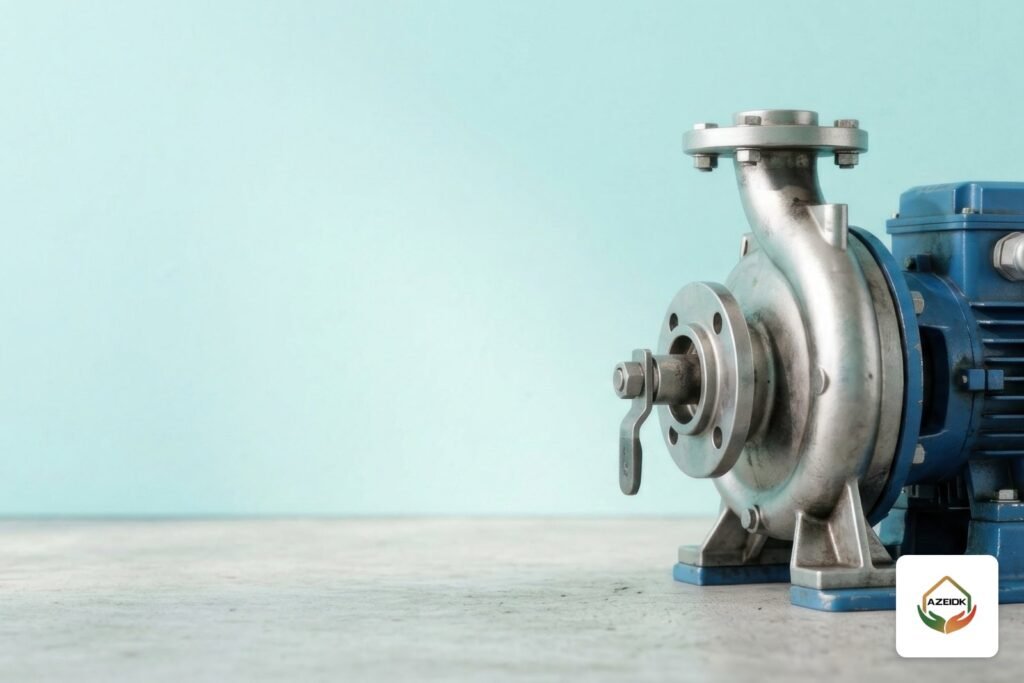
An end suction fire pump is a horizontal centrifugal pump that takes water in at the front, along the shaft axis, and discharges from the top of the casing. It is the most common type in commercial and residential buildings and mid-size warehouses, because it covers flows up to about 1,000 gpm in a compact unit at a lower cost than larger types. AZEIDK supplies three options in Saudi Arabia: the UL and FM approved WATEX WE series, the Jack Pump VES series and non-listed 3PUMP packages, all in our fire pumps range.
For a comparison of fire pump types (electric, diesel, jockey, end suction, split case and vertical turbine), see our full guide.
This article answers a practical question: when is an end suction pump enough for your project, and when do you need another type?
Key points
- Per AZEIDK pages: Jack Pump VES covers 50 to 1,000 gpm and 84 to 230 psi; WATEX WE covers 25 to 1,000 gpm up to 530 psi.
- Back pull-out design: the rotating assembly comes out from the rear without breaking suction and discharge piping.
- Needs positive suction like every horizontal pump.
- Above about 1,000 gpm move to a split case pump; with water below the pump, to a vertical turbine.
- WATEX WE holds UL EX27019, and six of its models are FM approved to Class 1319.
In this article
- What is an end suction fire pump?
- Flow and pressure limits: when is an end suction fire pump enough?
- The performance curve: points to check
- WATEX WE: FM approved models and their ranges
- Listed or non-listed?
- The pump alone or a complete package?
- Installation and maintenance
- Frequently asked questions
- Summary
What is an end suction fire pump?
The name describes the layout. The suction flange is at the end of the pump in line with the shaft, and the discharge flange is on top of the casing. There is one impeller fed from one side. This simple design makes the pump shorter and lighter than a split case pump, with a smaller common baseplate for pump and driver.
The Jack Pump VES product page describes the back pull-out design: the bearing, shaft and impeller assembly is withdrawn from the rear without disconnecting suction and discharge piping. It also lists a ductile iron casing, bronze or stainless steel impeller, gland packing, replaceable wear rings and ANSI flanges, with the flange class to be confirmed from the catalog.
Flow and pressure limits: when is an end suction fire pump enough?
The practical limit is flow. The three series available from AZEIDK stop at about 1,000 gpm for listed pumps and 1,500 gpm for non-listed 3PUMP packages:
| Series | Flow | Pressure | Approval |
|---|---|---|---|
| WATEX WE | 25 to 1,000 gpm | Up to 530 psi | UL EX27019; FM Class 1319 for six models |
| Jack Pump VES | 50 to 1,000 gpm | 84 to 230 psi | UL listed per catalog, designed to UL 448 |
| 3PUMP | 500, 750, 1,000 and 1,500 gpm | 8 to 10 bar by model | Non-listed; UL/FM versions on request |
An end suction pump is usually enough when:
- The combined hydraulic demand of sprinklers and hose cabinets falls within the series range, with margin so the duty point sits in a good part of the curve.
- Water reaches the suction under positive pressure, from a tank whose level is above the pump centerline or from a public main where the project allows it.
- The project specification does not call for another type for maintenance reasons or to match existing pumps.
You need another type when flow exceeds the series range, moving to a split case pump, or when the water level is below the pump, moving to a vertical turbine pump.
The performance curve: points to check
The Hydraulic Institute summarizes the NFPA 20 curve conditions: pressure at 150% of rated flow not less than 65% of rated pressure, and churn (no-flow) pressure between 101% and 140% of rated pressure. The required duty point must sit on or below the curve. These are NFPA 20 reference values; in Saudi Arabia the binding rules are the Saudi Fire Protection Code SBC 801, Civil Defense requirements and the edition named in the project specification.
End suction pumps raise one more question. A small model that only just meets the duty point sits at the end of its curve, leaving little margin for any project change. Compare two neighbouring models, and check churn pressure plus maximum suction pressure against component ratings. The full method is in our NFPA 20 guide.
WATEX WE: FM approved models and their ranges
UL certificate EX27019 names eleven WE models, from WE 50-260 to WE 125-315. FM Approvals record PR464696 to Class 1319 names six models with defined ranges, for example WE 80-260 from 200 to 750 gpm, and WE 100-315 from 200 to 1,000 gpm at 139 to 218 psi net pressure. The full table is in our WATEX fire pumps guide.
This matters when the insurer or consultant requires FM approval, because approval covers a model and its range, not the brand. For the verification method see fire pump UL and FM approval.
Listed or non-listed?
3PUMP packages are non-listed, and AZEIDK supplies UL/FM versions on request. The choice depends on what the project specification, consultant, Civil Defense and insurer require. The safe rule: never offer a non-listed model to a project whose specification requires listing, and never assume a pump listing covers the whole package with its controllers and valves. For a supplier comparison read Jack Pump or WATEX.
The pump alone or a complete package?
When asking for a quotation for an end suction fire pump, define the scope clearly. Two offers cannot be compared if one covers the pump only and the other a complete package. The 3PUMP packages documented by AZEIDK, for example, consist of an electric pump, a diesel pump and a jockey pump, all end suction. AZEIDK’s fire pumps page states that assembled non-listed systems include the jockey pump, controllers, pressure switches and gauges and valves on a steel skid.
With listed pumps, review each item separately: pump, driver, controller, relief valve where needed, flow meter and diesel fuel tank. Each has its own approval on its datasheet, so ask for a clear item schedule showing model and approval for every component.
Installation and maintenance
General suction rules apply, as Consulting-Specifying Engineer summarizes them from NFPA 20: eccentric reducers at size changes, velocity no more than 15 ft/s near the suction flange, and suction pressure not below minus 3 psi at 150% flow. The main pump works with a jockey pump that holds system pressure.
In maintenance, watch the packing drip. Gland packing needs a light drip for cooling; if it stops or increases, adjustment is due. The routine program is in electric fire pump maintenance.
Frequently asked questions
What is the maximum flow of an end suction fire pump?
For the listed series AZEIDK supplies, about 1,000 gpm (WATEX WE and Jack Pump VES). Non-listed 3PUMP packages reach 1,500 gpm.
Is an end suction pump cheaper than a split case?
Usually yes at the same flow, because it is smaller and lighter. Price still depends on model, approval, driver and scope, so compare offers item by item.
What does back pull-out mean?
The bearing, shaft and impeller assembly is withdrawn from the rear for service without disconnecting suction and discharge piping.
Is the WATEX WE pump FM approved?
Six of its models are FM approved to Class 1319 under PR464696, and all models named in the certificate are UL listed under EX27019.
Can an end suction pump draw from a ground tank below it?
No. It needs positive suction. With water below the pump, a vertical turbine pump is used.
Is a 500 gpm pump enough for a residential building?
Building type does not decide it; the hydraulic calculation for sprinklers and hose cabinets does. After that, pick the model whose curve covers the duty point.
Summary
An end suction fire pump suits most projects with demand up to about 1,000 gpm and a positive suction supply. Choose the model from the curve, not the series range, settle the required listing before comparing prices, leave margin on the curve and define scope item by item so offers compare fairly. AZEIDK’s technical selection team reviews this with you before supply.
Related reading: Vertical Turbine Fire Pump, Split Case Fire Pump and High-Rise Building Fire Pumps.
Need an end suction fire pump? Send the required flow and pressure and the listing your specification requires, and we will send the matching WATEX, Jack Pump or 3PUMP model with its datasheet. Contact the AZEIDK team
Related guides
- Ajax Burglar Alarm System Design for Villas, Shops and Warehouses in Saudi Arabia: Choosing the Hub and Placing Detectors
- Clean Agent Fire Suppression for Equipment Rooms in Saudi Arabia
- Fire Protection and Safety Companies in Dammam and Al Khobar: A Practical Guide
- Nursery Requirements in Saudi Arabia: Fire Safety, Alarms, Exits and CCTV