Fire-rated doors need an inspection at least once a year under NFPA 80. A qualified person checks each door from both sides, tests that it closes and latches on its own, measures the clearances and records the results in a signed report. Any deficiency found is corrected without delay, because a door that does not close by itself stops neither smoke nor fire.
This article covers the period after handover: what is checked on each door, what is measured, who may inspect, and how to maintain the closer, panic hardware and frame without voiding the rating. Ordering and accepting doors on a project is covered separately in Fire-Rated Doors: How to Order and Accept Them.
Key takeaways
- NFPA 80 requires fire door assemblies to be inspected and tested after installation, after any maintenance or repair, and annually.
- According to FCIA’s summary, NFPA 80 (2025 edition) defines “annual” as once a year with no less than 9 and no more than 15 months between inspections.
- NFPA 80 lists 13 inspection items for swinging doors, including labels, holes, glazing, clearances, self-closing, positive latching and field modifications.
- Maximum clearance between a hollow metal door and its frame is 1/8 in. ±1/16 in.; under the door it is 3/4 in. in the general case (2025 edition, as summarized by iDigHardware).
- Periodic inspection records are kept for at least three years; acceptance test records for the life of the installation.
In this article
- When should fire-rated doors be inspected after handover?
- Who may inspect a fire door?
- NFPA 80 annual inspection items for swinging doors
- How are door and frame clearances measured?
- Maintaining the door closer, panic hardware and frame
- Common fire door maintenance mistakes
- How to organize door inspection within a maintenance contract
- Frequently asked questions
- Conclusion
When should fire-rated doors be inspected after handover?
A fire door only works when it is closed and latched. Corridor and stair doors cycle hundreds of times a day: closers weaken, hinges wear, and someone adds a lock or a sign without asking the manufacturer.
According to the NFPA 80 summaries published by the Steel Door Institute (SDI) and FCIA, inspections fall on three occasions:
| Occasion | What is required | Reference |
|---|---|---|
| Right after installation | Acceptance inspection and operational test of every door; record kept for the life of the installation | NFPA 80 (since the 2013 edition) |
| After any maintenance or repair | Re-inspection to confirm the work did not affect door performance | NFPA 80 |
| Annually | Full inspection and test at 9 to 15 month intervals; record kept for at least three years | NFPA 80 (2025 edition, definition 3.3.5 per FCIA) |
| Short, regular walk-round by the building manager | Quick look for doors wedged open, broken or not latching | Good practice, not an NFPA 80 item |
In Saudi Arabia, the requirements for each opening come from the approved drawings, the Saudi Building Code including the Saudi Fire Code SBC 801, and Civil Defense requirements. NFPA 80 is a technical reference adopted by the designer or written into the project documents and the maintenance contract; it is not presented here as a legal requirement in its own right.
Who may inspect a fire door?
NFPA 80 requires inspections to be carried out by a qualified person with knowledge and understanding of the door’s operating components. As quoted by Consulting-Specifying Engineer, the standard defines a qualified person as someone who holds a recognized degree, certificate or professional standing, or who has shown, through knowledge, training and experience, the ability to deal with the subject. SDI notes that no specific certification is required.
NFPA 80 annual inspection items for swinging doors
NFPA 80 lists 13 items for swinging fire doors, and each door is inspected from both sides. Here they are as SDI and iDigHardware present them, with what the technician looks for:
- Labels: leaf and frame labels are present and legible, not painted over or removed.
- Holes: no open holes in the door or frame, including holes left by a removed lock or sensor that were not repaired by an approved method.
- Glazing: glass and glazing kit are secure, and the glass is labeled fire-rated glazing.
- Proper working order: door, frame and hardware operate without obstruction.
- Missing or broken parts: no missing hinge screws, no broken closer arm.
- Clearances: within the allowed limits (see the next section).
- Self-closing: the active leaf closes completely when released from the fully open position.
- Coordinator: on pairs, the leaves close in the correct sequence.
- Positive latching: the latch engages the frame and holds the door closed.
- Auxiliary hardware: nothing added interferes with operation, such as a kick-down holder or a chain.
- Field modifications: no site modification that voids the label.
- Gasketing and edge seals: present, continuous and of the right type where smoke control is required.
- Signage: covers no more than 5% of the door face, is not fixed to the glass and does not interfere with operation.
The signed report lists the date, facility, inspector, the result for each door and the deficiencies. It must be kept on a medium that will last for the full retention period.
How are door and frame clearances measured?
A sagging hinge widens the gap at the latch side and head without anyone noticing. Under the 2025 edition of NFPA 80, as summarized by iDigHardware:
| Location | Door type | Maximum |
|---|---|---|
| Head, jambs and meeting stiles (6.3.1.8) | Hollow metal door | 1/8 in. ±1/16 in. |
| Head and jambs | Wood doors rated above 1/3 hour | 1/8 in. |
| Head and jambs | 1/3-hour wood doors in hollow metal frames | 3/16 in. |
| Bottom of door (4.8.4) | General case, to finished floor or threshold | 3/4 in. |
| Bottom of door | Door bottom more than 38 in. above the floor | 3/8 in. or per the labeling agency’s procedure |
Clearances are measured on the pull side. If these values differ from the approved manufacturer instructions for the door, refer to the designer and manufacturer before making any change.
Maintaining the door closer, panic hardware and frame
Door closer
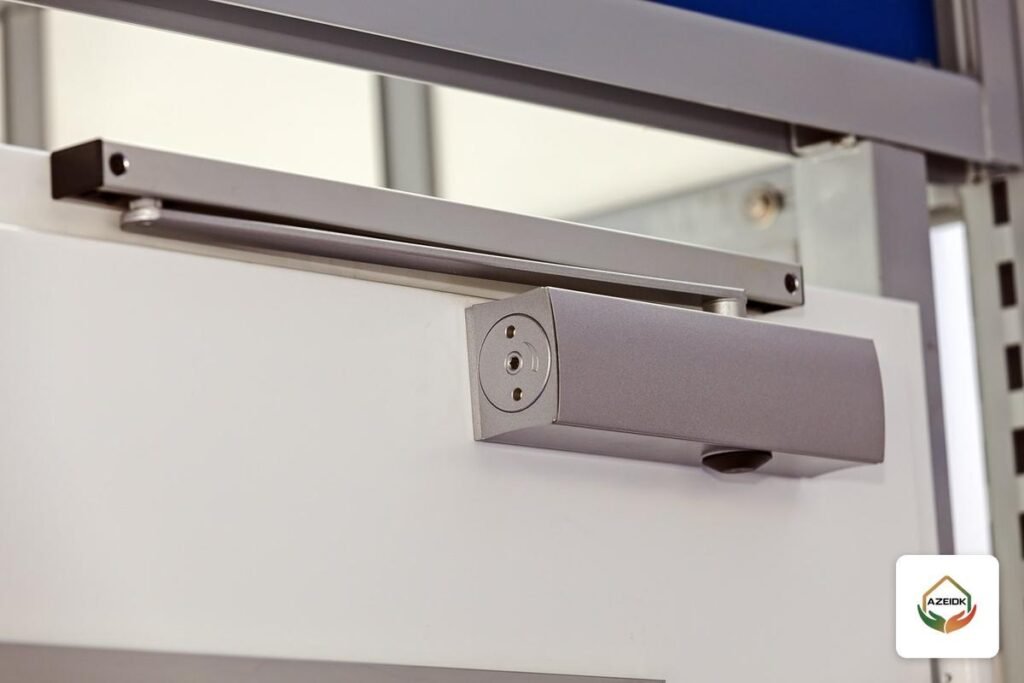
Open the door fully and let go: it must close and latch on its own. If it stops short, check the speed and spring settings, or a leaf rubbing on a sagging frame. Oil leaking from the closer body means it is due for replacement. A replacement must be a closer approved for fire-rated doors and compatible with the door assembly certificate, not whatever is in the store.
Panic hardware
Fire doors use fire exit hardware, not ordinary panic bars. Test it by pushing from the egress side to confirm it opens without a key or unusual effort, then let the door close and confirm the latch projects and engages. Panic bar types and swing direction are covered in Emergency Exit Doors in Saudi Arabia.
Frame and hinges
Check that the steel frame is anchored to the wall, that no dents stop the latch from engaging, and that the frame label is intact. Tighten hinge screws and replace worn hinges with the type and number specified in the door certificate. Holes left by a removed lock or sensor are repaired by the method set by NFPA 80 and the manufacturer’s instructions, not by a cosmetic filler that only hides the hole.
Doors that stay open in daily use
If a fire door has to stay open, use an approved hold-open device that releases the door on a signal from the fire alarm system or a smoke detector, so the door becomes self-closing. During inspection, trigger the signal and confirm the door closes and latches. Wooden wedges, kick-down holders and chains are among the most frequent violations.
Common fire door maintenance mistakes
- Replacing broken fire-rated glass with ordinary glass, which voids the rating of the whole door.
- Painting over the label when repainting the door, so the rating cannot be proved at inspection.
- Fitting an electric lock or door contact through a new hole without checking the door certificate.
- Putting off a closer repair because the door can be closed by hand, when it must close on its own.
- Inspecting without a record, or with an unsigned record, leaving nothing to show the authority.
- Relying on the annual inspection and skipping the re-inspection after maintenance or repair.
How to organize door inspection within a maintenance contract
Add the doors to the asset register with the other fire systems: a number per door matching the drawing door schedule, plus location, rating, closer and lock type. Each deficiency then becomes a work order with a close-out date.
Under AZEIDK’s preventive and periodic maintenance, every visit ends with a report of results, observations and recommended corrective actions, plus an updated maintenance log that can be presented at inspection or licence renewal. The fire-rated doors and emergency exits solution includes periodic door inspection within maintenance contracts and follow-up when repair or replacement is needed, along with supply of Falcon Gold metal fire doors and their hardware. For the difference between scheduled visits and fault repair, see Preventive vs Corrective Fire Maintenance.
Frequently asked questions
How often should fire doors be inspected?
At least once a year under NFPA 80, at 9 to 15 month intervals as defined in the 2025 edition, plus an inspection after installation and after any maintenance or repair.
What are the common faults in fire doors?
A closer that does not finish closing, a latch that does not engage, excessive gaps from sagging hinges, painted labels, open holes, fire glass replaced with ordinary glass, and doors wedged open.
Can a fire door be held open?
Not with a wedge, kick-down holder or chain. It may stay open only on an approved hold-open device that releases automatically on fire alarm or smoke detection, so the door closes and latches by itself.
What does Civil Defense check on doors?
We have not found a published Civil Defense checklist specific to doors. The practical preparation is to make sure the doors match the approved drawings, pass the 13 NFPA 80 items, and have a signed maintenance log ready for inspection or licence renewal.
Who can inspect fire-rated doors in a facility?
A qualified person with knowledge of the door’s components and operation, through certification or training and experience. NFPA 80 does not require a specific certificate, but the authority may ask for proof of expertise.
How long are fire door inspection records kept?
At least three years for periodic inspection records, and for the life of the installation for acceptance test records, unless the authority specifies otherwise.
Can a new lock or sensor be added to an existing fire door?
Only if the item is approved for fire-rated doors and permitted by the door certificate, and the preparation is done by a method the manufacturer accepts. A random hole drilled on site is a field modification that can void the rating.
Conclusion
Fire-rated doors need discipline more than equipment: an annual check of every door against the NFPA 80 items, real clearance measurements, tests of the closer, latch and hold-open device, and a signed record. For any repair, the replacement part must be of a type the door certificate allows, and the door is inspected again afterwards.
Need an annual fire door inspection schedule with records ready for inspection? The AZEIDK team adds your doors to the maintenance contract and gives you a report of findings and a plan to close them. Talk to the AZEIDK team
Related guides
- Fire Extinguisher Price in Saudi Arabia (KSA): What Drives the Price by Type, Capacity and Approval
- Fire Extinguishers in Riyadh: How to Buy the Right Extinguisher for Home, Shop and Facility
- MEP Contractors in Saudi Arabia: MEP Scope, Fire Systems and How to Choose
- Fire Safety Log Book and Maintenance Records for Civil Defense Inspection and Salamah Renewal