A DSPPA public address system comes in three main families: analog systems on 100 V speaker lines for paging and background music, IP network audio systems that stream over the building network, and the PAVA9500 voice alarm and evacuation system that links to the fire alarm panel. Which one fits depends on building size, zoning, and whether you need daily paging only or evacuation messages in a fire. This guide covers each family using the models AZEIDK actually lists under Public Address & Audio Systems, and explains how the fire alarm interface works.
Key takeaways
- DSPPA analog systems such as the DMA6xxxU series suit offices, shops, mosques and small schools: 6 zones and 250 to 650 W.
- The IP network system (MAG6000 series) suits campuses and multi-building sites, scheduling audio to terminals over the building network.
- The PAVA9500 voice alarm host: 8 zones, 500 W or more on a 100 V line, main/backup amplifier switching and speaker line monitoring.
- The fire alarm interface uses dry contact inputs, programmed to the approved cause and effect matrix.
- Voice evacuation requirements come from the adopted code, Civil Defense and the consultant’s specification, so request the equipment certificates they require in the submittal.
In this article
- What is a DSPPA public address system?
- Analog 100 V systems: when are they enough?
- DSPPA IP network audio: when do you need it?
- DSPPA PAVA9500 voice alarm and evacuation system
- How does a DSPPA system interface with the fire alarm?
- Which DSPPA system fits your project?
- DSPPA loudspeakers for each space
- What drives the cost of a DSPPA system?
- How AZEIDK can help
- Frequently asked questions
- Conclusion
What is a DSPPA public address system?
DSPPA specializes in public address equipment: amplifiers and mixers, network audio, voice alarm systems, loudspeakers and conference systems. On Saudi projects a PA system (often called a paging system) is usually specified for three jobs: paging and announcements, background music, and spoken messages in an emergency.
The difference between those jobs is real. A paging and music system can be simple. A voice evacuation system is part of the life safety package and falls under the code, Civil Defense and the consultant’s specification. So the selection starts with one clear question: will the system be used for evacuation in a fire?
Analog 100 V systems: when are they enough?
In an analog system a central amplifier drives loudspeakers on 100 V or 70 V lines. Each speaker has a transformer with power taps that the technician selects on site. The basic rule for this kind of system is that the sum of the speaker taps on an amplifier must not exceed its rated output.
The DSPPA DMA6xxxU series are rack-mounted digital mixer amplifiers with six speaker zones, each with its own volume control, and 100/70 V outputs. The four models, DMA6250U, DMA6350U, DMA6500U and DMA6650U, differ mainly in power (250, 350, 500 and 650 W). They accept microphone, line and emergency (EMC) inputs, include Bluetooth, FM radio and MP3 sources, and have two RJ-45 inputs for remote paging stations.
This is usually enough for offices, shops, restaurants, mosques and small schools that need paging and background music in a few zones. An emergency input does not make the amplifier an approved voice evacuation system; that decision belongs to the consultant and the project requirements.
DSPPA IP network audio: when do you need it?
In a network system, audio travels over the building network to terminals, and each terminal drives the speakers near it. This helps on large or spread-out sites where long speaker runs from one equipment room are impractical.
- MAG6182II: the rack-mounted control center for the MAG6000 series, with a 17.3-inch touch screen. It schedules and routes background music, paging and emergency broadcasts to IP terminals. Per the datasheet it supports fewer than 110 terminals in unicast and an unlimited number in multicast.
- MAG6701: an IP terminal with a built-in 60 W amplifier that drives local 100 V speakers. It has local USB/SD playback and a microphone input, and can run scheduled programs without the server.
This option suits universities and large schools with bell schedules and announcements, multi-building compounds, and large factories. It depends on a sound network, so design it together with the other low current systems from the start.
DSPPA PAVA9500 voice alarm and evacuation system
The DSPPA PAVA9500 is a rack-mounted host that combines an 8-zone amplifier, message player and zone control, with switching between main and backup amplifiers. Key specifications from the official datasheet:
| Item | PAVA9500 |
|---|---|
| Zones | 8 zone outputs; the PAVA9500E expansion unit adds 8 more |
| Output power | 500 W or more (100 V) |
| Line monitoring | Speaker line fault detection: ground fault, open circuit, short circuit |
| Inputs | 2 balanced MIC and 4 LINE, plus an emergency microphone input |
| Voice messages | WAV files on an SD card |
| Dry contacts | 8 inputs and 8 outputs |
| Status relays | System fault relay and emergency mode relay |
| Power | AC 220–240 V and DC 24 V |
It pairs with the PAVA9008 paging microphone for security rooms and reception desks: buttons for up to 16 zones, connected to the host over RJ45 and powered through the same cable, with up to 8 units daisy-chained. The datasheet gives up to 600 m from the host to a single unit, and 300 m when up to three units are cascaded.
The AZEIDK product page does not mention an EN 54 certificate for this host. If the consultant asks for equipment approved to a specific standard, request the certificate from the manufacturer as part of the submittal before supply.
How does a DSPPA system interface with the fire alarm?
The usual interface with the fire alarm system is relay outputs from the fire alarm panel wired to the PAVA9500 dry contact inputs. The typical sequence is:
- The approved cause and effect matrix defines which alarm, in which zone, triggers which message in which zones.
- The fire alarm panel outputs are programmed to close the matching contact on alarm.
- The PAVA9500 receives the signal and broadcasts the evacuation message in the defined zones, overriding paging and background music.
- The host reports fault or emergency status through its relays to the fire alarm panel or control room, as the design requires.
- Every scenario in the matrix is tested at commissioning and handover, and the results are documented.
A common mistake is wiring the system to a single fire alarm output that broadcasts evacuation to the whole building at once, when the design calls for phased evacuation or alert messages in neighboring zones. A second mistake is ignoring the cables: voice evacuation needs fire-resistant cable where the design calls for it, as covered in our article on fire alarm cables and circuit integrity.
For when Saudi projects need voice evacuation and how speech intelligibility is measured, see our voice evacuation systems guide.
Which DSPPA system fits your project?
| Project type | Suitable family | Note |
|---|---|---|
| Shop, office, restaurant or mosque | Analog: DMA6xxxU series | Up to 6 zones, with a remote paging station if needed |
| School or university with bells and announcements | IP network: MAG6000 series | Central scheduling with terminals in each building |
| Mall, hotel, hospital or tower | Voice evacuation: PAVA9500 with PAVA9008 | Fire alarm interface, backup switching and line monitoring |
| Warehouse, factory or car park | Depends on the purpose, with outdoor horn speakers | Choose speakers for noise level and distance |
DSPPA loudspeakers for each space
- DSP903 ceiling speaker: 4.5-inch with a fire-resistant steel back can and built-in line transformer, taps of 3, 6 and 10 W on 100 V, and a 155–158 mm cutout. For corridors and rooms in offices, hotels and hospitals.
- DSP116 wall speaker: 1.5 to 10 W on 100/70 V lines, for spaces without suspended ceilings such as classrooms and mosques.
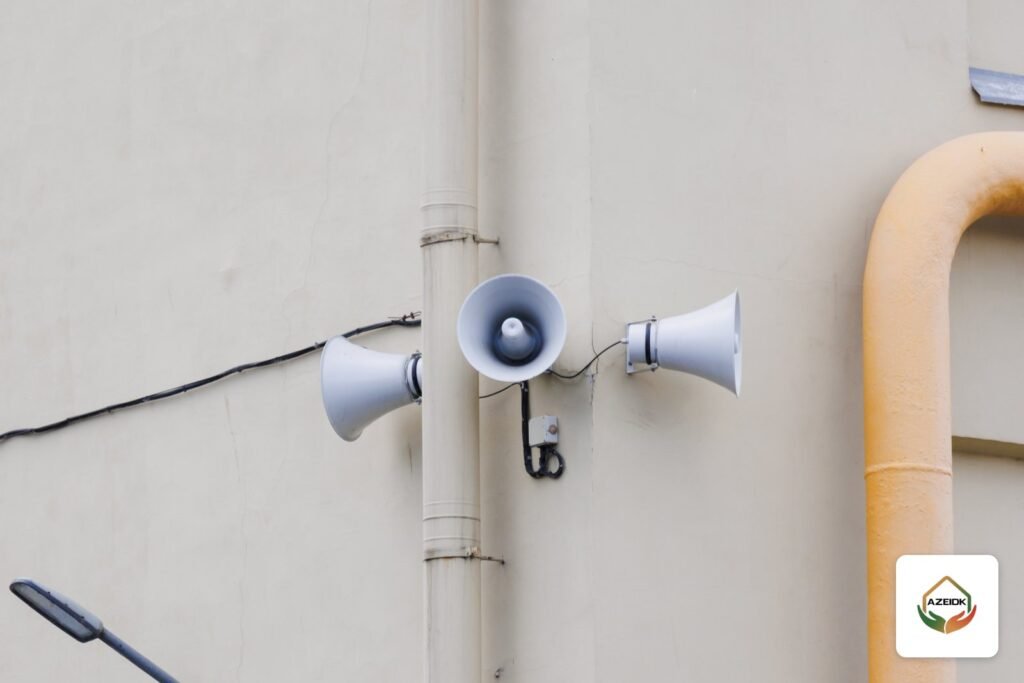
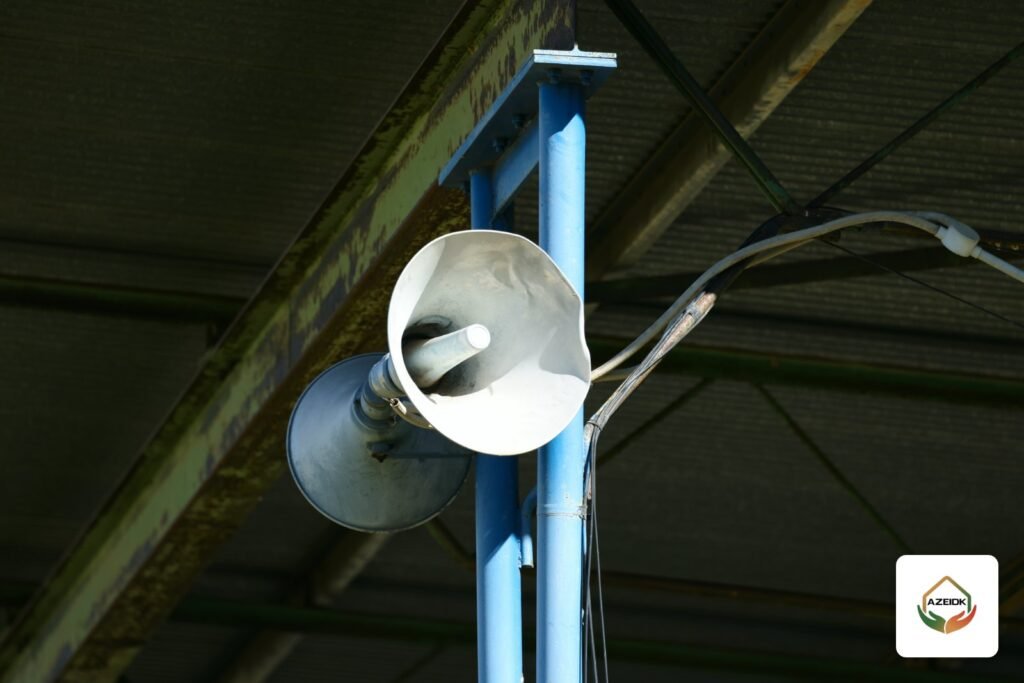
- DSP1650 horn: 50 W with taps of 6, 12.5, 25 and 50 W, rated IP66, for car parks, yards and factories.
Speaker quantity and layout come from an acoustic assessment of each space, not from a fixed number per square meter.
What drives the cost of a DSPPA system?
We do not quote prices because they vary by project. The cost drivers are the number of zones, the number and type of speakers, amplifier power and required backup, the system type (analog, IP or voice evacuation), cable type and lengths, programming of the fire alarm interface, and testing and documentation.
How AZEIDK can help
AZEIDK supplies DSPPA products in Saudi Arabia, with the official datasheet for each model. We review the drawings and the consultant’s requirements, propose the right family, zones and speakers, and handle supply, installation, programming, the fire alarm interface, testing and handover.
Frequently asked questions
What is the difference between a PA system and voice evacuation?
A PA system handles paging, announcements and background music. Voice evacuation broadcasts emergency messages when the fire alarm operates and needs line monitoring, a backup amplifier and a fire alarm interface. The two can be combined if emergency messages take priority and the equipment is accepted for that use.
How many zones does the DSPPA PAVA9500 support?
The host has 8 zone outputs, and the PAVA9500E expansion unit adds 8 more. The PAVA9008 paging microphone has buttons for up to 16 zones.
Can a DSPPA system connect to another brand’s fire alarm panel?
Usually yes, because the interface uses dry contacts that are not tied to a brand. The panel needs enough outputs programmed to the approved cause and effect matrix.
When should I choose IP audio over analog?
When the site is large or has several buildings, when you need central scheduling for bells and announcements, or when long speaker runs are impractical. For shops and small offices, analog is usually enough.
Is voice evacuation mandatory in my building?
That depends on occupancy, height and occupant load under the Saudi Fire Protection Code SBC 801, Civil Defense requirements and the consultant’s specification. Check with your project’s engineering office before design.
Which speaker suits a suspended ceiling?
The DSP903 ceiling speaker is made for suspended ceilings. It fits a 155–158 mm cutout with spring clips and has a fire-resistant steel back can.
Conclusion
A DSPPA public address system is not one product. An analog amplifier covers paging and music in a limited area, IP network audio suits large sites, and when evacuation in a fire is part of the brief, the PAVA9500 with a properly designed fire alarm interface is the family to look at. Define the purpose first, then the zones and speakers, then the certificates the consultant requires.
Need a PA or voice evacuation system for your project? Send us the drawings, building type and consultant requirements, and our team will propose the right system. Talk to the AZEIDK team
Related guides
- Access Control Installation and Commissioning: From Door Survey to Handover
- FirePro in Saudi Arabia: Condensed Aerosol Fire Suppression
- Kitchen Fire Suppression System Price in Saudi Arabia: What Drives the Cost (Hood Length, Appliances, Automatic Gas Shut-off) and How to Compare Quotations
- Fire Alarm Maintenance: Periodic Inspection and Testing Under NFPA 72 and SBC 801