WDR (wide dynamic range) is the camera feature that keeps a face readable when the person stands in front of a bright glass door, a sunlit gate or a lit canopy. Without it, the camera exposes for the bright background and the face turns into a dark silhouette, which is exactly the frame you need after an incident. This guide explains what WDR does, how to read the dB figure on a datasheet, where Saudi sites need it most, and what WDR cannot fix.
AZEIDK supplies and installs Hikvision cameras with published WDR ratings as part of its security and surveillance systems, from site survey to commissioning.
Key takeaways
- WDR keeps detail in bright and dark parts of the same scene, such as a face in front of a glass entrance.
- The rating is published in dB per model: in the Hikvision range AZEIDK supplies, models are listed at 120 dB, 130 dB and 140 dB.
- WDR helps placement; it does not replace it. A camera aimed straight at the sun or a floodlight still struggles.
What does WDR do in a CCTV camera?
A scene has a dynamic range: the gap between its brightest and darkest parts. A lobby with a glass facade at 3 pm has a very wide one: daylight outside, shade inside. A standard exposure picks one level, so either the street is white or the visitor is black. A WDR camera handles both in the same image, so the face at the door and the background stay usable.
This is why our common CCTV installation mistakes guide lists “facing the sun or a glass door” with the result “dark faces on a bright background”, and gives two fixes: change the angle, or use a camera with WDR enabled.
How to read the WDR dB figure
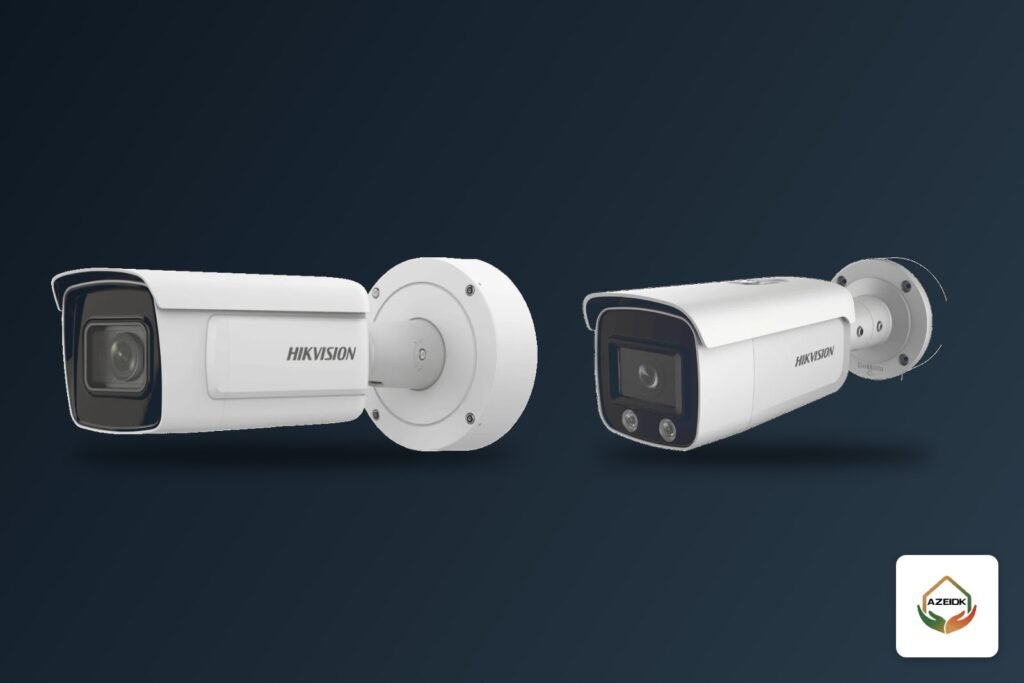
Manufacturers publish WDR in decibels (dB). A higher number means the camera is rated to handle a wider gap between light and shade. Compare the figure for the exact model on its datasheet, not the series name. Examples from Hikvision models that AZEIDK lists:
| Published WDR | Example models | Typical use in our guides |
|---|---|---|
| 120 dB | DS-2CD2T43G2-2I/4I, DS-2CD2363G2-I(U), DS-2CD1743G2-LIZ(S)U | General entrances, corridors, lift cars |
| 130 dB | DS-2CD2T47G2-L, DS-2CD2T87G2-L, DS-2CD2747G2T-LZS, DS-2CD2767G2HT-LIZS | Entrances and car parks where colour at night also matters (ColorVu) |
| 140 dB | iDS-2CD7A46G0/S-IZHSY (DeepinView) | Loading docks and large sites with harsh contrast |
The full model list is in Hikvision 4 MP, 6 MP, 8 MP and PTZ cameras, and the series are explained in Hikvision camera series. Product pages: iDS-2CD7A46G0/S-IZHSY and DS-2CD2T47G2-L ColorVu.
Where Saudi sites need WDR most
- Glass entrances in malls and entertainment centres: strong daytime backlight from the doors; WDR keeps faces from turning black. See entertainment centre CCTV.
- Banks and ATMs: our summary of the bank security requirements lists Full HD with WDR above 120 dB for identification views, and a WDR camera inside the ATM body. See bank and ATM CCTV requirements.
- Fuel stations: canopy lights create glare over the pump islands at night; the answer is WDR cameras positioned so they do not face the floodlights. See CCTV for petrol stations.
- Lift cars: polished panels and ceiling lights reflect into the lens; a small dome with WDR helps. See elevator CCTV.
- Warehouse loading docks: a bright yard behind a dark dock; here WDR matters more than megapixels. See warehouse CCTV.
What WDR cannot fix
- Aiming into the light: a camera pointed straight at the afternoon sun or a floodlight still loses the scene. Move or tilt it first.
- Wrong lens or distance: to identify a face you need enough pixels on it; choose the lens from the identification distance, as in field of view and DORI.
- Darkness: WDR handles contrast, not low light. For night use, see night vision, ColorVu and Starlight.
- Body choice: a bullet, dome or turret changes how sun and rain reach the lens; see dome vs bullet vs turret.
Checklist before you approve an entrance camera
- Write the goal for the view: identify, recognise or detect.
- Note the worst light: the hour when the sun hits the glass, or the night when the canopy lights are on.
- Choose a model whose datasheet states WDR and its dB value, and a lens that gives the required identification distance.
- Mount at a moderate height and tilt toward faces at the pinch point, not toward the sky or the street.
- At commissioning, check that WDR is enabled and review recorded footage taken at the worst hour, not only the live view.
Frequently asked questions
Is a higher WDR dB always better?
A higher published value means the camera is rated for stronger contrast, but placement, lens and settings decide the final image. Compare the dB figure between models only after the view and lens are right.
Does WDR help at night?
Only with contrast at night, such as bright canopy lights next to dark areas. Low light itself is handled by infrared, ColorVu or Starlight technology.
Do indoor cameras need WDR?
Where the subject stands in front of windows, glass doors or bright lights, yes. Lift cars and lobbies are common examples in our guides.
Can WDR be added to an existing camera?
No. It depends on the camera’s sensor and processing. If an existing entrance camera shows dark faces, the fix is a new angle or a WDR model at that point.
Faces at your entrance come out dark? Send AZEIDK photos of the entrance at the problem hour and the current camera model, and our team will propose the right camera, lens and mounting point. Request a quote from AZEIDK
Related guides
- Salamah Certificate for Factories: Fire Alarm, Firefighting and Document Requirements by Industrial Activity
- Temporary Event Requirements in Saudi Arabia: Event Sites, Seasonal Markets, Civil Defense Approval and Fire Resistant Kiosks
- Battery Smoke Alarm or Panel Fire Alarm System? When a Standalone Alarm Is Enough (with SD-425 and RadioLINK Rules)
- Fiber Optic Infrastructure in Buildings (Backbone): Types and Testing