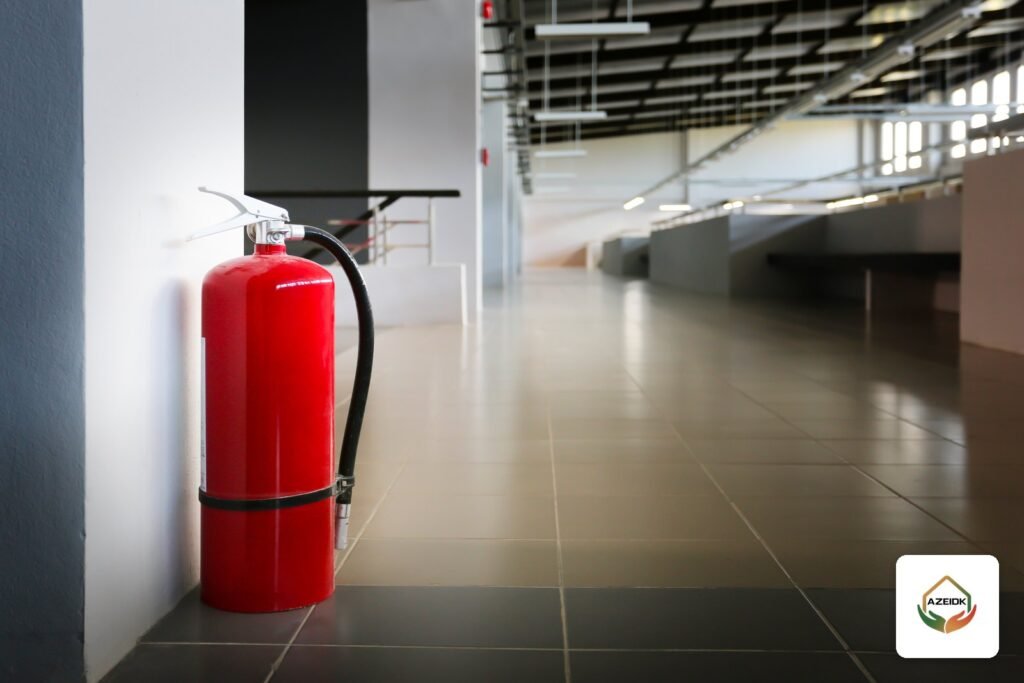
A Salamah certificate for factories is the Civil Defense safety licence issued to an industrial facility through the Salamah platform, and the Ministry of Industry and Mineral Resources requires it for every industrial facility. What it takes to get one depends less on floor area than on the activity and the materials used and stored. Those decide the fire alarm and firefighting systems and the document file. AZEIDK handles these applications through its Civil Defense approval support service.
Short answer: Every factory needs a Civil Defense safety licence, and the municipal requirements for factories list Civil Defense approval with an engineering report as a licensing requirement. The alarm and firefighting systems you need follow from the activity and materials under the Saudi Fire Protection Code (SBC 801), and the licence is valid for one year from issue.
This article explains how a Salamah licence differs from High Commission for Industrial Security (HCIS) approval, how requirements change between an assembly plant and a paint or food factory, and which documents to prepare before you apply.
Key takeaways
- The Ministry of Industry and Mineral Resources requires every industrial facility to hold a Civil Defense safety licence, as Okaz reported in July 2025.
- The Municipal Requirements for Factories (Ministry of Municipalities and Housing, 1447 AH / 2025) require Civil Defense approval and an engineering report confirming the building suits industrial use.
- Clause 4.4 of the same document applies all fire protection requirements of SBC 801 to factories.
- Facilities under HCIS follow its SAF directives. Check separately whether a Civil Defense licence is also needed.
- Salamah separates direct activities (safety tools invoice or technical report) from indirect, high-risk activities (safety company contract, maintenance contracts and inspection).
In this article
- What is a Salamah certificate for factories and who asks for it?
- Do factories need a Salamah licence or HCIS approval?
- How does a Salamah certificate for factories change with the industrial activity?
- Which fire systems does a factory need?
- Do stored materials affect licensing requirements?
- Documents required for a Salamah certificate for factories
- What role does the maintenance contract play in renewal?
- Common mistakes with a Salamah certificate for factories
- How AZEIDK supports factory licensing
- Frequently asked questions
- Conclusion
What is a Salamah certificate for factories and who asks for it?
In the market people say “Salamah certificate” or “Civil Defense licence”. The official document is the safety licence that the General Directorate of Civil Defense issues online through the Salamah platform (salamah.998.gov.sa). For the platform and the naming, see our Salamah certificate guide.
For factories, more than one authority asks for it. The Ministry of Industry requires a safety licence from every industrial facility and, during field visits, looks for safety measures suited to the activity, emergency exits, a fire-extinguishing system and safe storage of raw materials and products. The municipal requirements for factories (clause 2.1) list the municipal licence, commercial registration, industrial licence and the environmental permit from the National Center for Environmental Compliance, then Civil Defense approval with an engineering report.
Do factories need a Salamah licence or HCIS approval?
Most factories follow the general route: the Saudi Building Code, Civil Defense and the Salamah platform. Facilities in sectors supervised by HCIS, such as petroleum, gas, petrochemicals, electricity, mining and chemical industries, apply its Safety and Fire Protection Directives (SAF). The general document SAF-01 requires an HCIS-approved fire protection consultant to prepare the front-end engineering package, then an approved contractor to prepare the installation package, with HCIS reviewing both.
SAF-01 does not mention Civil Defense, so do not assume one approval replaces the other. Confirm with both authorities before design starts. Background is in our HCIS requirements article.
How does a Salamah certificate for factories change with the industrial activity?
Salamah classifies activities by risk, and its “Investor Journey” service shows your classification and what it needs. The platform does not publish one list of systems for all factories: the design under SBC 801, as accepted by Civil Defense, decides. The table below summarises what is usually reviewed for each type. It is a guide, not a substitute for an approved design.
| Activity | Main hazard | Typical detection | Typical suppression | What the file is checked for |
|---|---|---|---|---|
| Assembly and metal workshops | Ordinary combustibles, welding and cutting | Smoke or heat detectors by area, manual call points | Extinguishers, hose cabinets, sprinklers by area and classification | Occupancy classification, hot work permits |
| Paints, oils and chemicals | Flammable liquids | Flame detectors in filling and mixing areas | Foam or foam-water sprinklers, Class B extinguishers | Safety data sheets (SDS), quantities, spill containment |
| Wood, feed and plastics | Combustible dust | Heat detectors in dusty areas | Sprinklers, dust collection, explosion protection per analysis | Dust hazard analysis, housekeeping |
| Food and beverages | Cardboard packaging, frying oils, cold rooms | Detectors suited to humidity and cold | Sprinklers, special suppression for industrial fryers if present | Attached store and packaging materials |
| Electrical and control rooms in any factory | Electrical fire in sensitive equipment | Early detection | Clean agent or condensed aerosol | Cause and effect matrix, HVAC shutdown |
One factory can combine several hazards, so design starts with a hazard analysis for each area, as covered in our factory fire protection engineering guide.
Which fire systems does a factory need?
Detection and alarm
Point smoke detectors do not suit every part of a factory: dust and vapour cause false alarms that disrupt production. Heat detectors are used in dusty areas and flame detectors where flammable liquids are handled. AZEIDK supplies addressable and conventional panels and detectors from Context Plus, with the panel type chosen by zone count and building layout.
Water network and pumps
The water system usually covers sprinklers, hose cabinets and external hydrants, fed by fire pumps sized for the largest demand. Brands available from AZEIDK include Jack Pump fire pumps, and hose cabinets and extinguishers from Falcon Gold.
Foam and special suppression
Flammable liquid areas often need foam, including AFFF concentrates from Safe Guard. Electrical and control rooms are protected with special suppression systems after the room volume and integrity are assessed.
Do stored materials affect licensing requirements?
Yes, directly. Materials set the occupancy classification and hazard level, and so the sprinkler density, water quantity and detector type. Clause 4.5 of the municipal requirements limits the store attached to a factory: medium- and low-hazard materials related to the activity may be stored up to 25% of the total area or 150 m², whichever is less. This rises to 50% if warehousing is added as a separately licensed activity and warehouse requirements are met.
The same document requires fire separation between occupancies per SBC 201 and separation of oil and grease waste from the sewer. A mezzanine may grow from one third to half of the floor if an approved automatic suppression system and audible alarm are installed. If materials or storage height change after licensing, reassess protection before renewal. For stand-alone stores see our Salamah licence for warehouses.
Documents required for a Salamah certificate for factories
This list combines the municipal requirements and the Salamah platform guide. The platform shows what your activity needs, so check it when you apply:
- Valid commercial registration covering the activity.
- Industrial licence from the Ministry of Industry and Mineral Resources.
- Environmental permit from the National Center for Environmental Compliance for construction or operation.
- Proof of site tenure: lease, title deed or investment contract.
- Engineering report confirming the building suits the industrial activity under fire protection requirements.
- Direct activity: safety tools invoice from a qualified safety company, or a technical report from an approved engineering office on the platform.
- Indirect activity: contract with an approved safety company and maintenance contracts, followed by Civil Defense inspection.
- Approved or as-built system drawings, and alarm and firefighting test and commissioning reports.
- Third-party liability insurance where the mandatory scheme covers your activity once applied.
What role does the maintenance contract play in renewal?
The licence is valid for a full year from final approval, and renewal can be requested up to a month before expiry. For indirect activities, renewal depends on a valid maintenance contract with an approved safety company. The contract should name the systems actually installed: alarm, sprinklers, pumps, foam, special suppression and extinguishers, and visit and test records should be kept. Details are in Salamah licence renewal and the maintenance contract, and the factory can be covered by our annual maintenance contracts.
Common mistakes with a Salamah certificate for factories
- Relying on a retail-style safety tools invoice when the activity needs fixed systems and an approved design.
- Designing for floor area while ignoring the materials listed in the safety data sheets.
- Growing the attached store beyond the limit without a separate warehousing licence.
- Installing smoke detectors in dusty areas, then isolating the panel because of false alarms.
- Assuming HCIS approval replaces Civil Defense without checking.
- A generic maintenance contract that does not name the installed systems, or that expires before renewal.
How AZEIDK supports factory licensing
AZEIDK starts by reviewing the activity and its classification on the platform, then assesses the existing systems against the materials and processes and identifies gaps. Design, supply, installation and testing follow, along with the document file and closing out inspection comments. See our work for factories and industrial facilities. The final decision and timing rest with the authority, and no party can guarantee issue.
Frequently asked questions
Do Civil Defense requirements differ by type of factory?
Yes. The activity and materials set the risk classification on Salamah and the systems required under SBC 801. A paint plant usually needs foam and flame detection that an assembly plant does not.
How does an industrial facility obtain a safety licence?
Register on Salamah, check the classification through the Investor Journey, and install the systems. Then submit the invoice or technical report for a direct activity, or the safety company and maintenance contracts for an indirect one, followed by inspection.
How long is a safety licence valid?
One full year from the issue date, per the Salamah platform guide. Renewal can be requested a month before expiry.
Can the commercial licence be renewed without a safety licence?
The municipal requirements for factories list Civil Defense approval as a licensing requirement, so do not plan to issue or renew the municipal licence without it. Keep both renewal dates aligned.
What is the role of the Salamah platform in licensing?
It is the Civil Defense portal where licences are issued, renewed and cancelled, and it links investors with approved safety companies and engineering offices.
How long does it take to obtain a Salamah licence?
There is no single duration anyone can commit to. It depends on the classification, the readiness of systems and documents, and the inspection result. A complete file saves time.
How do I decide which systems my facility needs?
List the materials, processes and storage quantities, then analyse the hazard in each area. That analysis, with SBC 801, sets the alarm and suppression systems, which an engineering office approves before installation.
Conclusion
A Salamah certificate for factories is required by both the Ministry of Industry and the municipality, and the activity and materials decide how demanding it is. Start with the platform classification and a hazard analysis, get the systems ready before the paperwork, and tie the maintenance contract to the installed systems so renewal goes through without delay.
Preparing your factory for a Salamah licence or renewal? Send us the activity, materials and site plan, and we will review the required systems and documents with you before you apply. Talk to the AZEIDK team
Related guides
- General Contracting for Factories and Warehouses in Saudi Arabia: Structure, MEP and Fire Systems Under One Contract
- Water Mist Fire Suppression in Saudi Arabia: Applications and Technical Considerations
- Mini CCTV Cameras: Small Cube and Pan-Tilt Cameras from EZVIZ and Hikvision, Wi-Fi or SD Card, and What Saudi Law Allows
- CCTV Shop in Makkah: Directory of Companies and Shops and How to Check Licensing