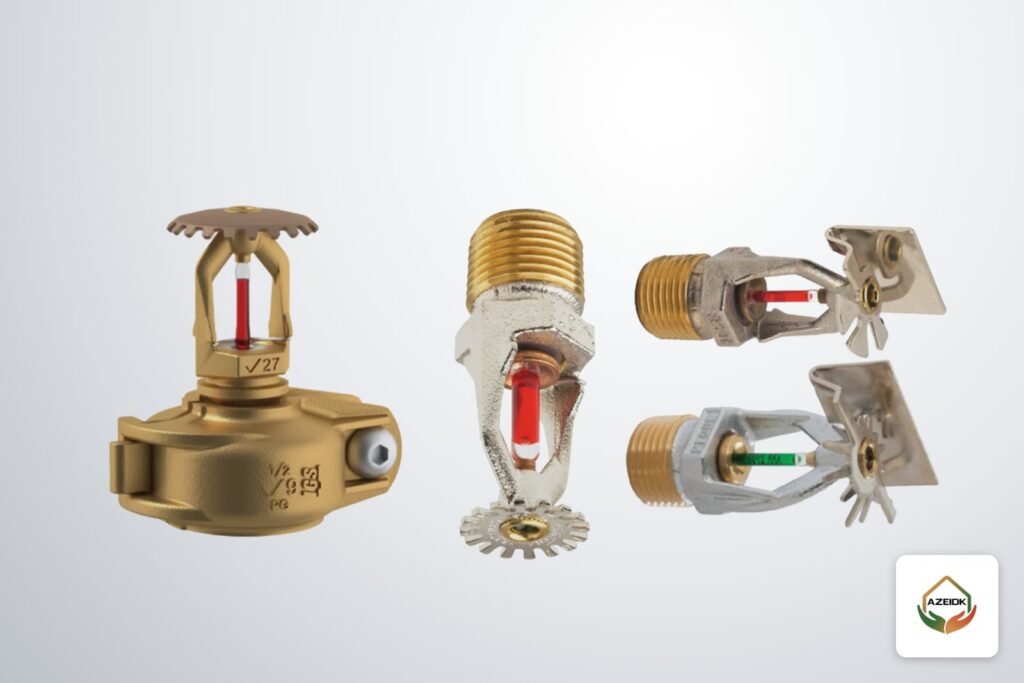
Victaulic sprinkler installation follows the official FireLock Installation and Maintenance Instructions I-40: use the model’s own sprinkler wrench on the wrench boss only, apply two to three wraps of PTFE tape to the male threads only, stay within the maximum torque (19 N·m for 1/2-inch NPT, 27 N·m for 3/4-inch NPT), and leave the bulb protector on until just before the system goes into service.
This article walks through those steps for the Victaulic FireLock models AZEIDK GROUP lists in Saudi Arabia: the V27 sprinklers V2703, V2704 and V2707, the K11.2 storage sprinklers V3403 and V3407, the V4702 ESFR, and the FL-QR/SW horizontal sidewall range. The focus is on the details a consultant or owner checks at handover.
Key Takeaways
- The reference is Victaulic I-40, Installation and Maintenance Instructions for FireLock Automatic Sprinklers (REV Y, updated 04/2024), read together with each model’s datasheet.
- Each family has its own wrench: V27 for V27 sprinklers and the V2710 sidewall, V34 for V3403, V3407 and V3410, V44/V47 for the V4702, and V56 for the V2826 and V4226 sidewalls.
- Maximum assembly torque in I-40: 14 ft-lbs (19 N·m) for 1/2-inch NPT and 20 ft-lbs (27 N·m) for 3/4-inch NPT.
- Never install a sprinkler that was dropped or struck, even if it looks undamaged, and never paint or coat a sprinkler on site.
- Bulb protectors are removed by hand, without tools, before the system is placed in service; the sprinkler cannot operate properly with the protector on.
In this article
- Which Official Document Governs Victaulic Sprinkler Installation?
- Before Installation: Receiving, Storage and Handling
- Which Sprinkler Wrench Fits Each Model?
- Thread Sealant and Torque for Victaulic Sprinkler Installation
- Installation Steps in Order
- When Should the Bulb Protector Be Removed?
- Escutcheons, Ceiling Holes and Guards
- Why Victaulic Sprinklers Must Not Be Painted or Cleaned with Chemicals
- Installation Mistakes That Fail Acceptance
- Pre-Acceptance Checklist
- Replacing a Victaulic Sprinkler After Operation or Damage
- Victaulic FireLock Sprinklers from AZEIDK GROUP
- Frequently Asked Questions
- Conclusion
Which Official Document Governs Victaulic Sprinkler Installation?
Victaulic publishes a single installation and maintenance manual for its FireLock automatic sprinklers, I-40. It covers storage and handling, thread sealant, torque, the wrench table, bulb protectors, escutcheon hole sizes, painting and replacement.
The manual does not replace the datasheet. Approved temperature ratings, deflector-to-ceiling distances, the approved escutcheon and UL/FM status all vary by model and configuration. Start from the product page: Victaulic FireLock V27 K5.6 sprinklers, FL-SR/ST K11.2 storage sprinklers V3403 and V3407, V4702 ESFR pendent and FL-QR/SW horizontal sidewall sprinklers.
I-40 requires FireLock sprinklers to be used in systems designed and installed to NFPA 13 or equivalent, FM or VdS standards where they apply, and local building and fire codes. In Saudi Arabia that means the Saudi Fire Protection Code SBC 801 and the approved project documents. Installers should be trained and experienced.
Before Installation: Receiving, Storage and Handling
Most sprinkler rejections on site start before the sprinkler reaches the pipe. I-40 requires the following:
- Store sprinklers in a cool, dry place in the original packaging; do not empty them into bags or buckets.
- Do not handle a sprinkler by its deflector.
- Do not install any sprinkler that has been dropped or struck by another object, even if it shows no damage.
- Do not install a glass-bulb sprinkler with a cracked bulb or fluid loss; discard damaged or corroded sprinklers.
- Verify model, orifice (K-factor) and temperature rating before installation.
Install each sprinkler only in its intended orientation. The V3403 is upright and the V3407 is pendent, even though both are K11.2.
Which Sprinkler Wrench Fits Each Model?
Victaulic sprinklers are not installed with an adjustable or pipe wrench. I-40 assigns each family a wrench that engages the wrench boss without loading the frame, deflector or bulb. For the models on the AZEIDK site:
| Model | Type | Open-end wrench | Recessed wrench |
|---|---|---|---|
| V2703 / V2704 | Upright K5.6 | V27 (ST01000000) | Not applicable |
| V2707 | Pendent or recessed pendent K5.6 | V27 (ST01000000) | V27-2 (ST12000002) |
| V3403 | Upright storage K11.2 | V34 (ST02000000) | Not applicable |
| V3407 | Pendent storage K11.2 | V34 (ST02000000) | V34 Recessed (ST22000000) |
| V4702 | ESFR pendent K16.8 | V44/V47 (ST92000800) | Not applicable |
| V2826 / V4226 | Horizontal sidewall K2.8 / K4.2 | V56 (S325390000) | V56-2 (S325391000) |
| V2710 | Horizontal sidewall K5.6 | V27 (ST01000000) | V27-2 (ST12000002) |
| V3410 | Horizontal sidewall K8.0 | V34 (ST02000000) | V34 Recessed (ST22000000) |
For models supplied with an IGS grooved inlet instead of a thread, the connection is made with the Style V9 coupling and its 3/16-inch hex bit (J000V09000), following the V9 instructions. For grooved joints in general, see grooved coupling installation.
Thread Sealant and Torque for Victaulic Sprinkler Installation
How much PTFE tape goes on a sprinkler thread?
I-40 calls for two to three wraps of tape or a non-hardening pipe-joint compound on the male threads only. Sealant must not enter the orifice or touch the bulb or seal. Nothing goes on the fitting’s female thread, and any loose tape is trimmed before make-up.
What is the maximum torque for Victaulic sprinklers?
Thread the sprinkler in by hand, then finish with the correct wrench. I-40 sets these maximum assembly torques:
| Thread (NPT) | Maximum torque | AZEIDK models with this thread |
|---|---|---|
| 1/2-inch | 14 ft-lbs / 19 N·m | V2703, V2704, V2707, V2826, V4226, V2710 |
| 3/4-inch | 20 ft-lbs / 27 N·m | V3403, V3407, V3410, V4702 |
| 1-inch | 30 ft-lbs / 41 N·m | None of the listed models |
The instruction is to tighten securely enough to prevent leakage without exceeding these values. The table is written for NPT; for BSPT versions (15 or 20 mm) check the model datasheet. Over-torque distorts the frame or stresses the bulb; under-torque shows up as a leak during the hydrostatic test. For leak causes after commissioning, see fire sprinkler leaks.
Installation Steps in Order
- Depressurize and fully drain the piping, including any isolated branch or section, before installing, removing or adjusting.
- Inspect the sprinkler: no cracked bulb, no fluid loss, no bent frame or deflector.
- Recessed models: install the recess collar and tighten it fully against the wrench boss.
- Apply sealant to the male threads only.
- Hand-thread in the correct orientation, then tighten with the designated wrench on the wrench boss, within the maximum torque.
- Recessed models: center the escutcheon and push it onto the collar until it contacts the ceiling or wall.
- Where required, install the sprinkler guard after the sprinkler is installed and before the system is tested.
What changes for horizontal sidewall sprinklers?
The FL-QR/SW product page requires horizontal installation only, with the waterway axis perpendicular to the wall and the word TOP on the deflector facing up. The deflector-to-ceiling distance comes from the model’s approval table. For selection, see Victaulic sidewall sprinklers.
When Should the Bulb Protector Be Removed?
FireLock sprinklers ship with plastic bulb protectors. I-40 states that sprinklers cannot operate properly with protectors installed, so they must be removed from all sprinklers before the system is placed in service, carefully by hand and never with tools on glass-bulb sprinklers.
The manual allows removal immediately after installation for all upright sprinklers and for any sprinkler more than 10 ft (3 m) above the floor. Lower pendent and sidewall sprinklers keep their protectors through ceiling and finishing work, followed by a dedicated removal round before commissioning. This item belongs on the snag list before handover.
Escutcheons, Ceiling Holes and Guards
A recessed or concealed sprinkler and its escutcheon are not chosen separately. As quoted in the QRFS references below, NFPA 13 (2022) requires escutcheons used with recessed, flush-type or concealed sprinklers to be part of a listed sprinkler assembly. NFPA 25 (2023) requires a missing listed escutcheon on these sprinklers to be replaced with the listed part, and the sprinkler to be replaced if that part is no longer available.
I-40 also gives ceiling hole sizes per escutcheon style. For semi-recessed escutcheons the hole is 51 mm minimum and 60 mm maximum, matching the V27 product page for the recessed V2707 (51 to 60 mm hole, escutcheon about 75 mm in diameter). A larger hole leaves a gap around the sprinkler; a smaller one stops the escutcheon from seating.
Guards go on after the sprinkler is seated and before testing: engage the guard tabs in the recess between the wrench boss and the threads, then tighten the two screws evenly without damaging the frame, deflector or bulb. For guard and escutcheon types, see sprinkler head guards and escutcheons.
Why Victaulic Sprinklers Must Not Be Painted or Cleaned with Chemicals
I-40 is explicit: do not paint, coat, plate or alter sprinklers. It states that alterations, including painting and coating, void the Victaulic warranty and impact system integrity. Protect sprinklers before ceilings are painted. If the project needs a colored finish, order a factory finish such as white or black polyester from the model’s options.
Do not clean sprinklers with soapy water, detergents, ammonia or other chemicals; remove dust with a soft, dry cloth. Do not hang or attach anything to a sprinkler, and do not test sprinklers with a heat source.
Installation Mistakes That Fail Acceptance
- Sprinklers installed with a pipe or adjustable wrench, leaving marks on the frame or deflector.
- PTFE tape visible inside the orifice, or compound on the bulb.
- Leaks at the hydrostatic test from under-torque, or a distorted frame from over-torque.
- Upright sprinklers installed pendent or vice versa, or a sidewall with TOP facing down.
- An escutcheon that does not match the model, or a ceiling hole outside the specified range.
- Bulb protectors left on after commissioning.
- Paint or overspray on sprinklers from finishing work.
- Temperature rating or K-factor different from the approved drawings, especially in storage and ESFR areas.
Pre-Acceptance Checklist
| Item | What to check | Reference |
|---|---|---|
| Match | Model, K-factor, temperature, response and finish as per drawings and submittal | Approved drawings and datasheet |
| Condition | No cracked bulbs, distortion, corrosion or paint | I-40 |
| Orientation | Upright, pendent or sidewall as designed; TOP up on sidewalls | I-40 and datasheet |
| Escutcheon | Listed escutcheon for the model, in contact with ceiling or wall | Datasheet and NFPA 13 |
| Protectors | Removed from every sprinkler before service | I-40 |
| Leakage | No leaks at joints after testing | NFPA 13 and the AHJ |
I-40 also reminds installers that the whole system is tested after installation per NFPA 13, NFPA 25 or equivalent and the authority having jurisdiction, and that a successful test does not replace correct installation and maintenance. For flushing, hydrostatic and main drain tests, see sprinkler system acceptance tests.
Replacing a Victaulic Sprinkler After Operation or Damage
An operated sprinkler is never reassembled or reused. Replace it with a new sprinkler of the same type, orifice, temperature rating and response. Replacement starts by taking the system out of service and notifying the AHJ, then relieving pressure, removing the sprinkler with the correct wrench, installing the new one with the same steps and checking for leaks. After a fire, inspect the whole system and replace sprinklers exposed to corrosive products or high temperatures.
Victaulic FireLock Sprinklers from AZEIDK GROUP
AZEIDK GROUP supplies the Victaulic FireLock sprinklers listed on its Saudi product pages as part of its fire fighting systems, with the datasheet and installation instructions for each model, and provides testing, commissioning and handover. Before final approval, check the latest Victaulic documents for the required configuration and its approval status. For details of the V27 models and their response types, see Victaulic V27 sprinklers.
Frequently Asked Questions
What torque should a 1/2-inch sprinkler be tightened to?
Victaulic I-40 sets a maximum of 14 ft-lbs (19 N·m) for FireLock sprinklers with 1/2-inch NPT threads. Tighten enough to prevent leakage without exceeding that value.
Can PTFE tape be used on sprinkler threads?
Yes. I-40 allows two to three wraps of tape or a non-hardening pipe-joint compound on the male threads only, kept away from the orifice and bulb.
Can a Victaulic sprinkler be installed with a pipe wrench?
No. Each family has a designated wrench, such as V27, V34 or V56, that engages the wrench boss without loading the frame, deflector or bulb.
When should the plastic bulb protector be removed?
Before the system is placed in service, by hand and without tools. It may be removed right after installation on upright sprinklers or on any sprinkler more than 3 m above the floor.
Can sprinklers be painted with the ceiling?
No. Victaulic prohibits painting, coating or altering sprinklers; it voids the warranty and impacts system integrity. Order the required color as a factory finish.
Can I install a sprinkler that was dropped but looks fine?
No. I-40 says not to install any sprinkler that has been dropped or struck, even if it does not appear damaged.
Conclusion
Installing a Victaulic sprinkler takes minutes, but the details are specific: the right wrench for the model, sealant on the male thread only, torque within the limit, correct orientation, a listed escutcheon and protectors removed at the right time. Checking these during installation costs far less than removing and reinstalling sprinklers after handover comments.
Preparing to install Victaulic sprinklers on your project? Send us the models, quantities and approved drawings, and we will supply the sprinklers with the datasheets, installation instructions and the correct wrench for each model. Contact the AZEIDK GROUP team
Related guides
- CO2 Fire Suppression System: Total Flooding vs Local Application, NFPA 12 Life Safety, and When to Choose It Over FM-200
- Mosque Speakers in Saudi Arabia: Indoor, Outdoor, Amplifier and Zoning
- Hotel Access Control: Staff Areas, Stores, Lift Card Control and CCTV Integration
- CCTV Camera Placement & Coverage