Mosque speakers are really two separate systems: indoor speakers that carry the imam’s and the khateeb’s voice clearly to every row inside the prayer hall, and outdoor speakers on the minaret or roof that carry the adhan to the area around the mosque. An amplifier, a mixer and microphones tie them together. In Saudi Arabia, use of the outdoor speakers is governed by instructions from the Ministry of Islamic Affairs, Dawah and Guidance, so the system should be designed to make following them easy. This article explains what a mosque sound system is made of and how it is designed and installed, as part of AZEIDK low current systems.
Key takeaways
- Keep the indoor speaker output separate from the outdoor speaker output, on the amplifier or a zone selector, so each can be controlled on its own.
- Put the outdoor speakers on their own zone with a switch and a fixed level, so their use can follow the current Ministry of Islamic Affairs instructions, which the mosque administration obtains from the ministry branch.
- Clarity inside the prayer hall comes from speaker layout and aiming, not from turning the amplifier up.
- The women’s prayer area, courtyards and annexes need their own zones with clearly labelled switches.
- A normal mosque sound system is not a fire voice evacuation system. If evacuation is required, it has its own design and approval.
In this article
- What makes up a mosque sound system?
- Indoor mosque speakers: how does the imam’s voice reach every row clearly?
- Outdoor mosque speakers: a separate zone at a set level
- Amplifier and mixer: how to choose
- Can the mosque sound system be used for fire evacuation?
- Common mistakes with mosque speakers
- Choosing a mosque sound system step by step
- Frequently asked questions
- Conclusion
What makes up a mosque sound system?
Every mosque sound system, from a small neighbourhood masjid to a large jami, follows the same chain: a sound source (microphone), then mixing and processing, then amplification, then distribution to speakers through zones. Mosques differ in the number of zones, amplifier power and speaker types, not in the basic idea.
| Component | Role in the mosque | What to watch |
|---|---|---|
| Mihrab microphone | The imam’s voice during prayer | A fixed gooseneck microphone close to the mouth, or a clip-on wireless microphone for an imam who moves |
| Minbar microphone | Friday khutbah and lessons | Its own mixer input so its level is set apart from the mihrab microphone |
| Adhan microphone | Calling the adhan and iqama | Preferably routed to the outdoor speaker zone |
| Mixer or control unit | Mixing inputs and tone control | Separate control per input, and low-frequency cut to reduce boom under domes |
| Amplifier | Powering the speakers | Enough power for all speakers plus a reserve margin, with separate outputs or a zone selector |
| Indoor speakers | Main hall, women’s area, annexes | Column or ceiling speakers depending on ceiling height and shape |
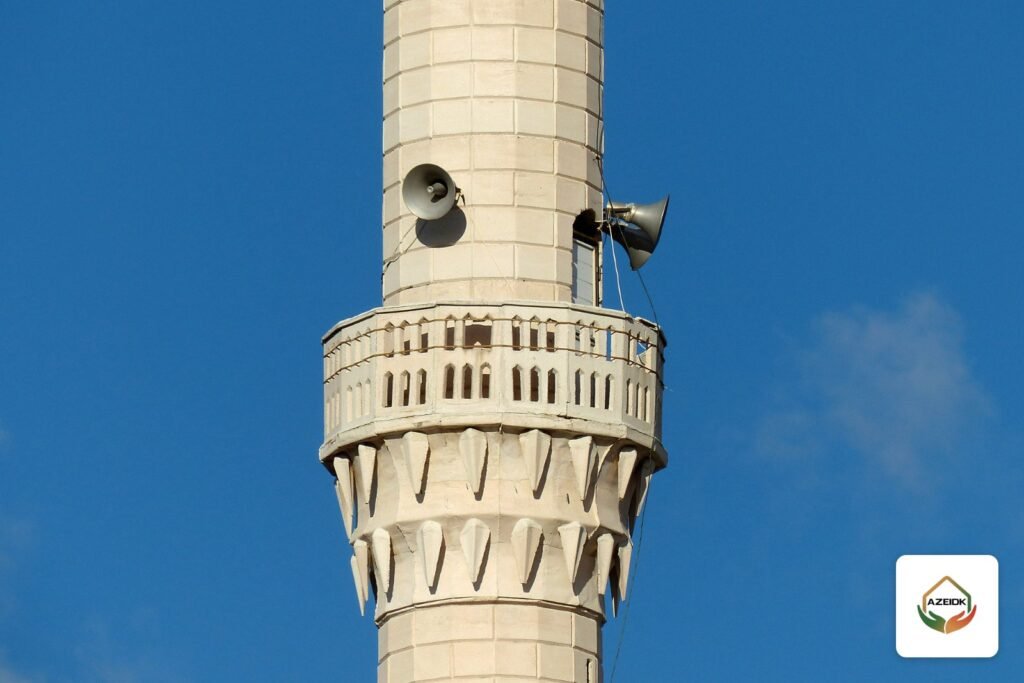
| Outdoor horn speakers | Minaret or roof | Resistant to heat, dust and rain, and aimed with care toward the mosque’s surroundings |
Indoor mosque speakers: how does the imam’s voice reach every row clearly?
The most common complaint in mosques is not weak sound but echo: words blur in the back rows even though the sound is loud. Most prayer halls are large rooms with hard surfaces (marble, gypsum, glass) and a dome or high ceiling, so sound reflects and arrives late. The fix starts with speaker choice and layout:
- Column speakers: mounted on columns or side walls at a suitable height, they aim sound horizontally at the worshippers instead of spreading it into the dome. They are the usual choice in high-ceiling mosques.
- Ceiling speakers: suited to low or suspended ceilings such as corridors, the women’s prayer area and annexes, laid out on a regular grid to avoid dead spots.
- Layout before power: more speakers at a lower level give better clarity than two large speakers at the front running loud.
- Women’s prayer area: its own zone with its own switch and level, because its size and height usually differ from the main hall.
The number and position of indoor speakers are set after visiting the mosque and measuring its dimensions and ceiling type, which is what a technical site inspection and assessment covers before any supply.
Outdoor mosque speakers: a separate zone at a set level
Outdoor speakers raise most of the questions because their use and level are governed by instructions from the Ministry of Islamic Affairs, Dawah and Guidance, and those instructions can be updated. We do not quote them here; the mosque administration should obtain the current instructions from the ministry branch in its region. The designer’s and contractor’s job is to make following them easy in daily use.
In engineering terms, the system must allow three things:
- Outdoor speakers on their own zone that can be switched on and off by themselves, while indoor speakers keep running.
- A fixed level for the outdoor zone at the required limit, so it does not change when the hall is turned up.
- A clear, labelled switch for the muezzin, so compliance does not depend on whoever happens to run the system.
Horn speakers are the usual outdoor choice because they project sound in a defined direction and withstand outdoor conditions. One example is the Hikvision DS-QAZ1307G1T-E outdoor horn speaker listed in AZEIDK’s products. Choose the number and direction of horns to suit the mosque’s surroundings, and do not add horns to make up for a lower level.
Amplifier and mixer: how to choose
Mosque amplifiers are usually 100V line types, as used in public address systems, because they let many speakers run on long cable runs, and each speaker has a tap that sets the power it draws. When selecting, check:
- Total speaker load: add up the selected tap power of every speaker and choose an amplifier that covers it with a reserve margin per the datasheet.
- Number of zones: main hall, women’s area, courtyard, outdoor speakers, and annexes such as the ablution area or lesson room where needed.
- Microphone inputs: one each for the mihrab, minbar and adhan, with room for a wireless microphone.
- Power supply: power cuts during prayer are a recurring problem, so plan a suitable backup source if the mosque needs one.
A good amplifier with a zone selector is what makes daily compliance with the instructions easy. See the public address and audio systems AZEIDK supplies, including DSPPA and Hikvision products.
Can the mosque sound system be used for fire evacuation?
Not automatically. A normal sound system is built for prayer and sermons, while a voice evacuation system is linked to the fire alarm panel, plays pre-recorded messages, has its cabling and amplifiers monitored, and has its own design and approval. If the mosque sits inside a larger building or complex that requires voice evacuation, the system is designed as a voice alarm system from the start, such as the DSPPA PAVA9500 voice alarm and evacuation host. More detail is in voice evacuation alarm systems and on the fire alarm systems page.
Common mistakes with mosque speakers
- Turning up the amplifier to fix echo, which makes the blur worse.
- Indoor and outdoor speakers on the same output, so the outdoor ones cannot be switched off during prayer.
- A few large speakers at the front, leaving the back rows unclear.
- Outdoor horns aimed straight at neighbouring homes.
- Exposed cables or unprotected joints on the roof, damaged by heat and dust.
- Unlabelled switches, so settings change with every new muezzin or imam.
Choosing a mosque sound system step by step
- Survey the mosque: dimensions, ceiling height, dome, women’s area, courtyards, minaret.
- Define the zones: main hall, women’s area, courtyard, outdoor, annexes.
- Choose the speaker type for each zone and lay it out on the drawing.
- Size the amplifier from the total tap load plus a reserve margin.
- Specify the microphones and mixer inputs.
- Set levels after installation and fix the outdoor zone level in line with the current instructions.
- Hand over a simple layout drawing and labelled switches to the imam and muezzin.
These steps run through technical selection of systems and equipment and then installation and implementation.
Frequently asked questions
Who decides when a mosque’s outdoor speakers are used?
It is governed by Ministry of Islamic Affairs instructions, which the mosque administration obtains from the ministry branch. The system’s job is to let the outdoor zone be switched on and off by itself.
How is the level of mosque outdoor loudspeakers set?
The outdoor zone level is fixed and kept independent of the indoor level, at the level the current ministry instructions call for, and the setting is documented so it does not drift as mosque staff change.
What are the best indoor speakers for a mosque?
No single type suits every mosque. Column speakers suit high-ceiling halls, ceiling speakers suit low ceilings and annexes, and the final choice follows a site survey.
Why is there echo in the mosque even with new speakers?
Echo comes from hard surfaces, the dome and ceiling height, and it grows as the amplifier is turned up. More speakers at a lower level, aimed at the worshippers, reduce it.
How much amplifier power does a mosque need?
It is calculated from the total power of the speakers at their selected taps, plus a reserve margin per the datasheet. There is no fixed figure for every mosque.
Can the mosque sound system serve as a fire alarm?
Not directly. Voice evacuation is linked to the fire alarm panel and has its own monitoring and approval requirements, so it is designed as a separate system or a dedicated voice alarm system.
Conclusion
A good mosque sound system is built on a clear split: indoor speakers laid out for a clear imam’s voice, and outdoor speakers on their own zone at a level set in line with the current Ministry of Islamic Affairs instructions. Start with the survey, then the zones, then the amplifier, and never treat echo by turning the volume up.
Fitting out a new mosque or reorganising an existing system? The AZEIDK team can help with the survey, speaker and amplifier selection, and installation. Talk to the AZEIDK team
Related guides
- CO2 Fire Suppression System: Total Flooding vs Local Application, NFPA 12 Life Safety, and When to Choose It Over FM-200
- Salamah Certificate for Malls and Shopping Centres: Building Licence, Tenant Shops and Who Is Responsible
- CCTV Commissioning: Testing Views, Retention, Night Vision, User Rights and Handover
- Fire Extinguisher Parts and What Each One Does: Cylinder, Valve, Handle, Safety Pin, Gauge, Siphon Tube, Hose and Nozzle