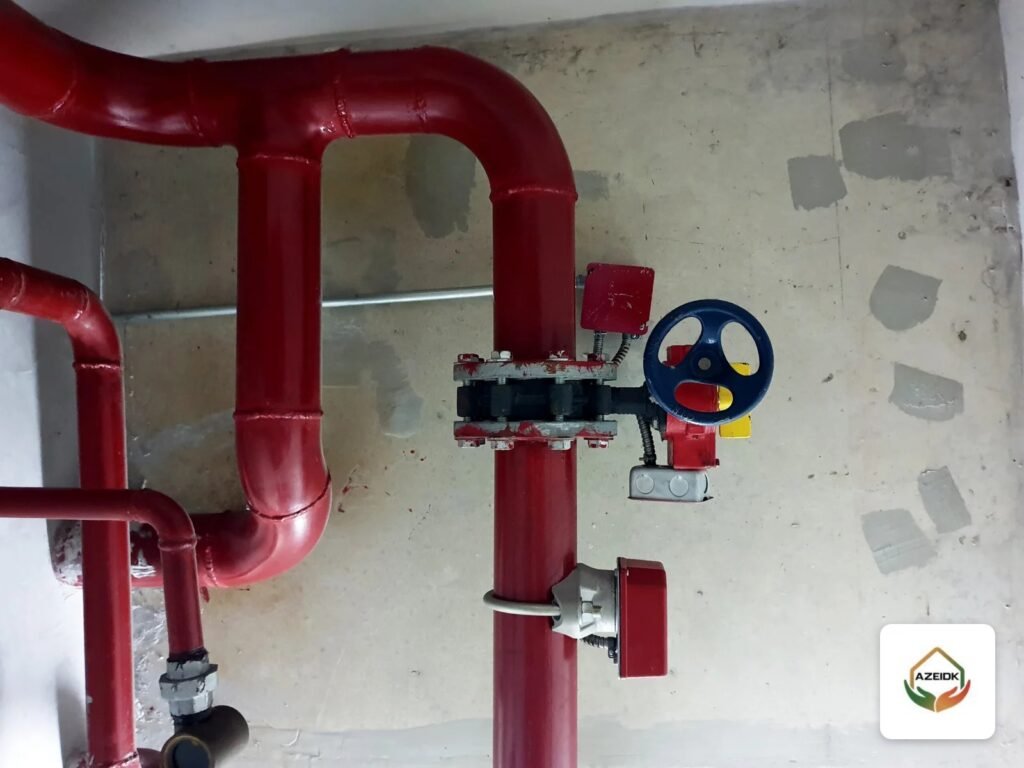
Grooved coupling installation looks quick: groove the pipe end, fit the gasket, tighten two bolts. Yet many leaks found in grooved fire networks at pressure testing trace back to a step done wrong: a groove out of tolerance, a dirty pipe end, a dry gasket where lubrication was needed, or a coupling not tightened until its bolt pads meet.
This guide follows the installation steps set out in manufacturers’ instructions for sprinkler and hose systems, from choosing the grooving method to the visual check before the hydrostatic pressure test. AZEIDK supplies LUYUAN ductile iron grooved fittings and Shurjoint couplings, and carries out installation through its installation service.
Key takeaways
- Roll grooving forms the groove without removing metal and, according to Victaulic, is used on roughly 90% of grooved pipe today. Cut grooving removes wall material and is preferred for very thick walls, lined or coated pipe and some materials such as ductile iron.
- Groove dimensions are checked against the coupling manufacturer’s own table, not a generic one.
- The surface between groove and pipe end must be free of indentations, projections, weld seam anomalies and roll marks.
- On installation-ready couplings, tightening stops at visible metal-to-metal contact of the bolt pads, without exceeding the maximum torque.
- Every joint is inspected visually before filling and testing, and faulty joints are corrected before service.
Roll grooving or cut grooving?
Victaulic explains that roll grooving cold-forms the groove without removing any pipe material, is faster and needs no cutting oil or swarf cleanup. Cut grooving removes material from the outside diameter.
| Item | Roll groove | Cut groove |
|---|---|---|
| Method | Presses the wall inward, no metal removed | Removes metal from the outside surface |
| Typical use | Roughly 90% of grooved pipe today | Very thick walls, lined or coated pipe, some materials such as ductile iron |
| Site cleanliness | No swarf, no cutting oil | Cutting oil and swarf cleanup |
| Reference | The coupling manufacturer’s groove table, including permitted wall thickness for each method | |
Saudi fire networks usually use Schedule 10 and Schedule 40 pipe, covered in our fire pipe guide. Check the manufacturer’s table before grooving to confirm the wall suits the chosen method.
Grooved coupling installation steps on site
1. Prepare the pipe end
Cut the end square and remove sharp edges. Clean off oil, grease, loose paint, dirt and cutting particles. Victaulic’s instructions for the FireLock Style 009V require the outside surface between the groove and the pipe end to be generally free of indentations, projections, weld seam anomalies and roll marks, since this is where the gasket seats.
2. Groove and measure
Set the grooving tool for the pipe size and wall, then measure groove diameter and, where required, maximum flare against the manufacturer’s table. The LUYUAN catalogue includes roll groove dimension tables, and Victaulic refers to its own specification publication. If dimensions are out of tolerance, rework the end per the grooving tool manual. Never fit a coupling on a non-conforming groove.
3. Paint and finish
Victaulic notes that pipe should be grooved before painting. If it was painted first, check that the coating survived grooving, remove damaged paint from the gasket seating area and keep coating thickness there within the manufacturer’s limit.
4. Check and lubricate the gasket
Confirm the gasket suits the service using the manufacturer’s colour code. For the 009V, lubrication is not required on wet systems installed and operating at or above -18°C with a new gasket. Dry systems, low-temperature service, air tests and reused gaskets need a thin coat of compatible lubricant on the sealing lips, never in excess. Rules differ by model, so read the instructions for the exact coupling.
5. Assemble and tighten
Insert both pipe ends until they touch the gasket centre leg and check visually that the coupling keys sit in the grooves. Tighten the nuts by the method the instructions specify, stopping at visible metal-to-metal contact of all outside mating surfaces at the bolt pads, and never above the maximum torque in the manufacturer’s tables.
Visual inspection before the pressure test
Victaulic treats visible contact at all outside mating surfaces as the indication of correct torque and assembly, and notes that inside surfaces will not meet, which is expected. Checklist for every joint before filling:
- Visible metal-to-metal contact at every bolt pad on every joint.
- Oval bolt necks seated in their holes.
- No bent bolts, bulged nuts or damaged pads. These mean over-torque, and the whole coupling must be replaced.
- No coupling left partially assembled on pipe ends.
- Gaskets and bolts of the specified model when reassembling.
Flushing and the documented pressure test follow, as described in our sprinkler acceptance tests guide.
Common grooved installation mistakes
| Mistake | Likely result | Prevention |
|---|---|---|
| Groove deeper or shallower than the table | Leak or joint separation under pressure | Measure every groove against the manufacturer’s table |
| Dirty or heavily painted pipe end | Leak at the gasket | Clean the gasket seat and groove before painting |
| Incompatible or excessive lubricant | Gasket damage or roll-out | Use the specified lubricant in a thin coat |
| Uneven or excessive tightening | Uneven gaps or cracked pads | Tighten only to metal-to-metal contact and inspect |
| Working on a pressurised system | Risk to the fitter and joint damage | Depressurise and drain before removal or adjustment |
Choosing the right fittings for the project
Before installation, the submittal should settle the coupling type: rigid for straight runs that need stiffness, or flexible where movement or expansion must be absorbed. The LUYUAN range supplied by AZEIDK includes rigid and flexible couplings, elbows, tees, mechanical tees and grooved flanges. Its catalogue states that most products are listed or approved by bodies including UL and FM, while approval must be checked for each model and size. For brand detail see LUYUAN grooved fittings and Shurjoint grooved couplings. The topic matters most for warehouses and factories with long pipe runs.
Frequently asked questions
What is the difference between roll grooving and cut grooving?
Roll grooving forms the groove without removing metal and is the most common method. Cut grooving removes wall material and is preferred for thick walls, lined or coated pipe and materials such as ductile iron.
When do I stop tightening a grooved coupling?
On installation-ready couplings, at visible metal-to-metal contact of the outside mating surfaces at the bolt pads, without exceeding the maximum torque in the manufacturer’s table.
Does a grooved coupling gasket need lubrication?
It depends on the model and system. Some models need none on wet systems with a new gasket but need a thin coat of compatible lubricant on dry systems and reused gaskets.
Should pipe be painted before or after grooving?
Victaulic recommends grooving before painting. If pipe was painted first, remove damaged paint from the gasket seating area.
What are the signs of over-tightening?
A bent bolt, bulged nut or damaged bolt pad. The whole coupling should then be replaced.
Can I use a gasket from another model during maintenance?
Not advisable. Manufacturers specify the gasket for each model, and damaged parts should be replaced with parts for the same model.
Conclusion
The quality of a grooved joint is decided long before the wrench: the right grooving method for the pipe, a groove within the manufacturer’s table, a clean end and a suitable gasket lubricated as the model requires. Then comes tightening to metal-to-metal contact and a visual check of every joint. In Saudi Arabia the binding references are the Saudi Fire Protection Code SBC 801 and Civil Defense requirements, and manufacturer instructions are part of the product’s listing.
Preparing to supply or install a grooved network? Send us the bill of quantities and pipe sizes, and we will propose suitable models with datasheets and the approval status of each. Contact the AZEIDK team
Related guides
- Foam Monitors for Tank Farms, Loading Racks and Ports: Fixed or Portable, Manual or Automatic, and How They Connect to the Foam Tank and Pump
- CO2 Fire Suppression System Maintenance: Cylinder Weighing, Lockout Valve, Hose Testing and Monthly to Annual Checks
- Motion Detector for Burglar Alarms (Indoor PIR): Hikvision DS-PDP15P, Ajax Superior MotionProtect and Paradox PMD75M
- CCTV Monitor: Choosing Size, Resolution, HDMI or VGA and 24/7 Operation for Shops and Offices