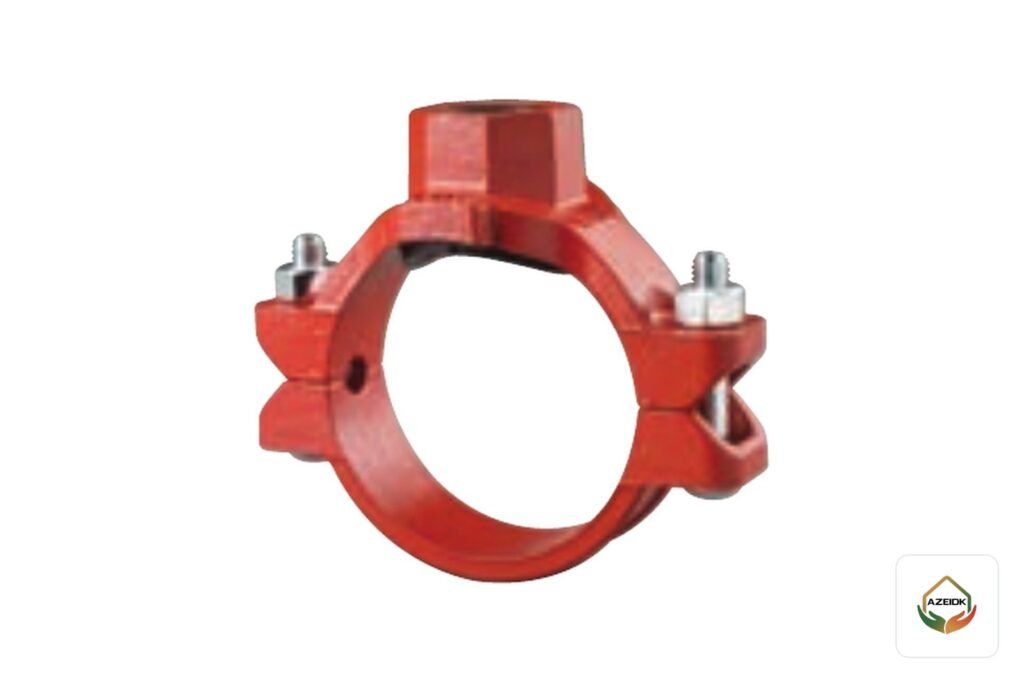
A mechanical tee takes a branch from the middle of a fire protection pipe without welding and without cutting the pipe to install a full tee. A round hole is cut in the pipe wall, then a two-piece housing with a gasket and two bolts is clamped around it. In Saudi Arabia AZEIDK supplies the Shurjoint Model 7721 mechanical tee with threaded outlet, rated at 300 psi (20 bar) UL/FM working pressure according to the Shurjoint catalogue.
This article covers when a mechanical tee is the right choice, how to read the size table, and the installation mistakes that cause leaks.
Key takeaways
- Shurjoint 7721: ductile iron housings, grade E moulded gasket, heat-treated carbon steel track bolts and nuts.
- Catalogue sizes run from 2 inch to 8 inch mains, with branches from ½ inch to 4 inch depending on the main size.
- The outlet is female threaded; the catalogue also lists a grooved-outlet model, so confirm availability with AZEIDK before specifying it.
- The hole is cut with a hole saw to the diameter in the table, never with a torch.
- The 300 psi rating is based on standard wall carbon steel pipe.
What a mechanical tee is and when to use one
The traditional way to add a branch on an existing line is to cut the pipe, fit a grooved, welded or threaded tee, and reconnect. A mechanical tee replaces that with one hole in the pipe wall. The upper housing carrying the outlet sits over the hole, the lower housing wraps the pipe from below, and two bolts are tightened.
Typical uses in fire protection networks:
- Sprinkler branches: taking a branch line or a sprinkler drop off the floor main.
- Device points: adding a pressure gauge, flow switch, drain or test line on an existing pipe.
- Changes in existing buildings: relocating sprinklers after a fit-out or adding a new area, with a short drain-down and less hot work.
We cover the stages of adding sprinklers to an occupied building in sprinkler retrofit for existing buildings; mechanical tees are among the most used fittings in that work.
How the Shurjoint 7721 works
Per the Shurjoint catalogue, the tee consists of an upper housing with the threaded outlet, a lower housing, a moulded gasket around the hole, a locating collar that drops into the hole to position the outlet, and two bolts with nuts. Tightened to the correct torque, the outlet housing makes metal-to-metal contact with the outside of the pipe and the gasket seals around the hole.
The catalogue notes that bolt pad gaps are normal as long as they are equal on both sides. A gap on one side and contact on the other means the fitting is cocked and must be corrected.
Reading the mechanical tee size table
Sizes are written as run x branch, so 4 x 1 inch is a 1 inch branch on a 4 inch main. Examples from the Model 7721 table:
| Size (run x branch) | Suggested hole diameter | Take-out T | Working pressure |
|---|---|---|---|
| 2 x 1 in (50 x 25 mm) | 1.50 in (38 mm) | 2.00 in (51 mm) | 300 psi |
| 3 x 1¼ in (80 x 32 mm) | 2.00 in (51 mm) | 2.80 in (71 mm) | 300 psi |
| 4 x 2 in (100 x 50 mm) | 2.50 in (64 mm) | 3.38 in (86 mm) | 300 psi |
| 6 x 2½ in (150 x 65 mm) | 2.75 in (70 mm) | 4.37 in (111 mm) | 300 psi |
| 8 x 4 in (200 x 100 mm) | 4.50 in (114 mm) | 5.24 in (133 mm) | 300 psi |
- Hole size follows the branch size, not necessarily the bore of the outlet. Values are suggested diameters with a plus-only tolerance.
- Dimension T is the distance from the centre of the run to the end of the pipe engaged in the outlet. Shop drawing teams need it to cut sprinkler drops accurately.
- Pressure: 300 psi is based on standard wall carbon steel pipe. For other pipe, refer to the catalogue and the listing.
Before ordering, prepare four items for each point: run and branch size, the thread type the specification requires for the branch, the pipe type and schedule (the catalogue rating assumes standard wall), and the quantity per size from the bill of quantities. This avoids the most common supply error: the right branch size on the wrong run size.
The full table is in section 1 of the Shurjoint full line catalogue (AZEIDK brand page).
Mechanical tee or grooved tee?
| Item | Mechanical tee | Grooved tee |
|---|---|---|
| Pipe preparation | One hole in the wall | Cut the pipe and groove both ends |
| Joints on the run | One fitting | A tee and at least two couplings |
| Best for | Branches clearly smaller than the run; additions on existing lines | Branches at or near run size; direction changes in the original design |
| Outlet | Threaded (7721); a grooved-outlet model is in the catalogue | Grooved |
Use the mechanical tee for branches clearly smaller than the main, and a full grooved tee when the branch approaches the main size or sits on a primary route. For other grooved products from the same maker see our Shurjoint grooved piping guide.
Installation steps from the catalogue, and leak causes
- Location: the hole goes exactly on the pipe centreline, or the locating collar will not seat.
- Cutting: use a hole saw of the diameter in the table. The catalogue prohibits torch cutting.
- Cleaning: remove rough edges and check the pipe surface within ⅝ inch (16 mm) of the hole for a smooth finish with no indentations or projections, and the area under the housing (dimension A) for dirt or scale.
- Assembly: seat the collar in the hole and tighten the nuts alternately until the outlet housing contacts the pipe, with equal bolt pad gaps.
- Branch: use a suitable thread sealant on the threaded branch and confirm the thread type on the order.
Common causes of leaks at the hydrostatic test: an oversized hole, cutting debris left in or around the hole, heavy paint left under the gasket, and uneven tightening. These checks are part of AZEIDK’s installation inspection before testing.
Approvals and Civil Defense requirements
In Saudi Arabia the binding requirements are the Saudi Fire Code SBC 801 and Civil Defense rules; most specifications adopt NFPA 13 as the technical reference for sprinkler piping details. Consultants usually ask for the fitting to be listed or approved for fire service at the size and pressure used. Check the model and size in the official UL and FM directories and include the catalogue page in the submittal. See UL Listed vs FM Approved.
FAQ
What is a mechanical tee in fire protection piping?
A fitting that takes a branch from the middle of a pipe through a hole in its wall, without cutting or welding, clamped with two housings and two bolts.
What is the pressure rating of the Shurjoint 7721?
300 psi (20 bar) UL/FM according to Shurjoint, based on standard wall carbon steel pipe.
Is there a mechanical tee with a grooved outlet?
The Shurjoint catalogue lists a grooved-outlet model for branches continued with a grooved coupling. The current AZEIDK page covers the threaded 7721, so ask the team about the grooved option before writing the specification.
Can the hole be cut with a torch?
No. The catalogue requires a hole saw of the specified diameter and smooth edges, because rough edges damage the gasket.
What is the largest branch a mechanical tee can take?
In the 7721 table, up to 4 inch on 6 and 8 inch mains, and up to 3 inch on a 4 inch main.
Can I use a mechanical tee to add sprinklers in an existing building?
Yes, it is one of its main uses, provided the change is approved by the consultant, installed to the drawings and tested afterwards.
Summary
A mechanical tee saves real time on branches and alterations, but it depends on an accurate hole, a clean surface and even tightening. Pick the size from the catalogue table, use dimension T in the shop drawings, and verify the listing before supply. The rest of the network is covered under AZEIDK fire fighting systems.
Need mechanical tees for your project? Send the run and branch sizes and the thread type, and we will send the matching Shurjoint models with catalogue pages for your submittal. Contact the AZEIDK team
Related guides
- Fire System Supply and Installation Contract Template: Clauses to Settle Before Signing (Scope, Drawings, Approvals, Testing and Handover, Warranty)
- Halon Extinguisher: Why It Was Phased Out and What Replaces It in Saudi Arabia
- CCTV Storage and Bandwidth Calculation for NVR Systems
- Falcon Gold vs SFFECO Fire Hose Reel Cabinets: Material, Doors, Mounting and Reel Compared