A restaurant fire maintenance contract differs from a maintenance contract for an office building, because the most critical system in a restaurant needs a visit at least every six months: the hood suppression system. When a brand has ten or more branches across several cities, maintenance stops being a set of separate visits and becomes a schedule to manage: which branch was visited and when, which fusible links were replaced, which extinguisher needs refilling, and which certificate Civil Defense will ask for at renewal.
For what any contract should cover before you sign, see our fire system maintenance contract guide for Saudi Arabia.
This article sets out what a contract should cover for one restaurant or a chain, the schedule for each system, and how reports are organised to support licence renewals. AZEIDK provides preventive and periodic maintenance and corrective maintenance and technical support for fire systems in restaurants and commercial kitchens.
Key takeaways
- Hood suppression is serviced at least every 6 months by a qualified firm, with fusible links replaced annually, as fire authority guides based on NFPA 96 and NFPA 17A summarise.
- Exhaust duct inspection and cleaning has its own NFPA 96 schedule (Table 11.4) by cooking volume: monthly for solid fuel, quarterly for high volume, semi-annually for moderate, annually for low.
- One contract covers fire, safety and alarm systems; CCTV and low current are a separate contract.
- For chains, the contract rests on an asset register per branch, one visit schedule and one report format for every branch.
- Any hood system discharge is followed by cleanup, recharge and reset before the kitchen reopens.
In this article
- What does a restaurant fire maintenance contract cover?
- Maintenance schedule by system
- How is a multi-branch contract managed?
- What happens when a branch hood system discharges?
- Menu or appliance changes: when does the system need modifying?
- Maintenance and licence renewal
- What should a maintenance quotation include?
- FAQ
- Conclusion
What does a restaurant fire maintenance contract cover?
For a single branch, the contract usually covers the following, depending on what is actually installed:
- Hood suppression: cylinder, nozzles and caps, fusible links, cables, manual pull station and gas shut-off valve.
- Fire extinguishers: wet chemical Class K in the kitchen; powder or CO2 in dining, stores and at electrical panels.
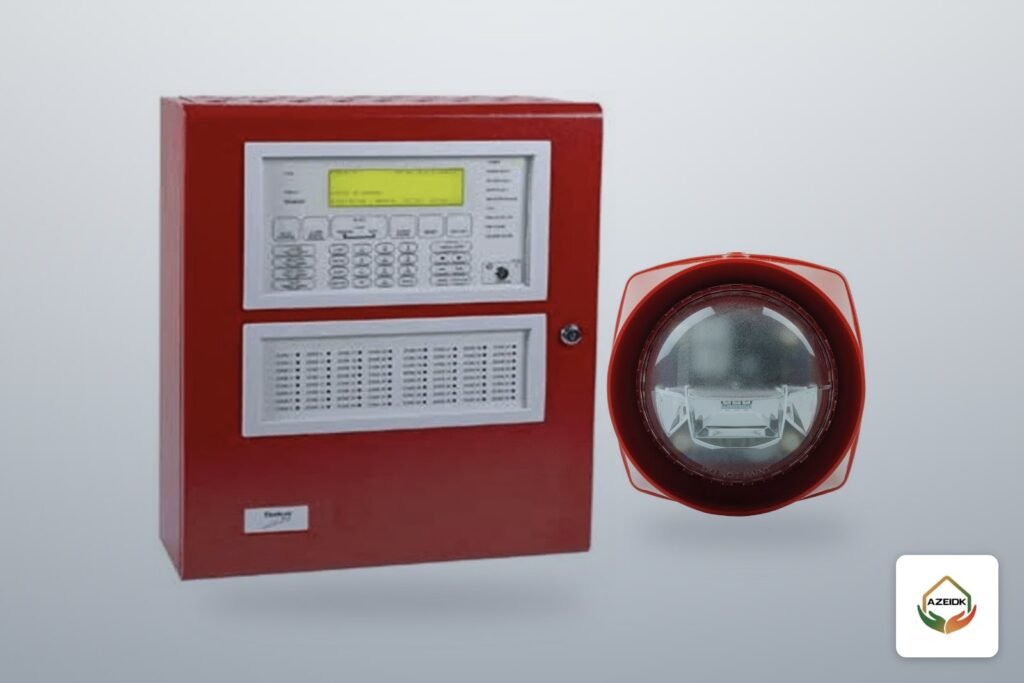
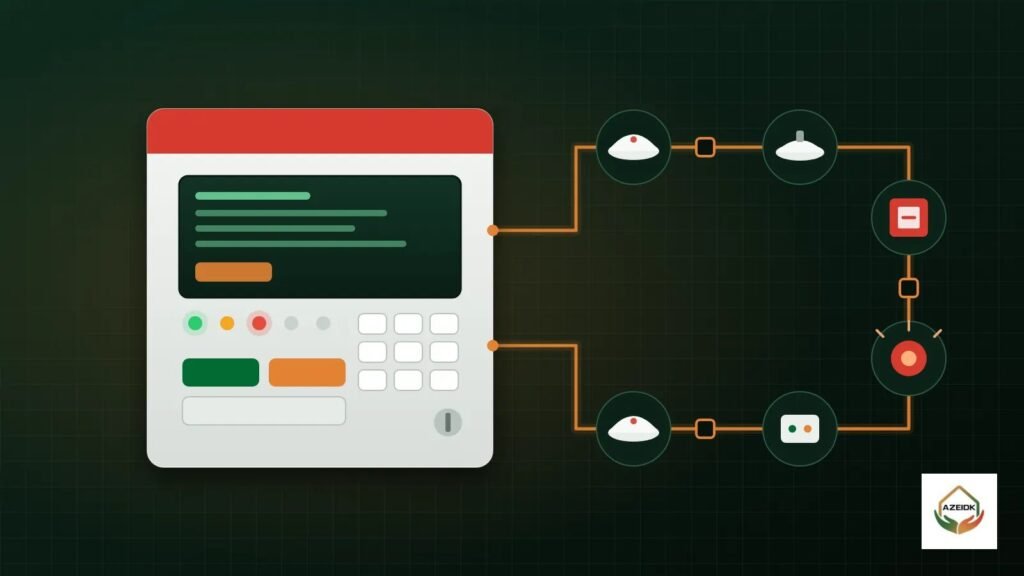
- Fire alarm: panel, detectors, manual call points, sounders and beacons, and the hood system signal.
- Emergency lighting and exit signs.
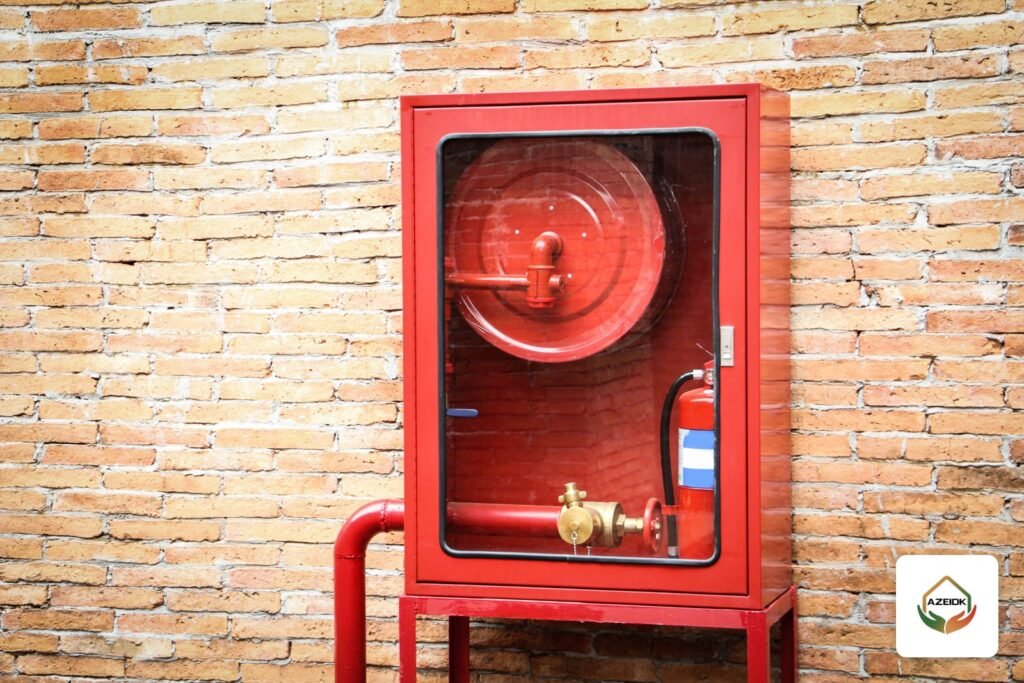
- Sprinklers and hose cabinets where present in the unit.
- Gas leak detectors and their shut-off valves.
Under AZEIDK’s contract structure, fire, safety and alarm systems sit in one contract, while CCTV and low current systems are a separate contract, even when the same restaurant needs both.
In small branches without an alarm system or sprinklers, the contract centres on the hood system, extinguishers and emergency lighting, but the frequency does not drop, because the kitchen is still the hazard. Branches inside malls also send their reports to mall management as the lease requires.
Maintenance schedule by system
| System | Frequency | Work done |
|---|---|---|
| Hood suppression | At least every 6 months | Cylinder and pressure, nozzles and caps, cables, manual release, gas shut-off test |
| Fusible links | Annually | Replace with links of the temperature rating in the system manual |
| Exhaust duct cleaning (NFPA 96) | Monthly to annually by cooking volume | Done by a specialist cleaning crew; its report is filed with the maintenance record |
| Fire extinguishers | Monthly inspection, annual maintenance | Pressure, seal, hose, weight and refill as needed |
| Fire alarm | Per NFPA 72 and manufacturer instructions | Test detectors, call points, sounders and the hood system signal |
| Emergency lighting | Periodic test | Run on battery and confirm duration |
The hood system and fusible link frequencies and the duct cleaning schedule come from the Kansas State Fire Marshal summary based on NFPA 96 (Table 11.4) and the International Fire Code, applied together with the system manufacturer’s instructions. The six-monthly inspection is detailed in kitchen suppression inspection and maintenance, and extinguisher service in fire extinguisher maintenance and refill.
How is a multi-branch contract managed?
The problem for chains is not the inspection itself but the administration: branches opened at different times with systems from different brands, branch managers who change, and licences renewing on different dates. A good contract solves this with four elements:
- An asset register per branch: hood system type and brand (Ansul, Hood Safer, American Fire Control or others), nozzle count, fusible link rating, number and type of extinguishers, and the alarm panel.
- One visit schedule: grouped by city, with agreed work hours that do not stop the kitchen, such as before opening or after closing.
- One report format: each branch gets a report of what was checked, replaced and needs repair, with tag photos and the next visit date.
- An emergency route: a contact line and an agreed response time in the contract for discharges and faults.
What happens when a branch hood system discharges?
After any discharge, from fire or error, the kitchen stays closed until the agent is cleaned up, the system recharged and its fusible links replaced, then the system and gas valve are reset manually and tested. This is outside the periodic visit and falls under corrective maintenance; the steps are in kitchen suppression recharge after discharge. The contract helps by fixing the response time and who supplies parts that match the system brand.
Menu or appliance changes: when does the system need modifying?
Chains change menus often: a fryer is added, a griddle becomes a charcoal grill, or an appliance moves under the hood. Hood suppression is designed for specific appliances and positions, so any change can leave an appliance outside nozzle coverage. The contract should require the maintenance team to be told before any cook line change, so coverage is checked and nozzles adjusted or an added system recommended. For non-standard appliances see shawarma and grill restaurant fire suppression.
Maintenance and licence renewal
Maintenance reports and inspection certificates are what each branch relies on when renewing its Salamah certificate and municipal licence. The chain’s head office should therefore keep an electronic copy of each branch report, sorted by licence expiry date. Renewal requirements are covered in Balady licence renewal.
What should a maintenance quotation include?
To compare maintenance offers fairly, ask every bidder to state the same items:
- The branch list and systems covered in each branch, with extinguisher numbers and types and the number of hood systems.
- The frequency of each visit and the work done, including annual fusible link replacement and gas shut-off testing.
- What the contract value includes and what is charged separately, such as recharge after discharge and spare parts.
- Emergency response time in each city.
- The report format after each visit, and who receives it at the branch and head office.
- How systems from different brands across branches are handled, and the availability of matching spare parts.
The cheapest offer that leaves out fusible link replacement or gas shut-off testing can cost more at the first incident. Comparing on the same scope is what makes the price difference meaningful.
FAQ
How often are restaurant kitchen suppression systems serviced?
At least every six months by a qualified firm, with fusible links replaced annually, as fire authority guides based on NFPA 96 and NFPA 17A and manufacturer instructions state.
Does the fire maintenance contract include kitchen duct cleaning?
Duct cleaning is separate work by a specialist crew on the NFPA 96 schedule; its report goes into the maintenance file because grease build-up affects the system.
Can CCTV and fire systems be in one contract?
At AZEIDK, the fire, safety and alarm contract is separate from the CCTV and low current contract, even for the same client.
Do all branches need the same schedule?
The core frequency is the same, but duct cleaning varies with cooking volume; a 24-hour or grill-heavy branch needs shorter intervals.
What if a branch adds a new fryer or grill?
Tell the maintenance team before use so nozzle coverage is checked and the system modified if needed, then tested and the drawing updated.
Does AZEIDK service fire extinguishers under the contract?
Yes. AZEIDK services fire extinguishers with its own maintenance team as part of its preventive and periodic maintenance contracts.
Conclusion
A restaurant fire maintenance contract works when it is built around the hood system and its six-monthly schedule first, then extinguishers, alarm and emergency lighting. For chains, a single register and one report format for every branch matter as much as the inspection itself, because that record is what you rely on after an incident and at licence renewal.
Running a restaurant or a chain? Send us your branch list, cities and the systems in each branch, and we will prepare one maintenance schedule and a clear contract scope. Talk to the AZEIDK team
Related guides
- Hotel Access Control: Staff Areas, Stores, Lift Card Control and CCTV Integration
- CCTV for Companies and Offices: Entrances, Reception, Server Rooms and Permissions
- Falcon Gold in Saudi Arabia: Fire Cabinets, Doors & Equipment
- Fire Pump UL and FM Approval: How to Check the Certificate and Model Before You Buy