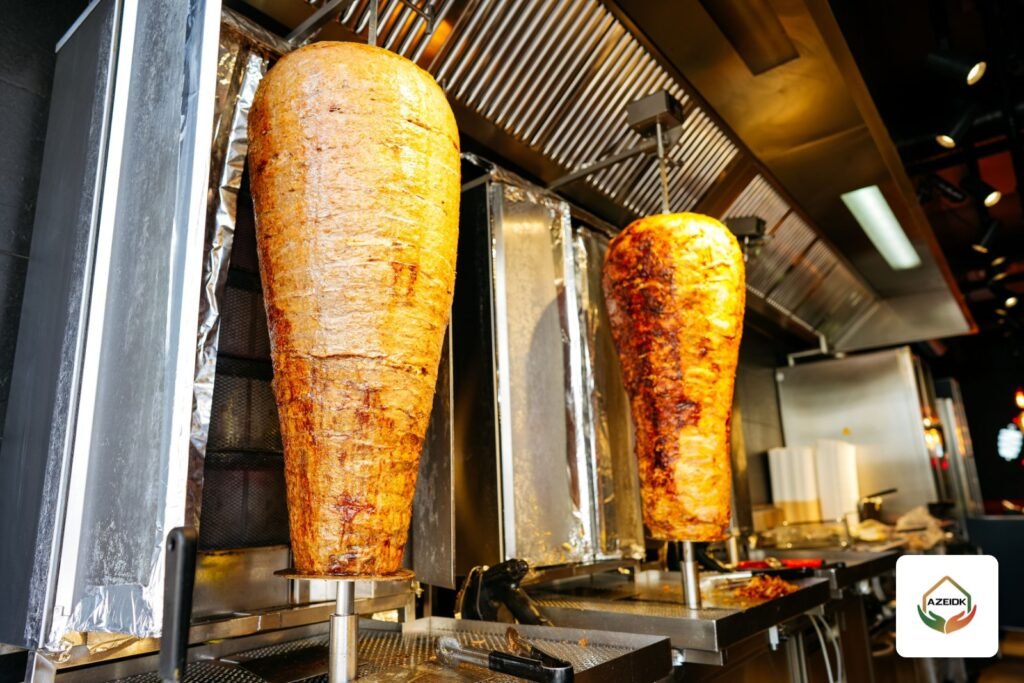
A shawarma restaurant fire suppression system is a wet chemical system installed on the kitchen hood and duct, and it has to cover every appliance under the hood with a nozzle chosen for that appliance’s type, size and position, as set out in the design manual of a system listed to UL 300. Fryers, griddles, charcoal char-broilers and upright broilers are named in the manufacturers’ data sheets. The vertical shawarma broiler and the tannour (the traditional bread oven) are not named in the documents we reviewed, so their coverage needs written confirmation from the manufacturer before drawings go for approval.
Key takeaways
- Each appliance under the hood needs its own coverage from the system design manual. One general nozzle “for the kitchen” is not enough.
- The ANSUL R-102 data sheet and the American Fire Control catalog both name fryers, griddles, charcoal and gas char-broilers, upright and chain broilers, and woks.
- The vertical shawarma broiler and the tannour are not named in either document, so ask the manufacturer for written confirmation.
- Charcoal and wood appliances fall under a separate NFPA 96 chapter on solid fuel cooking operations, with extra rules for fuel and ash.
- Adding an appliance or rearranging the cook line means the system must be re-evaluated before cooking resumes.
In this article
- Why shawarma and grill restaurants need a different approach
- Which appliances do the manufacturers’ documents name?
- Shawarma restaurant fire suppression: what to confirm for the vertical broiler
- Protecting charcoal grills and the tannour: solid fuel rules
- Adding a broiler or rearranging the cook line
- Preparing a grill restaurant for Civil Defense approval
- Frequently asked questions
- Conclusion
Why shawarma and grill restaurants need a different approach
A typical restaurant cook line has fryers, a griddle and a range. Every known kitchen suppression system covers those. Shawarma shops, grill houses and traditional bakeries in Saudi Arabia are different. Under one hood you may find a gas or electric vertical shawarma broiler, an open charcoal grill, a tannour for bread and a fryer for fries. Each one has a different heat source, a different point where grease drips, and a different height below the filters.
A wet chemical system does not “flood the whole area”. Every nozzle has a type, distance, angle and aim set by the listed design manual, and every appliance has a nozzle that covers it. Protection for these restaurants therefore starts with an accurate appliance list, not just the hood length. General system components are covered on our kitchen fire suppression systems page. This article focuses on the non-standard appliances.
Which appliances do the manufacturers’ documents name?
The table is based on two published documents: the ANSUL R-102 data sheet (form F-2004004-09) and the American Fire Control kitchen fire suppression catalog (form AFC-3292). The R-102 data sheet states that the system is UL listed and meets UL 300, and that it meets NFPA 17A and NFPA 96. The AFC catalog states that testing was carried out in accordance with UL 300 and UL 1254. “Not named” does not mean the appliance cannot be covered. It means coverage has to be confirmed from the design manual or by the manufacturer.
| Cooking appliance | ANSUL R-102 (F-2004004-09) | American Fire Control (AFC-3292) | What to check |
|---|---|---|---|
| Fryer | Named | Named, including split vat fryers | Number of vats and oil surface area |
| Griddle and range top | Named | Named | Surface size and nozzle height |
| Natural charcoal broiler | Named | Named (charcoal char-broiler) | Fuel bed depth, grate area, solid fuel rules |
| Gas-radiant and lava rock char-broilers | Named | Named | Heat source type and grate area |
| Mesquite wood broiler | Named | Referenced in catalog testing | Treat as solid fuel |
| Upright and chain broilers | Named | Named | Opening position and nozzle aim |
| Wok | Named | Named | Wok diameter |
| Vertical shawarma broiler | Not named | Not named (vertical char broilers are referenced in testing) | Written manufacturer confirmation before design |
| Tannour (gas or wood) | Not named | Not named | Manufacturer confirmation, plus solid fuel rules if wood-fired |
See the AZEIDK product pages for the ANSUL R-102 system and the American Fire Control kitchen fire suppression system, and the American Fire Control brand page.
Shawarma restaurant fire suppression: what to confirm for the vertical broiler
A shawarma broiler stands upright. Heat comes from the side, from gas burners or electric elements, and grease runs down the skewer into a tray at the base. That geometry is nothing like a griddle or a fryer, so the installer should not pick a “close enough” nozzle from another appliance’s table. Before design, collect the following and send it to the supplier:
- Heating type, gas or electric, and number of burner panels.
- Appliance dimensions: height, width, depth and skewer length.
- Location of the grease tray, and whether the whole appliance sits within the hood footprint.
- Distance from the top of the appliance to the filters.
- Whether two or more shawarma broilers stand side by side.
What you need back is a document from the manufacturer, or the relevant page of the official design manual, showing the nozzle type and position for that appliance. If listed coverage is not available, the decision goes to the approved consultant and the authority having jurisdiction. Nothing should be installed on an assumption. Many shawarma broilers are electric, so also check that power to the appliance is cut when the system operates. The AFC catalog states that activation shuts off electrical and gas supplies. The R-102 data sheet states that the release mechanism works with mechanical gas shut-off valves and, through a switch and manual reset relay, with electrical shut-off devices.
Protecting charcoal grills and the tannour: solid fuel rules
When the heat source is charcoal or wood, the restaurant falls under a separate NFPA 96 chapter on solid fuel cooking operations. NFPA’s 2018 food truck safety fact sheet, which references the 2017 edition of NFPA 96, cites these points from it:
- Solid fuel appliances that produce grease-laden vapors are protected by listed fire-extinguishing equipment (14.7.1).
- Fuel is not stored above appliances or vents, or within 3 ft (about 0.9 m) of cooking appliances (14.9.2.2).
- Fuel is kept away from flammable liquids, ignition sources, chemicals and food supplies (14.9.2.7).
- Ash is removed at regular intervals and at least daily (14.9.3.6.1), and kept in a closed metal container at least 3 ft from appliances (14.9.3.8).
In Saudi Arabia, the Restaurant and Kitchen Requirements issued by the then Ministry of Municipal and Rural Affairs (1441 AH) require the food preparation and cooking area to be separated from fuel and cleaning-material storage, and a separate fuel store where charcoal or wood stoves are used, with SBC-801 fire requirements applied. For kitchen exhaust hoods the document refers to SBC-801 Section 609, and for exhaust and ventilation to SBC-501 Chapter 5.
The tannour is a special case. A gas tannour is an ordinary cooking appliance under the hood and needs coverage confirmed by the manufacturer. A wood or charcoal tannour also falls under the solid fuel rules. State the tannour type in writing on the drawings so the reviewer and the installer read it the same way.
One point is often missed: the smoker box or wood-chip holder added to a gas broiler for flavor. According to Intertek’s standards update notice for NFPA 96, a clause added in the 2014 edition says a solid fuel holder shall not be added to an existing appliance until the fire-extinguishing system has been evaluated by its service provider (12.1.2.2.1).
Adding a broiler or rearranging the cook line
Grill restaurants change their cook line often: a second shawarma broiler for the season, a fryer moved to the end of the hood, a griddle swapped for a charcoal grill. Each change moves the hazard under the nozzles. As summarized in Intertek’s notice, NFPA 96 (since the 2014 edition) requires existing dry or wet chemical systems that do not comply with UL 300 to be brought into compliance when the cooking medium, the appliance positions or the appliances themselves change (10.2.3.1).
The practical rule for the owner: do not move or add an appliance under the hood until the system technician has reviewed the nozzle layout. This review is a normal part of our preventive maintenance contracts, and it can also be requested on its own before any change.
Preparing a grill restaurant for Civil Defense approval
- Appliance list: name, fuel type, dimensions and position under the hood for each appliance, with photos.
- Design: the Restaurant and Kitchen Requirements state that fire protection systems are designed by an engineering office approved in fire protection by the General Directorate of Civil Defense.
- System selection and coverage: a UL 300 listed system, with manufacturer confirmation for every appliance not named in the data sheet.
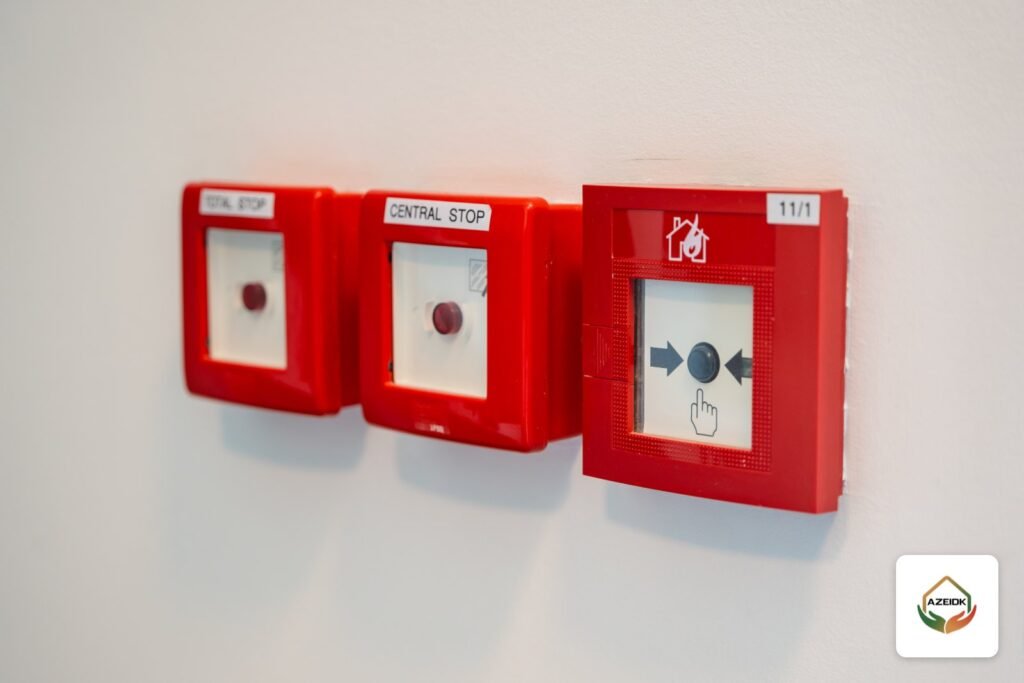
- Energy shut-off: a gas shut-off valve or electrical disconnect for every appliance under the hood, according to the system design.
- Portable extinguisher: a wet chemical extinguisher for cooking oil and grease fires next to the cook line.
- Submittal: data sheet, design manual pages, nozzle layout and manufacturer confirmations.
- Testing and handover: functional test and handover of documents to the owner.
AZEIDK helps prepare the fire protection file through its Civil Defense approval support service. This does not guarantee the approval outcome, which rests with the authority.
Frequently asked questions
Is a shawarma restaurant fire suppression system different from a normal kitchen system?
It is the same wet chemical hood system, but the design differs because the vertical shawarma broiler is not named in the ANSUL R-102 and American Fire Control documents we reviewed, so its coverage must be confirmed by the manufacturer.
Is a dry powder extinguisher enough in a grill restaurant?
It does not replace the hood suppression system. For cooking oil and grease fires, use a wet chemical extinguisher made for those fires, placed next to the fryers and grills.
Does a charcoal grill need different protection from a gas grill?
Yes, on the fuel side. Natural charcoal broilers are named in the manufacturers’ documents, but they also fall under the NFPA 96 solid fuel rules, such as storing charcoal away from appliances and removing ash daily.
I added a second shawarma broiler under the same hood. Do I need to modify the system?
Most likely. Changing appliances or their positions changes the coverage needed, and NFPA 96 links such changes to a review of system compliance. Ask for a nozzle review before you start cooking.
Does the system shut off gas and power to the appliances?
The American Fire Control catalog states that activation shuts off electrical and gas supplies, and the ANSUL R-102 data sheet states compatibility with mechanical gas valves and electrical shut-off devices. The actual arrangement is set in the design.
Is a wood-fired tannour protected the same way as a gas tannour?
Both need manufacturer-confirmed coverage, but a wood tannour also falls under the solid fuel rules, and the Saudi restaurant requirements call for a separate store for charcoal or wood.
Conclusion
Protecting shawarma, grill and tannour restaurants starts with the appliance, not the hood. Standard appliances such as fryers, griddles and charcoal or gas char-broilers are named in the manufacturers’ documents. The vertical shawarma broiler and the tannour need written confirmation before design. Add the solid fuel rules for charcoal and wood appliances, and review the system every time the cook line changes.
Running a shawarma or grill restaurant and need a hood suppression system? Send us your appliance list with photos. We will review the coverage with you and supply, install and maintain the system. Talk to the AZEIDK team
Related guides
- CCTV and Security System Maintenance: Periodic Checks and Contract Scope
- Heat Detectors: Types, Fixed Temperature vs Rate of Rise, and Installation Basics
- Falcon Gold Fire Extinguishers: Types, Sizes and Placement
- Upgrading an Old CCTV System: IP, HD over Coax (PoC/Turbo HD), and What to Keep or Replace