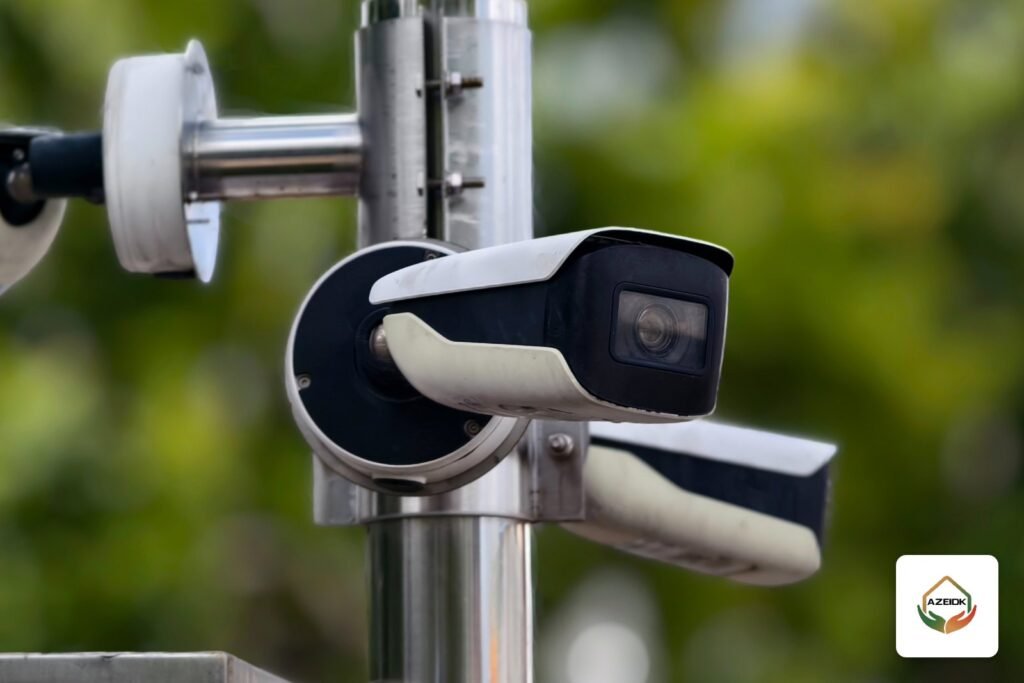
CCTV for government buildings is a legal obligation as well as a technical choice. Saudi Arabia’s Security Surveillance Cameras Law covers ministries, authorities and public institutions, and its Implementing Regulations set where cameras go and who may view recordings. This guide covers camera placement in a government building, the specifications entities check, and how the control room and recording are managed.
For camera types, resolution, night vision and storage, see our CCTV cameras guide for Saudi Arabia.
AZEIDK supplies and installs Hikvision and Dahua security and surveillance systems for the government entities sector.
Key takeaways
- The law was issued by royal decree on 7 Rabi al-Awwal 1444 AH (3 October 2022) and applies to ministries, authorities and public institutions.
- The Implementing Regulations (Umm Al-Qura, 20 Dhu al-Qadah 1444 AH) list locations including building entrances, lobbies, corridors, parking entrances and warehouses.
- The law bans cameras in toilets, changing rooms and medical examination rooms; audio recording is not enabled without approval.
- Access is limited to authorised users with an access log; recordings are released only on official request from Ministry of Interior law enforcement bodies or the State Security Presidency.
- Retention is set by the specification document; after a reported security incident, recordings are kept until the investigation ends or that period, whichever is longer.
In this article
- Does the CCTV law apply to government buildings?
- Where CCTV for government buildings is installed
- Where cameras are not allowed
- The control room and who views recordings
- How long must recordings be kept?
- Specifications the entity checks
- Installation, handover and maintenance
- Linking CCTV with access control and fire alarm
- Frequently asked questions
- Conclusion
Does the CCTV law apply to government buildings?
Yes. Article 2 of the law lists ministries, authorities and public institutions within its scope. Article 4 exempts government security and military bodies and the Ministry of Foreign Affairs only from the requirement to link cameras to operations rooms, not from the law as a whole. Cameras placed by individuals inside private residential units and compounds fall outside the law’s definition. For the law in general, see the Saudi Security Surveillance Cameras Law.
Where CCTV for government buildings is installed
Article 2 of the Implementing Regulations lists required locations, including building entrances, lobbies, corridors, parking entrances and warehouses. Details for each activity are set in the specification document. Inside a government building, cameras are usually placed as follows:
| Location | Purpose | Typical camera |
|---|---|---|
| Main gate and visitor entrance | Face identification in and out | High-resolution, narrow field on the crossing point |
| Waiting area and service hall | Overview of hall and counters | Wide-angle dome |
| Corridors and stairs | Movement between floors | Dome or bullet by corridor length |
| Car park and entrance | Vehicles and plates | Outdoor IR camera, ANPR where needed |
| Perimeter and fences | Night intrusion | Outdoor camera with night illumination |
| Archive, server room and store doors | Record who enters restricted areas | Dome above the door, linked to access control |
| Cash counter, if any | Record cash handling | Camera aimed at the counter surface |
Where cameras are not allowed
Article 6 of the law bans cameras in toilets, changing rooms, and medical examination, inpatient and physiotherapy rooms, and leaves other categories of private places to the regulations. In government buildings the entity also reviews areas such as women’s prayer rooms and private rest rooms according to its own judgement and the specification. Article 8 of the regulations prohibits enabling audio recording without the Directorate’s approval and requires privacy masks on pan-tilt-zoom cameras and on rooftop cameras whose range goes beyond the site boundary. These clauses sit in the article on women’s salons and clubs, so the safer course is to apply them in government buildings too and confirm them in the specification. A common mistake is a PTZ camera in the forecourt with no masks set, reaching windows of neighbouring buildings.
The control room and who views recordings
The regulations limit access to authorised users and require access to be logged. Recordings are released only on official request from Ministry of Interior law enforcement bodies and the State Security Presidency. In practice the design should include:
- User accounts with different rights: live view, playback, or export.
- An activated operation log on the recorder or management software.
- A closed control room with access control and screens not visible from public corridors.
- A CCTV network separated from the staff network, with no unprotected internet ports.
See also CCTV for companies and offices.
How long must recordings be kept?
The normal retention period is set by the specification document for each activity. When a security incident is reported, Article 6 of the regulations requires the responsible person to sign an undertaking to keep recordings until the investigation ends or for the period in the specification document, whichever is longer. Storage cannot be sized before the required period is known; it depends on camera count, resolution, compression (H.265 or H.264), frame rate and days. See how long CCTV keeps recordings. Article 12 of the law sets a fine of SAR 5,000 for failing to keep recordings as required and SAR 20,000 for transferring or publishing recordings in breach of the law, plus per-camera fines for cameras that do not meet the specification or are not installed as the specification requires.
Specifications the entity checks
In government tenders, camera specifications sit in the specification booklet and the contractor answers them in a compliance statement; see CCTV installation tenders. Key items:
- Resolution and field of view per location, not one resolution for all.
- Night vision and ingress rating for outdoor cameras (IP66 or IP67, for example).
- NVR type, channels, disk bays and expansion.
- PoE switches and UPS backup for the recorder and switches.
- Central management software where the entity runs several buildings.
- Datasheets, product catalogue and material submittal.
Hikvision and Dahua products in our catalogue carry their model datasheets, which we match to the specification before quoting.
Installation, handover and maintenance
Work starts with a site survey and camera angles, then shop drawings for routes and cabling, then installation, programming and recording and playback tests through our installation service. At handover the entity needs a camera list with locations and IP addresses, admin passwords in a sealed envelope, and a report proving actual retention on disk. CCTV and low-current maintenance at AZEIDK is a separate contract from fire system maintenance; see low-current maintenance contracts.
Linking CCTV with access control and fire alarm
Cameras add more value when they work with other systems. A card or fingerprint event at the archive or server room door can be tied to a snapshot from the camera above it, and a forced door raises an alert in the control room with live video. The control room can also receive a fire alarm signal and call up cameras in the alarm zone, so the operator can check the situation before the response team arrives. This needs coordination between the CCTV and fire alarm suppliers at design stage and is hard to add after commissioning; see our low-current systems.
Frequently asked questions
Must government buildings have CCTV?
Yes. The law covers ministries, authorities and public institutions, and its regulations and the specification document set the locations.
Can cameras be placed in toilets or changing rooms?
No. Article 6 of the law bans cameras in toilets and changing rooms.
How long are government building recordings kept?
For the period in the specification document. After a reported security incident, until the investigation ends or that period, whichever is longer, under Article 6 of the regulations.
Who can view the recordings?
Authorised staff of the entity, with access logged. Recordings go to other parties only on official request from Ministry of Interior law enforcement bodies or the State Security Presidency.
Can audio be recorded in visitor halls?
The Implementing Regulations prohibit enabling audio recording without the Directorate’s approval, so it stays off until approval is given.
Does a fire maintenance contract cover cameras?
Not at AZEIDK. CCTV and low-current maintenance is a separate contract.
Conclusion
CCTV for government buildings starts with the law and its regulations: where cameras are required, where they are banned, who views and how long recordings are kept. Then come per-location specifications, a control room with clear user rights, documented handover and regular maintenance.
Equipping or upgrading CCTV in a government building? Send the layout or specification and we will propose locations and models with datasheets. Talk to the AZEIDK team
Related guides
- Gas Leak Detector for Restaurants and Commercial Buildings: Types and Mounting Locations
- Sprinkler System Acceptance Tests After the Pressure Test: Flushing, Main Drain, Inspector’s Test and Waterflow Alarm Before Handover
- TYCO Sprinkler Installation: W-Type Wrenches, Tightening Torque, and Royal Flush II and DS-1 Installation Steps
- How to Stop a Fire Alarm Safely: Silence vs Reset and What to Do Before Silencing the Bell