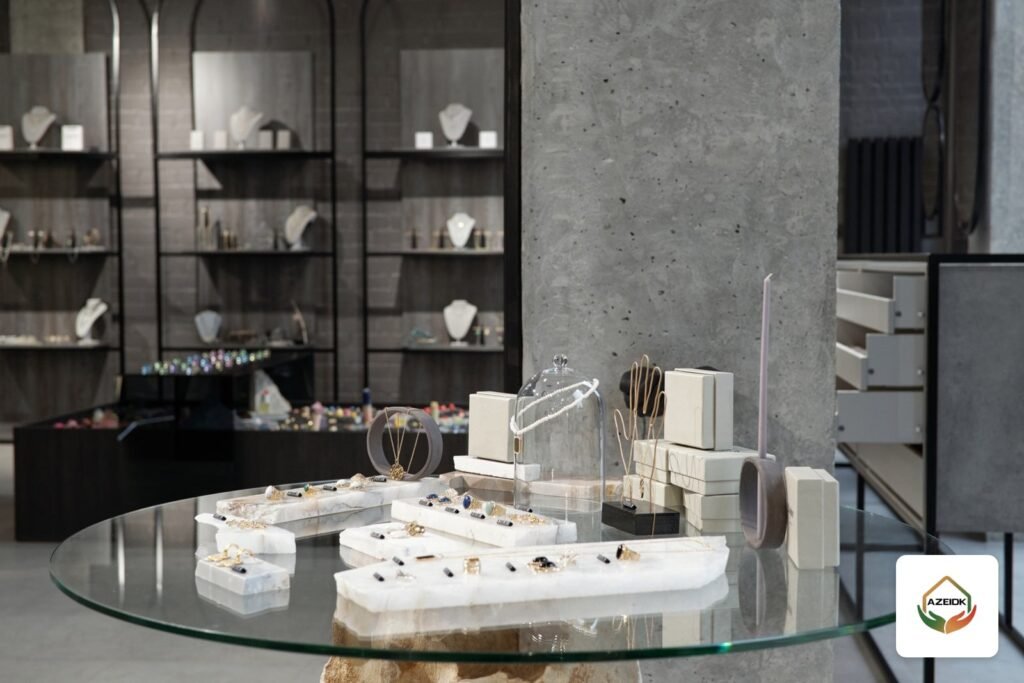
A jewelry store security system in Saudi Arabia should be designed around the counters, not the floor area: a high-resolution camera over every display and payment point, an entrance camera that captures faces clearly, and a recorder that keeps footage for the period set in the Security Requirements Document. Around that sit an intrusion alarm with a hold-up (panic) button, access control for the stockroom and safe, and a suitable extinguisher near the electrical panel. This guide covers what a gold and jewellery shop needs and how the systems fit together.
Key takeaways
- The Law on the Use of Security Surveillance Cameras was issued by Royal Decree No. (M/34) dated 7/3/1444H; its Implementing Regulation by Minister of Interior Decision No. (22688) dated 3/11/1444H.
- Retention periods, technical specifications and warning signs are set by the Security Requirements Document according to the site’s classification. Audio recording needs approval from the competent authority.
- According to Okaz (17 May 2025), an amendment to the Implementing Regulation of the Private Civil Security Law lists gold and jewellery shops among premises that must have round-the-clock guarding.
- Counter cameras need high resolution and a near-overhead angle; the entrance camera’s job is a clear face of everyone who walks in.
- Intrusion alarm, panic button and access control belong to the security package; fire extinguishers are a separate item for supply and maintenance.
In this article
- Why is a jewelry store security system different from a normal shop?
- What does the Saudi CCTV law require from the shop?
- Where should cameras go in a gold and jewellery shop?
- What resolution does a counter camera need?
- Intrusion alarm and panic button: how do they work together?
- Does a gold shop need a security guard?
- Access control for the stockroom and safe room
- What about fire safety in a jewellery shop?
- Maintenance: who looks after the cameras and alarm?
- Frequently asked questions
- Conclusion
Why is a jewelry store security system different from a normal shop?
In a typical shop you mainly need to see general movement at the till and the door. In a gold shop the question is sharper: can you prove which piece left the tray, in whose hand, and at which second? Pieces are small, a swap can happen with one quick hand movement over the counter glass, and a dispute with a customer may be about weight, karat or one item from a set.
So the design starts from the display points, not from a camera count. Each counter is treated as its own zone, with a view that covers the glass top, the drawer, the scale and both the seller’s and the customer’s hands. For general retail requirements see our commercial buildings and malls page; this article covers what is specific to gold.
What does the Saudi CCTV law require from the shop?
The legal frame is the Law on the Use of Security Surveillance Cameras, its Implementing Regulation, and the Security Requirements Document approved by the same decision. That document sets camera specifications, retention periods, warning sign formats and site sensitivity classes. We therefore do not quote a fixed retention figure here; the reference is the document and your activity’s classification.
Practical points for a gold shop owner, covered in detail in our article on Saudi CCTV law obligations:
- After a security incident is reported, footage is kept until the investigation ends or for the period in the document, whichever is longer.
- Audio recording needs approval from the competent authority. Many modern cameras have a built-in microphone, so disable it or obtain the approval.
- Shops inside enclosed malls and office buildings are exempt from installing exterior cameras for their own unit, since the building covers its perimeter. Interior cameras remain the shop’s responsibility.
- Licensing and renewal are linked to proof that the installation complies, so keep the layout drawing and device data.
Where should cameras go in a gold and jewellery shop?
| Location | Purpose | Installation note |
|---|---|---|
| Above each display counter | See the piece and both pairs of hands | Near-vertical angle; watch for showcase lighting reflecting on the glass |
| Scale and payment point | Record weight, amount and payment method | Do not capture the PIN entry screen of the card terminal |
| Entrance, inside | Clear face of everyone entering and leaving | Correct height; deal with backlight from the glass front |
| Street front (stand-alone shop) | Pavement and cars parked outside | Outdoor camera protected against dust and water |
| Stockroom and safe room | Who enters, when, carrying what | Link to the access control log |
| Recorder location | Protect the footage itself | Locked space customers cannot reach |
For coverage angles and identification distance, see our CCTV coverage guide.
What resolution does a counter camera need?
The counter camera is close to its target, but the target is tiny. Choose high resolution and a lens that matches the counter width rather than a wide lens that wastes pixels on walls. One example from AZEIDK’s range: the Hikvision DS-2CD2087G2-LU, 8 MP (3840 × 2160), fixed lens options of 2.8, 4 and 6 mm at F1.0, ColorVu for colour images at night, and IP67, according to the product page on AZEIDK’s site. Model and lens are confirmed after the site survey; see the full range on our Hikvision page.
High resolution costs storage. An 8 MP camera recording around the clock uses far more space than a 2 MP one, and the required retention multiplies that. Size the recorder first with our CCTV storage calculator or read how to calculate NVR storage and bandwidth.
Intrusion alarm and panic button: how do they work together?
Cameras record; they do not alert anyone at 3 a.m. The intrusion alarm protects the shop after closing: opening sensors on the door and shutter, motion detectors inside, and glass-break detection for the shop front. The panic (hold-up) button works during opening hours and sits under the counter where staff can press it unnoticed.
An example of a wireless control panel AZEIDK supplies is the Ajax Hub 2 Plus. Per Ajax’s official specifications, it runs Ethernet, Wi-Fi and two 2G/3G/4G SIM slots, supports up to 200 devices, sends alarms to the owner’s app as push notifications, SMS and calls, and to a monitoring station over protocols such as SIA (DC-09) and Contact ID, with photo verification from detectors fitted with a camera. Sensors include the Ajax DoorProtect opening detector; more on our Ajax page.
Multiple communication paths matter in a gold shop because cutting the internet cable outside is often the first move in a break-in. If the SIM path stays up, the alarm still gets through. Who receives the alarm and responds is decided by the owner with the licensed guarding company they contract.
Does a gold shop need a security guard?
Okaz reported on 17 May 2025 that the Ministry of Interior approved an amendment to Article 2 of the Implementing Regulation of the Private Civil Security Law, requiring commercial premises including gold and jewellery shops to provide guarding around the clock, through a provider licensed by Public Security. Technical systems do not replace that obligation, but they make the guard’s job easier: a monitor at the post, a panic button within reach, and an alarm that reaches the guard and the owner at the same time.
Access control for the stockroom and safe room
The stockroom and safe room should not open with a key passed between staff. A fingerprint, face or card reader logs who opened the door and when; linked to the camera, every door event has a matching video clip. AZEIDK supplies access control devices from ZKTeco, Hikvision and Dahua as part of its security and surveillance systems, chosen by staff count and preferred credential.
What about fire safety in a jewellery shop?
A gold shop is not a high fire-risk unit, but the electrical panel, showcase lighting and small appliances run for long hours. The practical minimum is a suitable extinguisher near the panel, such as a CO2 unit, plus whatever Civil Defense requires for the activity. See the range on our fire extinguishers page. Inside a mall, the fire alarm is usually part of the building system; the shop fit-out must not block detectors or sprinklers.
Maintenance: who looks after the cameras and alarm?
A common problem in shops is a camera that works while the recorder stopped recording weeks ago because the disk is full or failed, and nobody notices until footage is requested. The system needs periodic checks of recording, disks, time sync, sensors and batteries. At AZEIDK, CCTV and low-current systems (intrusion alarm, access control) sit under one maintenance contract, and fire extinguishers and safety systems under a separate one; see our maintenance contracts page.
Frequently asked questions
How many cameras does a gold shop need?
There is no fixed number. A practical rule is one camera per display counter, one for the entrance, one for the payment point, one for the stockroom or safe, plus an exterior camera if the shop is stand-alone rather than inside a mall.
How long must jewellery shop CCTV footage be kept?
The Security Requirements Document issued with the CCTV Implementing Regulation sets it by site classification. After a security report, footage is kept until the investigation ends or for that period, whichever is longer.
Can I record audio at the counter?
Audio recording needs approval from the competent authority. If the camera has a built-in microphone, have it disabled at installation until you obtain approval.
Why a panic button if the cameras already record?
Cameras document what happened. A panic button sends an immediate alert to the owner, guard or contracted provider during the incident itself, without the offender noticing.
Is a wireless intrusion alarm enough for a jewelry store?
Modern wireless systems such as Ajax use several communication paths and a backup battery, which suits most shops. What matters is that every entry point is covered and the alarm reports over more than one path.
Does a shop inside a mall need an exterior camera?
Shops inside enclosed malls and office buildings are exempt from exterior cameras for their own unit, but remain responsible for interior cameras under the requirements.
Conclusion
A jewelry store security system is built around the counters, the entrance and the safe, completed by a multi-path intrusion alarm, a panic button and access control, with footage kept for the period in the Security Requirements Document. Start with a site survey, then fix the layout, resolution and storage before buying.
Fitting out a gold or jewellery shop? Send us the shop layout and number of counters, and our team will propose the camera, alarm and access control layout. Talk to the AZEIDK team
Related guides
- On-Demand Fire Alarm Maintenance or an Annual Contract? When to Call a Technician
- Context Plus SigTEL Fire Telephone System: 8-Line Master Controller and Floor Outstations
- MEP Contractors in Saudi Arabia: MEP Scope, Fire Systems and How to Choose
- Smoke Detector Tester Tools: Aerosol Smoke, Test Poles and Heat Testers in Routine Fire Alarm Inspections