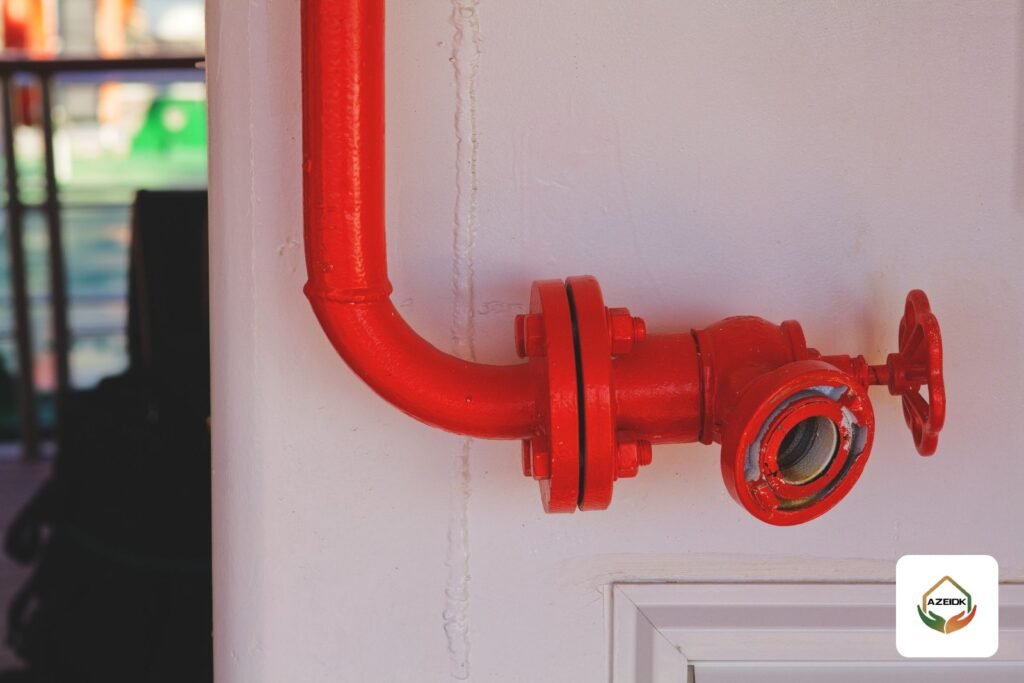
A fire hose cabinet valve (angle hose valve) is the valve that releases water to the hose inside a fire hose cabinet, or at a standpipe outlet in a stairwell. In Saudi Arabia AZEIDK supplies the Giacomini A55E angle hose valve in forged brass, in 1½ and 2½ inch sizes with female NPT threads on both ends, rated at 300 psi and shown as UL Listed and FM Approved in the datasheet.
This article covers where the valve sits in the cabinet, the difference between the two sizes, what NFPA 14 says about outlet pressure, and what to check before approval.
Key takeaways
- A55E is a 90 degree angle valve: water enters from below and leaves sideways to the hose.
- Sizes: 1½ x 1½ inch and 2½ x 2½ inch, female NPT inlet and outlet.
- Rated pressure 300 psi (20.6 bar); body and stopper in forged brass CW617N; red painted aluminium handwheel.
- Opens counterclockwise, closes clockwise.
- A plain hose valve does not reduce pressure. Where outlet pressure exceeds the design limit, NFPA 14 calls for pressure-restricting or pressure-reducing valves.
Where the cabinet valve sits
In a standpipe system each riser feeds a branch to the hose cabinet on every floor, or a direct outlet in the stair. The angle valve sits on that branch, with its inlet on the branch and its outlet facing forward or sideways for the hose.
The system class decides what is in the cabinet. NFPA 14 defines three classes: Class I with 2½ inch outlets for the fire service, Class II with 1½ inch outlets for occupants or trained staff, and Class III combining both. So some cabinets hold a 1½ inch valve with a hose, some a 2½ inch valve for Civil Defense, and some both, as the approved design requires. See fire hose cabinet types and components.
In Saudi Arabia the binding requirements are the Saudi Fire Code SBC 801 and Civil Defense rules; NFPA 14 is a technical reference for standpipe and outlet details. See our NFPA 14 guide.
Giacomini A55E specifications
| Item | Value |
|---|---|
| Type | Angle hose valve, female threads both ends |
| Sizes and codes | A55EY001: 1½ x 1½ in NPT-F, rough brass A55EY005: 2½ x 2½ in NPT-F, rough brass A55EX015: 2½ x 2½ in NPT-F |
| Rated pressure | 300 psi (20.6 bar) |
| Body and stopper | Forged brass CuZn40Pb2, EN 12165 CW617N (similar to ASTM B124 C37700) |
| Stem | Brass CW617N (1½ in), CW713R (2½ in) |
| Handwheel | Red painted aluminium |
| Listing and approval | UL EX2964 for all codes per the product page; FM for A55EY001 and A55EY005 |
Source: Giacomini datasheet 1043EN (AZEIDK brand page) and the AZEIDK product page. The datasheet also lists A56E with a male hose thread outlet, and A55EG and A56EG with grooved inlets; confirm availability with AZEIDK before naming them in a specification.
1½ or 2½ inch?
| Item | 1½ inch | 2½ inch |
|---|---|---|
| Used by | Occupants or safety team | Civil Defense and fire crews |
| NFPA 14 class | Class II, or within Class III | Class I, or within Class III |
| Connects to | 1½ inch hose on a rack or reel | Fire service hose lines |
| A55E code | A55EY001 | A55EY005 or A55EX015 |
Pick the size from the system class on the approved drawings, not from the catalogue. Make sure the outlet fitting matches the hose thread in use, since the A55E outlet is female NPT and needs a suitable adapter.
Outlet pressure: when a plain valve is not enough
As reference values from NFPA 14 (the binding rules in Saudi Arabia are SBC 801 and Civil Defense requirements): where pressure at a hose connection exceeds 175 psi, a listed pressure-regulating device is fitted to limit static and residual outlet pressure to 175 psi, and Class I outlets require 100 psi. According to Consulting-Specifying Engineer, citing the 2019 edition, 1½ inch outlets in Class II and III systems need a device that limits residual outlet pressure to 100 psi. Check the edition adopted for your project before design.
In practice, a plain angle valve like the A55E is rated for 300 psi as a component but does not reduce pressure. On the lower floors of towers, where static head and pump pressure add up, the designer decides which levels need reducing or restricting valves or a zoned solution. That decision belongs to engineering design and calculations, not to the supplier.
What to check before approval
- Size and class: per the approved standpipe drawings.
- Listing: the exact code in UL Product iQ and the FM guide, since approvals differ between A55E codes.
- Threads: NPT inlet, and an outlet fitting that matches the hose.
- Pressure per floor: from the hydraulic calculations, to confirm a plain valve is enough.
- Orientation in the cabinet: so the valve opens and the hose connects without clashing with the door or reel.
To compare quotations on equal terms, write the BOQ line in full, for example: “Angle hose valve 1½ inch, female NPT inlet and outlet, forged brass body, rated pressure not less than 300 psi, UL Listed and FM Approved for the supplied code, with an outlet fitting matching the cabinet hose.” This keeps generic unlisted valves out of the comparison.
Installation and periodic checks
The valve is fitted on the riser branch with a suitable thread sealant, and the branch is supported so the valve does not carry the weight of hose and pipe. After the network hydrostatic test, check for leaks at the stem and stopper and that the handwheel turns freely.
In maintenance the valve is inspected with the cabinet: ease of operation, no leaks, cap or fitting present, handwheel intact. See fire hose cabinet maintenance; these items are covered by AZEIDK maintenance contracts.
Common cabinet valve mistakes
- Wrong size against the drawings: a 2½ inch valve in a cabinet designed for a 1½ inch hose, or the reverse, so the hose will not connect without extra fittings.
- Thread mismatch: a female NPT outlet with a hose on a different thread and no suitable adapter.
- Wrong orientation: the outlet faces the door or the reel, making the hose hard to connect or kinked in use.
- No support: the branch carries the valve and hose and the thread starts leaking over time.
- Non-listed replacement during maintenance: the outlet no longer matches what the consultant and Civil Defense approved.
- Ignoring pressure on lower floors: plain valves on levels above the design limit, making the hose hard to control and risking rejection at handover.
FAQ
What is a fire hose cabinet valve?
An angle valve on the riser branch inside the cabinet that releases water to the hose, also called an angle hose valve.
What sizes does the Giacomini A55E come in?
1½ x 1½ inch and 2½ x 2½ inch, female NPT on both ends.
What is the pressure rating of the A55E?
300 psi (20.6 bar) per the datasheet; outlet pressure in the design is governed by NFPA 14 and the hydraulic calculations.
Is the A55E UL Listed and FM Approved?
The product page lists UL EX2964 for all codes and FM for A55EY001 and A55EY005 only. Check the code in the official directory.
How is a cabinet valve different from a pressure-reducing valve?
A plain cabinet valve only opens and closes. A pressure-reducing valve lowers outlet pressure on levels above the design limit.
Which way does a fire hose valve open?
Counterclockwise to open and clockwise to close, per the Giacomini datasheet.
Summary
The cabinet valve is small, but its size and pressure come from the standpipe design. Choose 1½ or 2½ inch by system class, verify the listing for that exact code, and check the pressure at each floor before approval. For the wider picture see our fire hydrants and landing valves guide, and AZEIDK’s fire cabinet range.
Need hose valves for your cabinets? Send the number of outlets and sizes from the drawings, and we will send the matching Giacomini A55E codes with datasheets and listing numbers. Contact the AZEIDK team