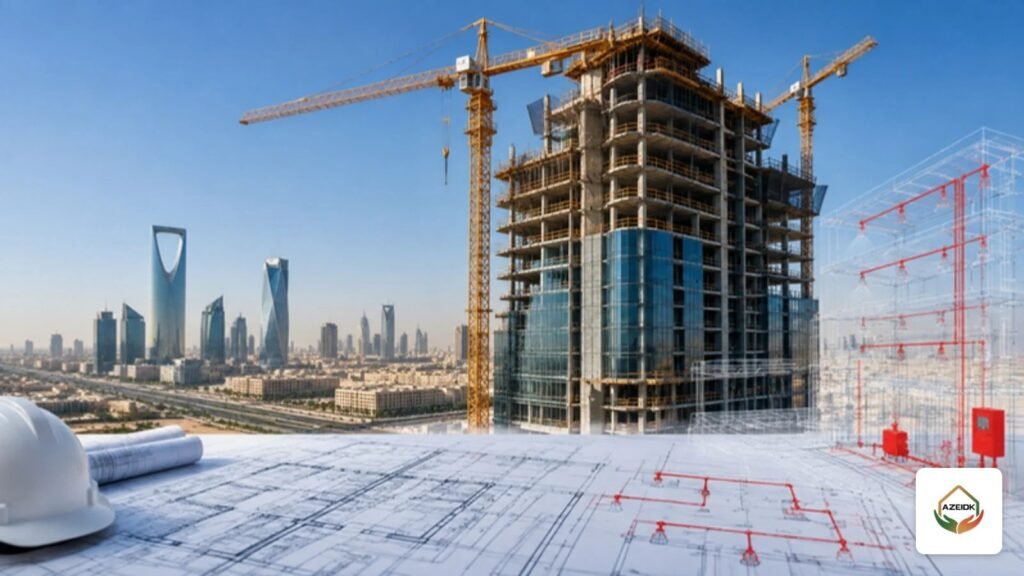
A fire protection project timeline in Saudi Arabia runs from contract award through shop drawings, material submittals, procurement, installation, testing and commissioning, and ends with the Civil Defense inspection and the license issued on the Salamah platform. There is no fixed duration for every project: it depends on building size, system types, equipment lead times, approval speed and how ready the civil works are. Delays rarely come from installation itself. They come from approvals, procurement and coordination.
Key takeaways
- Main stages: award, shop drawings, material submittals, procurement, installation, testing and commissioning, inspection and licensing, handover.
- Submittals and procurement start early and should run in parallel with shop drawings, not after them.
- Fire extinguishing equipment and fire pumps need a certificate of conformity through SABER under the SASO Technical Regulation for Fire Control Materials and Equipment.
- The Salamah licensing route depends on the activity’s risk classification, and official sources publish no fixed duration for high-risk activities.
- The usual causes of delay: late submittal approval, long lead items, coordination clashes, and no permanent power or water for commissioning.
In this article
- What are the stages of a fire protection project timeline?
- Stages 1 and 2: from award to shop drawings
- Stages 3 and 4: material submittals and procurement
- Stage 5: installation and sequencing
- Stage 6: testing and commissioning
- Stage 7: Civil Defense inspection and the Salamah license
- Stage 8: final handover
- What delays handover of a fire protection project?
- Frequently asked questions
- Conclusion
What are the stages of a fire protection project timeline?
Installation articles cover what happens on site. This one covers the full picture from award to the Civil Defense certificate, because most time is lost off site. The table summarises each stage, its outputs and what drives its duration, without fixed numbers because every project is different.
| Stage | Key outputs | What drives duration |
|---|---|---|
| 1. Award and mobilisation | Contract, kick-off meeting, baseline programme | Contract signature, site handover, approved design drawings |
| 2. Review and shop drawings | Coordinated shop drawings, updated calculations | Design completeness, number of clashes, consultant review cycle |
| 3. Material submittals | Datasheets and certificates approved by the consultant | Clear specifications, available certificates, rejections and resubmissions |
| 4. Procurement | Materials on site with conformity documents | Lead time per item, imports, conformity certificates |
| 5. Installation | Pipework, cabling, devices, panels | Civil works and ceiling readiness, crew size, sequence |
| 6. Testing and commissioning | Pressure tests, fire pump test, fire alarm programming and tests | Permanent power and water, closing snags |
| 7. Inspection and licensing | Civil Defense inspection or technical report, Salamah license | Activity classification, complete requirements, closed comments |
| 8. Handover | As-built drawings, O&M manuals, operator training | Complete documents and employer acceptance |
Stages 1 and 2: from award to shop drawings
After award, the contractor needs three things to really start: approved design drawings, the specification and the BOQ. The first technical task is to review them for gaps and conflicts, then prepare shop drawings coordinated with electrical, HVAC and architecture.
This stage looks slow but it is the cheapest time in the project. A clash solved on paper costs hours. A clash found after pipework is installed costs removal, reinstallation, RFIs and variation orders. Our fire drawings and specifications review checklist helps at this point.
Stages 3 and 4: material submittals and procurement
A material submittal presents the datasheet, catalogue and listing or approval certificates for each item to the consultant before purchase. Fire pumps, valves, sprinklers and fire alarm panels usually need separate approvals. Every rejection means another review cycle.
In Saudi Arabia, the SASO Technical Regulation for Fire Control Materials and Equipment requires a certificate of conformity through SABER for fire extinguishing equipment and fire pumps, while fire alarm systems and fire fighting systems themselves are excluded from its scope. Confirm the conformity status before these items ship, not when they arrive.
Lead times vary widely. UL listed or FM approved equipment, fire pump packages and imported made-to-order items usually take longer than stock items available locally. The practical approach is to identify long lead items in week one, submit them first and order as soon as they are approved. This is what our technical supply service covers.
Stage 5: installation and sequencing
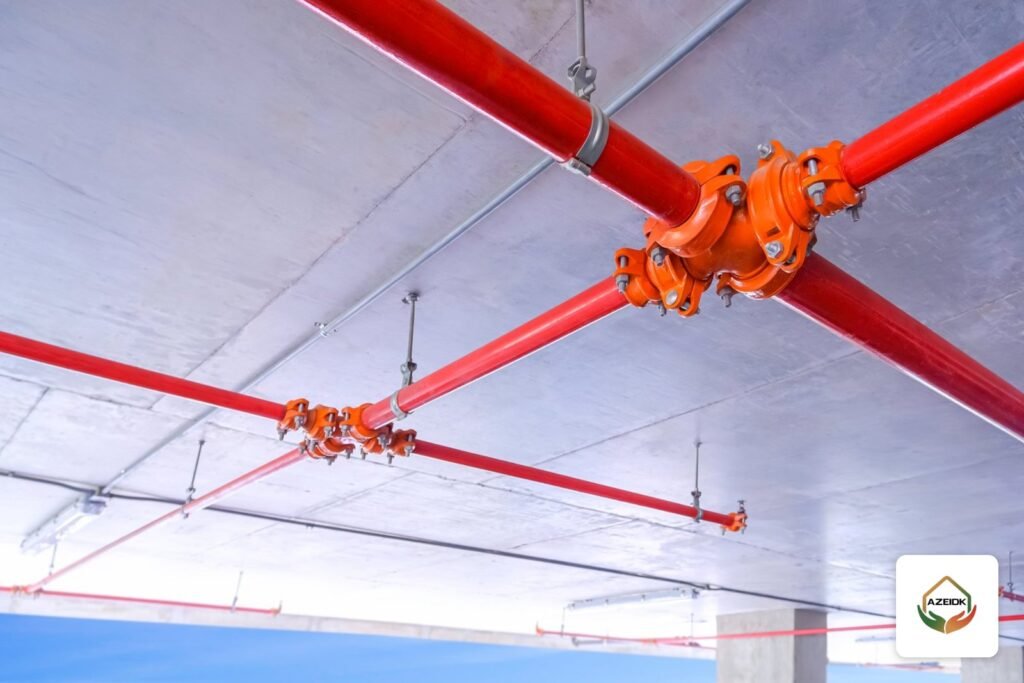
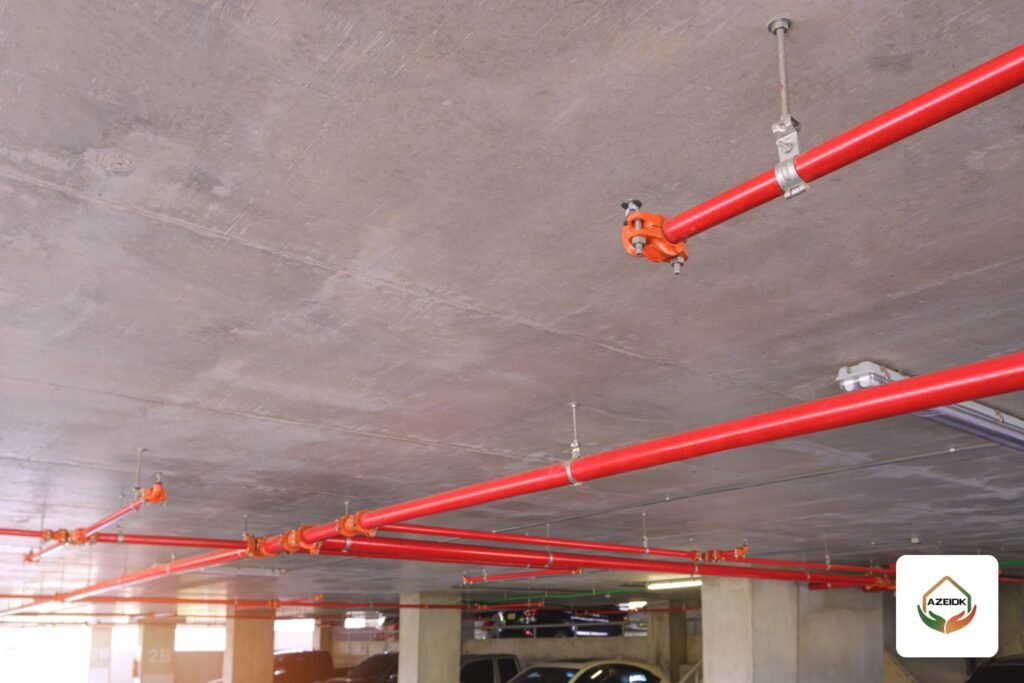
Installation depends more on the building’s readiness than on the fire crew. Suspended pipework needs soffits ready for hangers before false ceilings, fire alarm cables need ready containment, and the pump room needs floor, plinths and drainage. Site steps are covered in fire fighting system installation and fire alarm installation, and AZEIDK delivers this stage through its installation and implementation service.
Stage 6: testing and commissioning
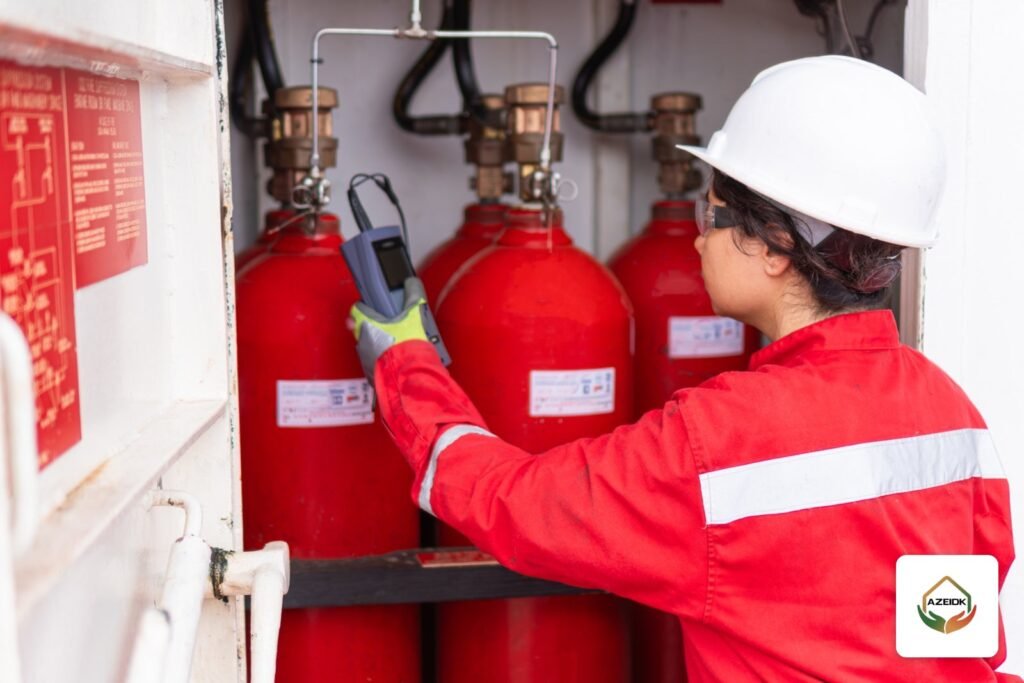
Testing happens in steps, not once at the end. Pipework is pressure tested before ceilings close, fire pumps go through acceptance testing, and the fire alarm system is programmed with every device and control output tested. See hydrostatic pressure testing of fire networks and fire pump acceptance testing and commissioning.
What delays this stage most is no permanent power for pumps and panels, an unfilled water tank, and late installation of interfacing systems such as lifts and HVAC that the fire alarm controls. Put these in the programme as activities with dates and owners. Details are in our testing and commissioning service.
Stage 7: Civil Defense inspection and the Salamah license
The Civil Defense license is issued on the Salamah platform. The route depends on the activity classification, as explained in our Salamah guide: for direct (low to medium risk) activities the applicant submits an invoice for safety equipment or a technical report; for indirect (high risk) activities it needs a contract with an accredited safety company, a maintenance contract and a Civil Defense inspection. See our full Salamah certificate guide.
The official sources we reviewed publish no fixed duration for indirect activities, so do not build your programme on an assumed number. What you control is readiness: tested and commissioned systems, drawings that match the site and closed comments. Before requesting inspection, use the Salamah inspection readiness checklist and see our Civil Defense approval support, which includes issuing the safety equipment installation certificate and coordinating with the approved engineering office that issues the technical report.
Stage 8: final handover
Handover is more than a signature. The employer needs as-built drawings, operation and maintenance manuals, test certificates, a spare parts list and operator training. Late documents delay the final payment and the start of the maintenance contract. See documentation and final handover.
What delays handover of a fire protection project?
- Late submittal approval: vague specifications or missing certificates mean repeated rejections.
- Lead times: ordering long lead items after design is complete instead of at the start.
- Conformity certificates: shipping extinguishing equipment or pumps without checking SABER requirements.
- Coordination clashes: finding clashes on site instead of on drawings.
- Employer changes: change of use or layout after installation starts.
- Temporary services: no permanent power or water at commissioning.
- Inspection comments: work that does not match the approved drawing or devices not fully programmed.
Frequently asked questions
How long does a fire alarm installation take?
There is no fixed duration. It depends on floor area, device count, containment readiness and the panel’s lead time and approval. Ask for a programme built on your project.
What are the stages of a fire protection project?
Award, shop drawings, material submittals, procurement, installation, testing and commissioning, Civil Defense inspection and licensing, then final handover.
Can procurement start before submittal approval?
It is not advisable. Buying before consultant approval risks rejection after delivery. Submit long lead items for approval first.
Do fire pumps need a SABER certificate?
Yes. The SASO Technical Regulation for Fire Control Materials and Equipment requires a certificate of conformity through SABER for fire pumps and extinguishing equipment.
How long does the Salamah certificate take?
Official sources publish no fixed duration for high-risk activities. Full readiness before requesting inspection is what shortens the time.
When is the fire network tested?
Pressure testing happens before ceilings close and pipes are concealed. Pump and fire alarm tests follow once permanent power is available.
Conclusion
A fire protection project timeline is governed more by approvals, procurement and coordination than by installation. Start shop drawings and submittals right after award, order long lead items early, and make power, water and snag closure dated activities in the programme. That way you reach the Civil Defense inspection ready.
Planning a fire protection project and want to reach the Civil Defense certificate without surprises? AZEIDK supports you from shop drawings to Civil Defense approvals and handover. Talk to the AZEIDK team
Related guides
- FirePro Aerosol Fire Suppression for Electrical Rooms and Panels
- Spare Sprinkler Head Box and Wrench: How Many Spares NFPA 13 Requires
- CCTV Camera with Audio from Hikvision: Built-in Mic vs Siren and Strobe, and When Audio Recording Is Allowed in Saudi Arabia
- Panoramic and Multi-Lens CCTV Cameras: When One Camera Can Replace Several in Car Parks, Yards and Warehouses (Dahua and EZVIZ)