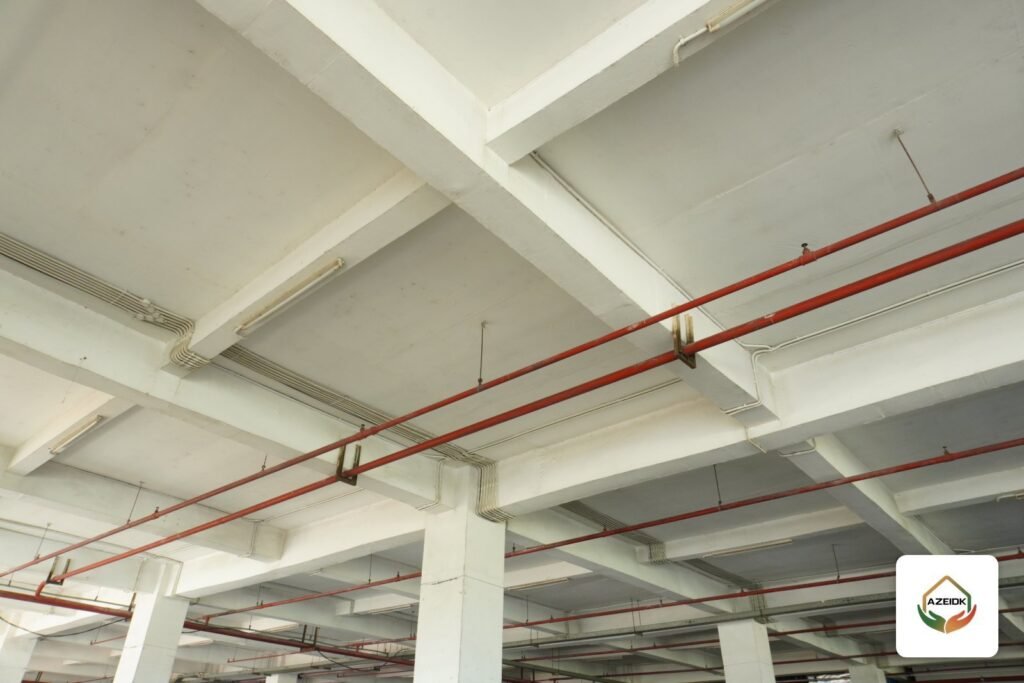
A Civil Defense licence for factories is issued through the Salamah platform for factories under the preventive supervision of the General Directorate of Civil Defense. Petroleum, industrial and service facilities within the supervisory scope of the High Commission for Industrial Security (HCIS) follow the HCIS Safety and Fire Protection (SAF) Directives instead, and their fire protection is designed and installed by an HCIS-approved consultant and contractor. Knowing your authority first tells you who designs the fire alarm and fire fighting systems and who reviews them. Published texts do not settle every case, so get written confirmation of the competent authority before design starts.
For AZEIDK’s work in this sector, see Industrial Facilities.
Key takeaways
- Civil Defense issues safety licences through Salamah, valid one year from final approval.
- According to Saudipedia, HCIS supervises 13 sectors, including petroleum, gas, petrochemicals, electricity, water, mining and chemical industries.
- The 2021 guidance manual for the Private Firefighting and Rescue Teams Regulation excludes HCIS-supervised facilities and sites from its scope and states that Civil Defense’s responsibility there is support.
- According to a published copy of SAF-01 (Version 2.0, 2017), in the HCIS path the facility owner selects an HCIS-approved fire protection consultant and contractor. HCIS reviews the design package, then the installation package.
- The Implementing Regulation of the Chemical Materials Management Law names three licensing bodies for chemical warehouses: HCIS, Civil Defense, and special business zones such as the Royal Commission and the Saudi Authority for Industrial Cities (MODON).
In this article
- Who licenses a factory for fire protection?
- Civil Defense licence for factories: the general path
- When does a factory fall under HCIS?
- Does HCIS approval replace a Civil Defense licence?
- What fire alarm and fire fighting does the owner need to prepare?
- Factories in industrial cities and special zones
- Common mistakes when identifying the licensing authority
- How AZEIDK can help
- Frequently asked questions
- Conclusion
Who licenses a factory for fire protection?
Both bodies sit within the Ministry of Interior framework: Civil Defense is part of the ministry, and HCIS is chaired by the Minister of Interior. Each has its own licensing and review path.
The factory does not choose its authority: what decides it is whether the facility falls within HCIS supervisory scope. The HCIS statute, approved by Council of Ministers Decision No. 707 dated 27/12/1443H, requires petroleum, industrial and service facilities within that scope to enable HCIS to carry out its duties. The published texts we reviewed do not give a test that settles this for every facility, so confirm it in writing.
Civil Defense licence for factories: the general path
A food plant, metal workshop or furniture factory usually takes the general path unless it falls within HCIS scope. The Municipal Requirements for Factories (1447H / 2025) list General Directorate of Civil Defense approval among the licensing requirements, together with an engineering report. For fire protection they refer to the Saudi Fire Protection Code (SBC 801).
The Salamah guide splits activities into two groups:
- Direct activities (low to medium risk): a safety equipment invoice from an approved safety company, or a technical report from an approved engineering office, depending on the activity.
- Indirect activities (high risk): a contract with a safety company, maintenance contracts, and a Civil Defense inspection before the licence is issued.
The “investor journey” service on the platform shows your activity’s classification. Factory requirements by activity type are explained in Salamah certificate for factories.
When does a factory fall under HCIS?
According to Saudipedia, HCIS supervises 13 sectors: electricity, petroleum, water, mining, ports, gas, industrial services, intercity rail, civil explosives, chemical industries, cities and research laboratories, petrochemicals, and military industries. The same source says it reviews fire protection projects under its SAF Directives and licenses safety consultants, contractors and fire protection providers.
Being in one of these sectors does not automatically place a facility under HCIS. Ask HCIS for written confirmation of your facility’s status before you appoint any designer.
For background on the SAF Directives, see HCIS fire protection requirements.
Does HCIS approval replace a Civil Defense licence?
We found no published text that answers this for every case. Three texts are relevant:
- The guidance manual for the Private Firefighting and Rescue Teams Regulation (Umm Al-Qura, 2021) excludes from its scope all facilities and sites supervised by HCIS and states that Civil Defense’s responsibility there is support.
- The Implementing Regulation of the Chemical Materials Management Law (Umm Al-Qura, August 2025) asks import permit applicants for either an HCIS licence confirming that chemical warehouses meet security, safety and fire protection requirements, or a valid Civil Defense licence. It requires HCIS-supervised facilities to follow the HCIS SEC and SAF instructions for warehouses.
- The published copy of SAF-01 (Version 2.0, April 2017, hosted by Jensen Hughes, not on the HCIS website) states that it applies to companies and organizations under HCIS supervision and does not mention Civil Defense.
These texts say less than they seem to. The first covers the private firefighting teams regulation, the second covers chemical warehouses, and the third is HCIS’s own document. None of them settles whether an HCIS-supervised facility also needs a Salamah licence. Ask HCIS and Civil Defense for written confirmation of the competent authority for your facility, including other activities on site, buildings HCIS may not cover, and municipal and Ministry of Industry requirements. Do not assume any exemption without it.
| Item | Civil Defense path (Salamah) | HCIS path |
|---|---|---|
| Who it covers | Facilities under Civil Defense preventive supervision, including factories outside HCIS scope | Petroleum, industrial and service facilities within HCIS supervisory scope |
| Technical reference | Saudi Fire Protection Code SBC 801 and what Civil Defense approves | SAF Directives, including SAF-04 Fire Protection Systems and Equipment |
| Who designs and installs | Engineering office and safety company approved on Salamah, depending on the activity | HCIS-approved fire protection consultant and contractor |
| Review | Invoice or technical report, or contracts and inspection for high-risk activities | HCIS review of the front end engineering package, then the installation package |
| Outcome | Salamah licence valid for one year, renewable one month before expiry | HCIS review of the packages, then testing and commissioning under its directives |
What fire alarm and fire fighting does the owner need to prepare?
In the Civil Defense path
Start with the occupancy classification under the Saudi Building Code, then the “Fire Protection and Life Safety Systems” part of SBC 801, which ties sprinkler and fire alarm requirements to the occupancy. The owner usually prepares:
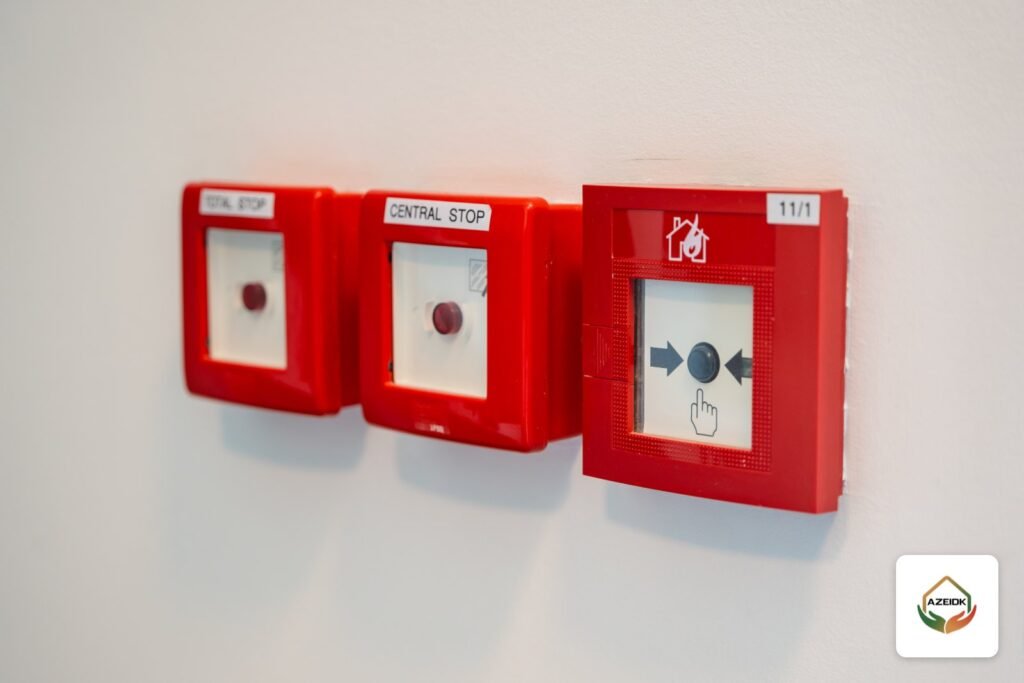
- An addressable or conventional fire alarm system sized to the number of zones and buildings, with the right detector for each area: heat detectors in dusty areas and flame detectors where flammable liquids are handled. AZEIDK supplies Context Plus panels and detectors as part of its fire alarm systems.
- A water-based fire fighting network: sprinklers, hose cabinets and valves, fed by a fire pump sized for the largest demand. Under fire fighting systems, AZEIDK supplies TYCO and Victaulic sprinklers, American Fire Control valves, Jack Pump and WATEX fire pumps, and Falcon Gold hose cabinets.
- Foam for flammable liquid areas where needed, such as SafeGuard AFFF concentrates and UL-listed WATEX foam bladder tanks.
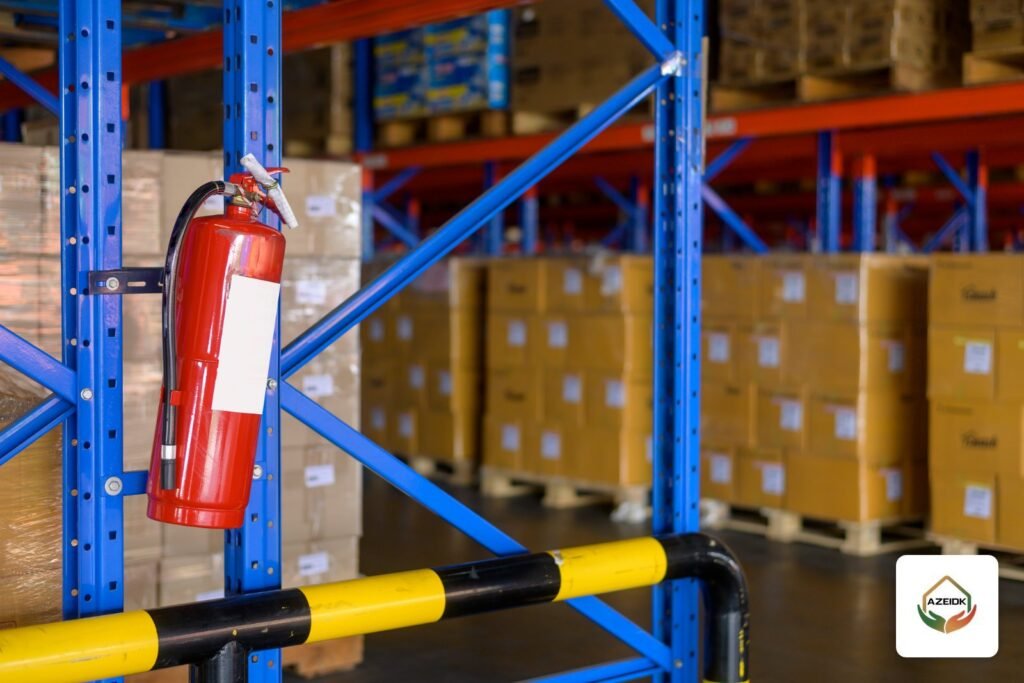
- Fire extinguishers placed by hazard type, and an up-to-date maintenance log.
In the HCIS path
The published copy of SAF-01 describes this sequence. The facility owner selects an HCIS-approved fire protection consultant, who prepares the fire hazard analysis and the front end engineering package. The owner reviews it and submits it to HCIS. After HCIS review, an HCIS-approved contractor prepares the installation package, which goes to HCIS for review. The consultant then approves the contractor’s shop drawings. The contractor supplies, installs and tests the systems, trains the owner’s staff, and all three take part in commissioning.
The documents the copy lists under SAF-04 include detection and alarm cause and effect diagrams, fire protection system calculations, and commissioning documentation. The owner should prepare an early equipment list with datasheets and listing certificates for the consultant.
What both paths share
A materials inventory from the safety data sheets (SDS), a hazard analysis per area, alarm interfaces to equipment and HVAC shutdown, and documented testing and handover. They are covered in detail in the factory fire protection guide.
Factories in industrial cities and special zones
The factory’s location can add a third party. Article 8-2 of the chemical materials implementing regulation lists the licensing bodies for chemical warehouses as HCIS, Civil Defense, and special business zones such as the Royal Commission and MODON. It tasks them with field monitoring through periodic visits under the permits they issue.
That article covers chemical warehouses only, but it shows the site authority has a role. In an industrial city or Royal Commission area, ask the site management for its fire protection requirements and approval route before design starts.
Common mistakes when identifying the licensing authority
- Designing to SBC 801, then finding the facility is classified by HCIS and redoing the package with an HCIS-approved consultant.
- Assuming a petroleum or chemical activity automatically means HCIS supervision without confirming the classification.
- Assuming HCIS approval replaces every other licence without a letter from the competent authority.
- Submitting drawings without a cause and effect matrix or pump calculations.
- Hiring a firm that is not HCIS-approved to design or install at an HCIS-supervised facility.
- Buying equipment before the consultant approves the datasheets and submittal.
How AZEIDK can help
In the Civil Defense path, AZEIDK’s Civil Defense approval support covers submitting and following up Salamah applications, a gap report after a site visit, coordinating with the approved engineering office on the technical report the platform requires, issuing the safety equipment installation certificate, and closing out inspection comments and resubmitting. Engineering design and the supply and installation of fire alarm and fire fighting systems are quoted separately. AZEIDK holds ISO 9001, ISO 14001 and ISO 45001 certificates covering the design, supply, installation and maintenance of fire fighting and fire alarm systems.
At HCIS facilities, design and installation stay with the HCIS-approved consultant and contractor. AZEIDK can supply equipment with the datasheet and listing certificates for each model for the consultant to review. AZEIDK is not a licensing body and does not issue HCIS or Civil Defense approvals. The final decision rests with the competent authority alone and cannot be guaranteed in advance.
Frequently asked questions
Do all factories need a Civil Defense licence?
Factories under Civil Defense preventive supervision need a Salamah licence, and the Municipal Requirements for Factories list Civil Defense approval among licensing requirements. Facilities within HCIS scope follow the HCIS directives. No published text settles whether they also need a Salamah licence, so get written confirmation from the competent authority.
What is the difference between a Civil Defense licence and HCIS approval?
A Civil Defense licence is issued through Salamah based on SBC 801. HCIS approval means HCIS reviews design and installation packages under the SAF Directives, prepared by HCIS-approved firms.
Does a Civil Defense licence require an inspection?
High-risk (indirect) activities need a Civil Defense inspection after a safety company contract and maintenance contracts are in place. Direct activities need a safety equipment invoice or a technical report, depending on the activity.
How long is a factory Salamah licence valid?
One full year from the final approval date, according to the Salamah guide. Renewal can be requested one month before expiry.
Can a safety company obtain the licence on my behalf?
Civil Defense issues the licence to the facility. A safety company prepares the systems and documents and can follow up the application, but no one can guarantee issue.
How do I know if my factory is under HCIS supervision?
Do not rely on the sector name alone. If your activity is in one of the sectors HCIS supervises, such as petrochemicals, mining or electricity, ask HCIS for written confirmation before design.
Conclusion
Before any drawing or quotation, confirm the authority for your factory: Civil Defense through Salamah, or HCIS for facilities within its scope, confirmed in writing by the competent authority. Check the role of the industrial city or special zone management too. Then it is clear who designs the fire alarm and fire fighting systems, to which reference, and who reviews them.
Not sure which authority covers your factory? Send us your activity, location and stored materials, and we will review the systems and documents needed in the Civil Defense path with you. Talk to the AZEIDK team
Related guides
- First Aid Box Contents for Facilities, Homes and Vehicles in Saudi Arabia: Falcon Gold H-323, H-324 and H-325 Sizes
- Smart Buildings: How Low Current Systems Integrate in One Building
- Fire Alarm Input/Output Modules: Interfacing Lifts, HVAC, Door Locks and Fire Pumps with Context Plus and Bosch Models
- Voice Evacuation Systems: When You Need Them and How They Work