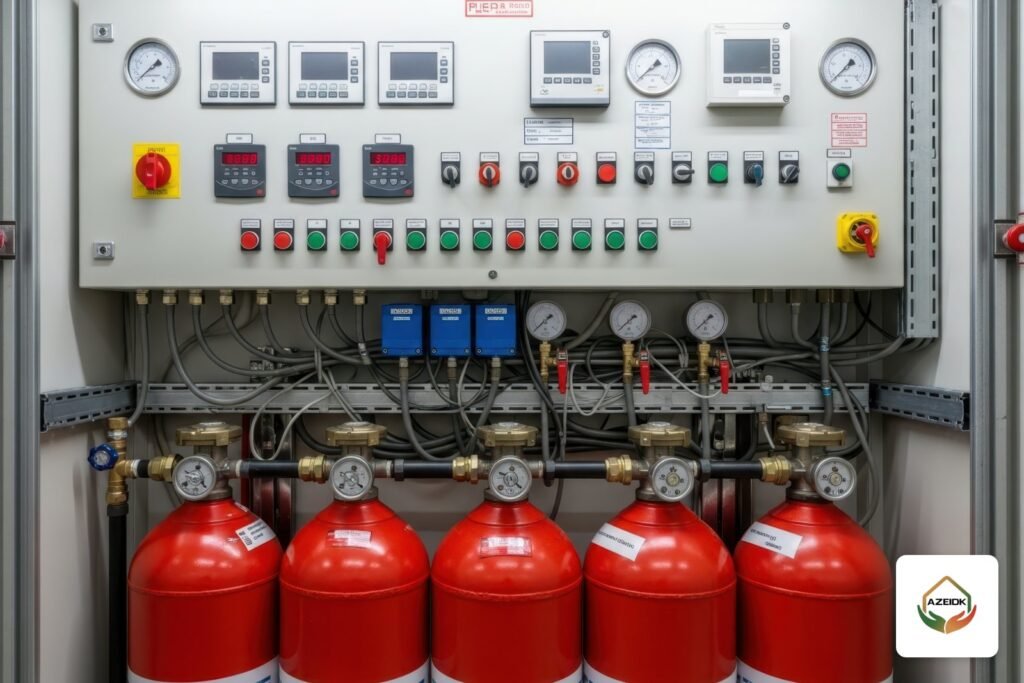
A dry pipe sprinkler system is a sprinkler network whose pipes hold pressurised air or nitrogen instead of water. Water enters only after a sprinkler opens, air pressure drops and the dry pipe valve trips. It is used where the space cannot be kept at or above 40°F (about 4°C), and in Saudi Arabia its most common use is cold rooms, freezers and refrigerated food warehouses.
This article explains how the dry pipe valve and air compressor work, why NFPA 13 sets a maximum water delivery time and system capacity, and what changes in design compared with a wet system. It sits within the fire fighting systems AZEIDK designs and installs.
Key takeaways
- Dry systems are used where the space cannot be held at 40°F (about 4°C) or above at all times.
- Systems with less than 500 gallons of interior pipe volume are exempt from delivery time and quick-opening device requirements, per Code Red’s summary of NFPA 13 (2019).
- Up to 750 gallons, a quick-opening device (accelerator) removes the delivery time requirement. Larger systems must meet the delivery times in the standard.
- The standard sets delivery time by hazard class; the shortest is 15 seconds for dry systems protecting dwelling units, per section 8.2.3.6.3 of NFPA 13 (2019).
- The design area is increased by 30% for dry systems, and the C factor for black steel is 100 instead of 120.
How does a dry pipe sprinkler system work?
In normal conditions water stands at the dry pipe valve in a heated room, and the piping beyond it runs into the cold area filled with compressed air or nitrogen from a compressor or nitrogen generator. The valve is held closed by the pressure differential between the air and water sides. When a sprinkler fuses, air escapes first, air pressure falls, the valve opens and water travels through the pipe to the open sprinkler.
That delay between sprinkler operation and water arrival is the key difference from a wet system, and most design rules follow from it. For a general comparison of wet, dry, preaction and deluge systems, see our sprinkler system types guide.
Dry pipe valve station components
| Component | Function |
|---|---|
| Dry pipe valve | Separates water from air and trips when air pressure drops |
| Air compressor or nitrogen generator | Maintains pipe pressure and makes up small leaks |
| Quick-opening device (accelerator) | Mounted on the valve to speed tripping when air pressure falls |
| Low air pressure switch | Sends a supervisory signal to the fire alarm panel |
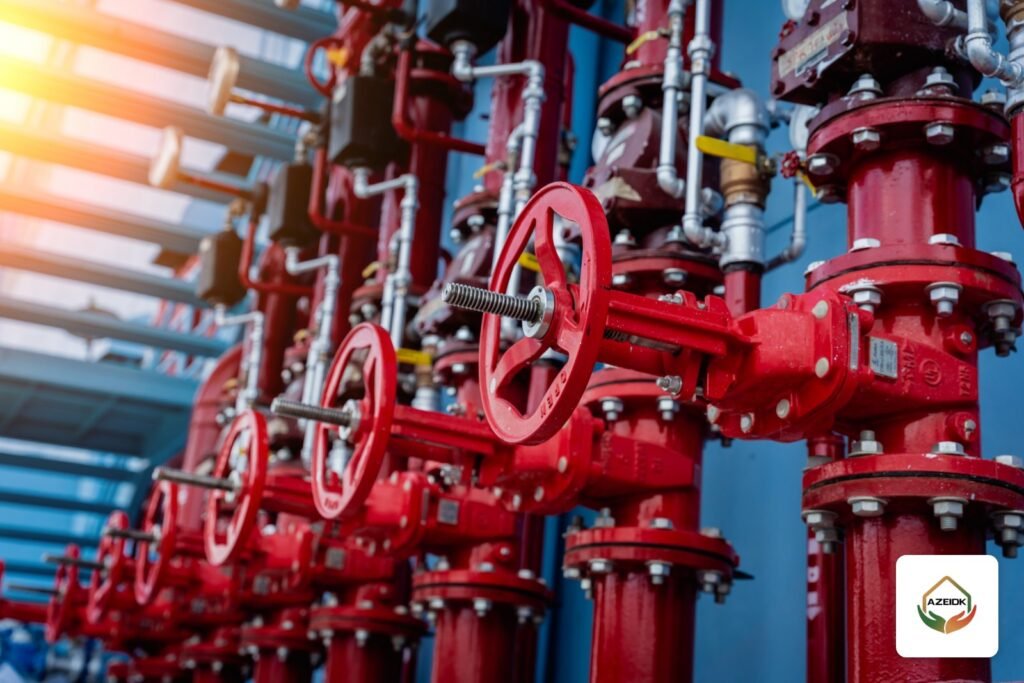
| Control valve and tamper switch | Isolates the system and supervises valve position |
| Inspector’s test and low point drains | Test delivery time and drain test water and condensate |
Code Red Consultants notes that quick-opening devices were accelerators and exhausters, and that exhausters are no longer manufactured, so today’s systems use an accelerator mounted on the valve.
System capacity and water delivery time
According to Code Red Consultants’ summary of NFPA 13 (2019 edition):
- Systems with interior pipe volume below 500 gallons need neither delivery time proof nor a quick-opening device.
- Up to 750 gallons, installing a quick-opening device removes the need to meet delivery times.
- Above 750 gallons the system must meet the delivery times in Table 8.2.3.6.1 of the standard.
The table ties delivery time to the hazard class and the number of sprinklers opened in the test: the higher the hazard, the shorter the allowed time. The one value stated outright in the text of the standard is 15 seconds for dry systems protecting dwelling units (section 8.2.3.6.3). Take the other values directly from the table of the edition adopted for the project.
In practice a large dry system is split into several dry pipe valves with smaller capacities, or delivery time is proven by calculation or field test.
What changes in design compared with a wet system?
- Design area: dry systems take a 30% design area increase, as a MeyerFire discussion citing NFPA 13 notes, so water demand rises and the pump may grow.
- Friction factor: black steel uses a C factor of 100 in dry and preaction systems instead of 120 in wet systems, which raises friction loss in the hydraulic calculations.
- Pipe pitch: branches are pitched to drains so test water and condensate do not stay inside. NFPA 13 summaries give at least ½ inch per 10 ft (4 mm/m) for branch lines in areas subject to freezing.
- Sprinklers: ordinary drops to pendent sprinklers trap water in the cold area, so listed dry sprinklers are used. See our article on the TYCO DS-1 dry sprinkler supplied by AZEIDK.
Air or nitrogen?
Compressed air carries oxygen and moisture, and with residual water at low points a dry system is prone to internal corrosion. Nationwide notes that nitrogen inerting in dry and preaction systems reduces oxygen in the pipe and slows corrosion. A nitrogen generator is therefore considered instead of a compressor in large refrigerated warehouses, decided on system size and running cost.
Dry system or dry sprinkler?
| Situation | Usual solution |
|---|---|
| Small cold or freezer room inside a conditioned building | Listed dry sprinklers fed from the adjacent wet system |
| Whole refrigerated or frozen warehouse | Dry pipe system with one or more valves sized for capacity and delivery time |
| Area where accidental water discharge is a concern (archives, sensitive equipment) | A preaction system is studied instead |
The decision belongs to the engineering design and calculations stage, since it affects the pump, piping and number of valves. The topic matters most for warehouses and logistics and food factories.
Testing and maintenance
At handover, water delivery time is tested from the inspector’s test at the most remote point where system capacity requires it, and the compressor setting, low air switch and its signal to the alarm panel are verified during testing and commissioning. In service, maintenance covers air pressure monitoring, draining low points and valve trip tests under NFPA 25 and the manufacturer’s instructions. As NFSA summarises, NFPA 25 requires a five-year internal assessment of every dry system without exception.
Frequently asked questions
What is the difference between dry and wet sprinkler systems?
In a wet system the pipes hold water that discharges as soon as a sprinkler opens. In a dry system they hold pressurised air or nitrogen, and water enters only after the dry pipe valve trips, so there is a limited delay.
When do I need a dry pipe system in Saudi Arabia?
Where temperature cannot be held at 4°C or above, such as freezer rooms and refrigerated warehouses. Small rooms may only need dry sprinklers from the wet system.
What is the allowed water delivery time?
NFPA 13 sets it by hazard class in its delivery time table: 15 seconds for dwelling units, with the other values taken from the edition adopted for the project. It applies to systems above the capacity thresholds.
What does an accelerator do on a dry pipe valve?
It is a quick-opening device that speeds valve tripping when air pressure drops, and removes the delivery time requirement for systems up to 750 gallons.
Why is the pump sometimes larger for a dry system?
Because the design area increases by 30% and the black steel C factor drops to 100, so required flow and pressure rise.
Is nitrogen required in a dry system?
Not in every case, but it reduces oxygen inside the pipe and slows corrosion, so it is worth studying for large systems.
Conclusion
A dry pipe sprinkler system solves one problem: protecting a cold space that cannot hold standing water in its pipes. The price is a calculated delay in water delivery, a larger design and closer maintenance of air pressure, drainage and corrosion. In Saudi Arabia the binding references are the Saudi Fire Protection Code SBC 801 and Civil Defense requirements, with NFPA 13 used as a technical reference adopted by the designer.
Designing a cold store or freezer rooms? Send us the layout, temperatures and storage method, and our team will choose between a dry system and dry sprinklers with the hydraulic calculations. Contact the AZEIDK team
Related guides
- How Long Do CCTV Cameras Keep Recordings? Retention Days, How to Calculate Them and What Saudi Rules Require
- Hazen-Williams Formula for Fire Pipe Friction Loss: C Factor, Diameter and How to Calculate
- Fire Systems Maintenance Companies in Makkah: Alarm and Fire Fighting Contracts for Hotels and Pilgrim Housing
- Voice Evacuation in Sports Halls and Covered Arenas: Clarity Against Reverberation, Speaker Layout and Fire Alarm Link