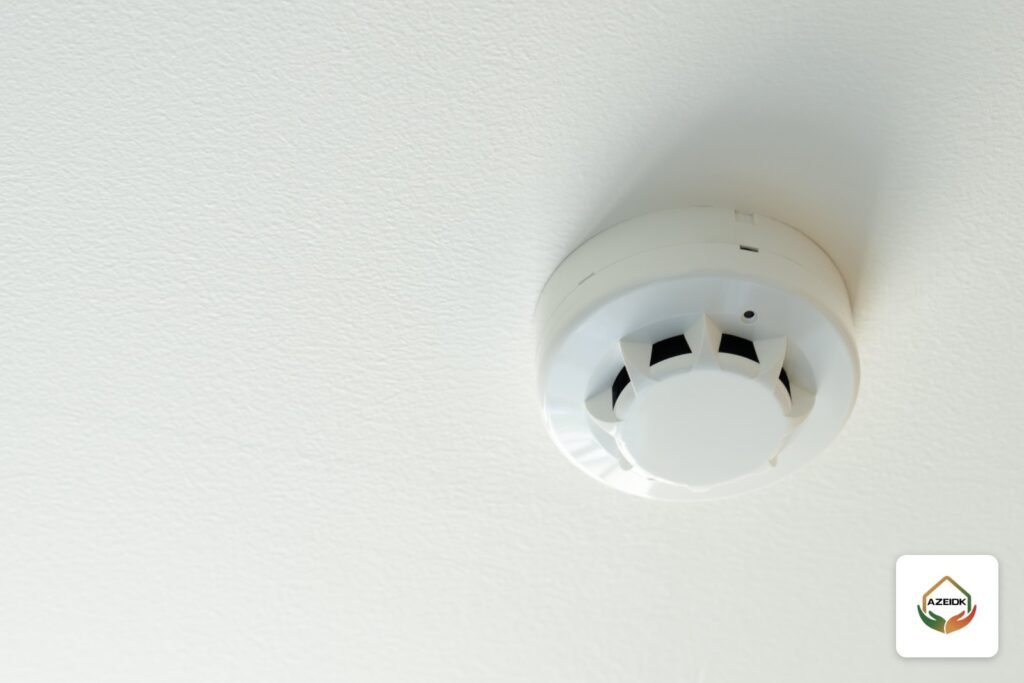
Getting the smoke detector in hotel room design right is where fire alarm planning for hotels and serviced apartments starts: a detector in every sleeping room, an alarm sound that wakes a sleeping guest, and a visible alarm (strobe) in a set number of rooms prepared for guests with hearing loss, all laid out so that shower steam does not trigger a false alarm that wakes the whole floor. In the international model codes that the Saudi fire code follows in its layout, an in-room detector sounds inside that room first and sends a supervisory signal to the panel, while building evacuation follows the approved alarm sequence. This article explains how these in-room points are designed and what the consultant checks before approving the drawings.
Key takeaways
- Sleeping rooms in hotels and serviced apartments need a smoke detector inside the room: either a standalone smoke alarm or a detector connected to the fire alarm panel.
- The international code text (IBC/IFC) allows system smoke detectors in place of smoke alarms, provided an in-room detector does not activate notification appliances outside that room and a supervisory signal reaches the panel.
- A sounder base under the room detector is the common way to put the alarm sound inside the room itself.
- The number of rooms with visible alarms (strobes) for guests with hearing loss is set by a table in the international code, based on the total number of rooms.
- Most in-room false alarms come from shower steam and from kitchenettes in serviced apartments. The fix is detector location and type, not removing the detector.
In this article
- What does hotel fire alarm design require inside a guest room?
- Smoke detector in hotel room: standalone alarm or panel detector?
- Sounder base: how does the alarm reach a sleeping guest?
- Strobes for guests with hearing loss: how many rooms need a visible alarm?
- How do you stop shower steam from causing false alarms in hotel rooms?
- Linking room alarms to the front desk and security room
- Common mistakes in room alarm design and installation
- How AZEIDK supports hotel fire alarm projects
- Frequently asked questions
- Conclusion
What does hotel fire alarm design require inside a guest room?
The Saudi Fire Protection Code SBC 801 follows the layout of the International Fire Code (IFC), and the 2024 edition of the Saudi Building Code has been mandatory since 30 June 2025. In the international code, hotels and serviced apartments fall under transient residential occupancy (Group R-1), and the R-1 provisions call for two things together: a building fire alarm system, and smoke alarms inside sleeping units.
Inside a sleeping unit, alarms go in sleeping rooms and in every room on the escape path from the sleeping room to the unit door. In a suite or serviced apartment this usually means one detector in the bedroom and another in the living area or internal hallway leading to the door. Floor corridors outside the rooms are covered by system smoke detectors, detailed in the approved design.
The figures and clause numbers here come from the international code text and NFPA 72 as given in the sources below. Before any design is approved, check the adopted SBC 801 text in its current edition and the Civil Defense requirements for the project, because some provisions may differ in the Saudi version. For the full licensing picture see our Salamah Civil Defense certificate guide, and for sector requirements see the hospitality industry page.
Smoke detector in hotel room: standalone alarm or panel detector?
The designer has two options. The first is a single station smoke alarm, mains powered with battery backup, that sounds from its own housing. The second is a system smoke detector on the same fire alarm loop that serves the corridors. The second option is the most common in modern hotels with addressable panels.
The international code text accepts system smoke detectors listed to UL 268 as an alternative to smoke alarms, with one key condition: activation of the detector inside a room must not activate notification appliances outside that room. Instead, a supervisory signal is sent to the panel and monitored. The logic is simple. A guest burning incense or taking a hot shower should not wake two hundred other guests. Front desk or security sees the signal on the panel and goes to the room.
| Item | Standalone smoke alarm | Smoke detector on the fire alarm panel |
|---|---|---|
| Sound inside the room | From the alarm itself | Sounder base or a notification appliance in the room |
| Front desk awareness | No signal without extra wiring | Supervisory signal with the room number on the panel |
| Fault monitoring | Relies on the device’s low battery chirp | Panel shows a fault or a removed detector |
| Routine maintenance | Each unit tested by hand | Tested through the panel and the maintenance program |
| Typical use | Small buildings or limited refurbishment | Hotels and serviced apartments with addressable panels |
Panel selection and the number of loops follow building size and room count. Loop layout and isolation are covered in addressable fire alarm loop design.
Sounder base: how does the alarm reach a sleeping guest?
A sounder base is a detector mounting base with a built-in sounder, fitted on the ceiling under the room detector. When the room detector senses smoke, the panel operates the sounder base in that room only. When a general building alarm is declared, the panel operates the room sounder bases according to the cause and effect matrix, so the sound reaches the guest at the bed instead of relying on a corridor sounder behind a closed door.
One point many designers miss: recent editions of the international code text require that, in sleeping rooms of Group R-1, the audible signal from the fire alarm system be a 520 Hz low-frequency signal complying with NFPA 72. Where a fire alarm system is required, the same applies to the signal from smoke alarms inside the sleeping unit. If the detector cannot produce this signal, a listed notification appliance that does, or a detector with an integral 520 Hz sounder, is added. So when selecting a sounder base, read the datasheet: does it support a 520 Hz tone, and is it compatible with the project panel and its protocol?
State clearly in the cause and effect matrix what happens when a room detector operates, what happens when a corridor detector or a manual call point operates, and when the sounder bases in all rooms are activated. This table is what the consultant and Civil Defense review. We explain it in fire alarm cause and effect matrix. If the hotel uses voice evacuation, see voice evacuation alarm systems.
Strobes for guests with hearing loss: how many rooms need a visible alarm?
A guest with hearing loss will not wake to sound, however loud. That is why the international code requires a set number of R-1 sleeping units to have visible alarms, activated by the in-room smoke alarm and by the building fire alarm system. The number is based on the total rooms in the building. These are rows of the table as given in the code text:
| Total sleeping units | Units with visible alarms |
|---|---|
| 6 to 25 | 2 |
| 26 to 50 | 4 |
| 51 to 75 | 7 |
| 76 to 100 | 9 |
| 101 to 150 | 12 |
| 151 to 200 | 14 |
| 201 to 300 | 17 |
| 301 to 400 | 20 |
| 401 to 500 | 22 |
| 501 to 1,000 | 5% of total |
Source: Table 907.5.2.3.2 as published in an IBC-based building code (see references). Check the figure against the adopted SBC 801 text before design.
In practice these rooms are fixed on the room layout with hotel management, because front desk staff must know them when checking in a guest with hearing loss. The room gets a listed strobe or combined sounder strobe, placed so it can be seen from the bed. Our site shows examples of audible and visible appliances such as Notifier L-Series wall horn strobes and Honeywell Gent S-Cubed. The final choice depends on the project panel and compatibility.
How do you stop shower steam from causing false alarms in hotel rooms?
A false alarm in a hotel is more than a nuisance. Repeated alarms teach guests and staff to ignore the alarm, and push some managers to cover or disconnect detectors, which is more dangerous than the false alarm itself. The main causes inside rooms:
- Shower steam: NFPA 72 does not allow a smoke alarm within a 36 in. (910 mm) horizontal path from the door of a bathroom with a shower or tub, unless the device is listed for close proximity. In small rooms the bathroom is often next to the entrance, so the detector moves toward the sleeping area, away from the door.
- Kitchenettes in serviced apartments: cooking near a photoelectric smoke detector causes repeated alarms. Place the detector to the NFPA 72 distances from cooking appliances, and discuss with the consultant a heat detector for the kitchenette itself if the approved design allows it. See heat detector types and installation.
- Incense (bakhoor and oud): a common part of Saudi hospitality. Removing the detector is not the answer. Guest information can mention it, and the local-only room alarm prevents a building evacuation.
- AC outlets: a detector too close to the supply air of an AC unit may respond late or collect dust. Keep the distance given in the manufacturer’s instructions.
Multisensor detectors combine smoke and heat sensing and are often used where false alarms are a risk. An example on our site is the Context Plus 58000-750IMC multisensor detector. A multisensor does not replace correct placement, and its type must be accepted in the approved room design. More on causes and fixes in fire alarm false alarm causes.
Linking room alarms to the front desk and security room
The point of the supervisory signal is that the front desk knows at once which room has an event. Every point on the addressable panel needs a clear label: room and floor number, not “Zone 3 Device 41”. A repeater panel or monitoring screen at the front desk is a good idea when the main panel sits in a remote control room.
Some hotels ask to link fire alarm signals to the property management system (PMS) or the building management system. This can be done through panel outputs or interfaces the manufacturer supports, and is defined at design stage after reviewing the datasheet, while the fire alarm system stays independent in its core function. AZEIDK handles programming and systems integration within the fire alarm scope.
Common mistakes in room alarm design and installation
- A detector in the suite living area only, with none in the bedroom.
- Corridor sounders only, assuming the sound will carry through a closed room door.
- Rooms for guests with hearing loss not marked on drawings and unknown to the front desk.
- A detector next to the bathroom door or in front of an AC outlet.
- Panel point labels that no longer match room numbers after fit-out.
- Dust covers left on detectors after fit-out and not removed before commissioning.
Before handover, every room detector, sounder base and strobe is tested and recorded in the test report. This is part of our testing, commissioning and handover service.
How AZEIDK supports hotel fire alarm projects
We provide fire alarm systems for hotels and serviced apartments from design and calculations to supply, installation, programming and testing, with support for the Civil Defense approval file. We review room layouts, set the positions of detectors, sounder bases and strobes, and prepare the cause and effect matrix. For existing buildings we start by assessing the current system and defining what is missing through our existing systems assessment and scope definition service. AZEIDK holds ISO 9001, ISO 14001 and ISO 45001 certificates with a scope that covers fire alarm design, supply, installation and maintenance.
Frequently asked questions
Is a smoke detector required in every hotel room?
Under the international code text for Group R-1, yes: in every sleeping room and in rooms on the escape path inside the unit. Check the adopted SBC 801 text and the Civil Defense requirements for your project.
Is the whole hotel evacuated when one room detector operates?
Where system detectors replace smoke alarms, the international code says the room detector must not activate notification appliances outside the room, and a supervisory signal goes to the panel. What happens next follows the approved alarm sequence.
What does a sounder base do in a hotel room?
It puts the alarm sound inside the room, so a sleeping guest hears it without relying on the corridor sounder. It operates on the room detector or on a general alarm, as set in the cause and effect matrix.
How many rooms need strobes for guests with hearing loss?
It depends on total rooms: for example 4 rooms for a 26 to 50 room hotel and 12 rooms for 101 to 150 rooms, per the international code table. Confirm against SBC 801.
Why does the room detector alarm after a shower?
Usually because it is close to the bathroom door. NFPA 72 does not allow a smoke alarm within 36 in. horizontally of the door of a bathroom with a shower or tub unless it is listed for that.
Can the fire alarm be linked to the hotel PMS?
Often yes, through panel outputs or interfaces the manufacturer supports. It is defined at design stage after reviewing the datasheet, without affecting the core fire alarm function.
Conclusion
The room alarm is what wakes the guest first. A detector in every sleeping room, sound that reaches the bed, strobes in the rooms set aside for guests with hearing loss, detectors kept away from shower steam and kitchenettes, and clear labels on the panel. These details are settled on the drawings before installation. Fixing them after fit-out is harder and costs more.
Fitting out a hotel or serviced apartments? Send us the room layouts, number of floors and the current panel type if there is one, and we will review detector, sounder base and strobe positions before installation. Talk to the AZEIDK team
Related guides
- Warehouse Smoke Detectors: Beam or Point for High-Bay Storage
- Fire Alarm Devices: System Components, How It Works and Types
- Outdoor CCTV Camera Guide: IP67 Weatherproofing, Heat, Night Vision and Vandal Resistance in Saudi Conditions
- Saudi Security Surveillance Cameras Law: Facility Obligations, Recording and Retention