Fire alarm in car workshops usually fails for one reason: a smoke detector fitted in a bay that fills every day with engine exhaust, welding fumes and oil mist. The result is repeated false alarms, then someone disconnects or covers the detector and the workshop is left without real detection. In most bays the answer is a heat detector, with smoke detectors kept for offices, the parts store and electrical rooms.
For how conventional and addressable systems compare, see our guide to choosing a fire alarm system for Saudi projects.
This guide explains where each detector type belongs in a car service centre, how to choose the heat detector rating, and what should report to the panel. It applies AZEIDK’s fire alarm systems to the car showrooms and workshops sector.
Key points
- Smoke detectors in service bays false-alarm on exhaust and welding; heat detectors are the usual choice there.
- A standard heat detector suits bays at normal temperature; a high-temperature (CS) detector suits areas with normal temperatures up to 55°C.
- Offices, reception, parts stores and electrical rooms stay on smoke detection for early warning.
- Heat detector spacing comes from the detector’s listing and is reduced on higher ceilings.
- Sprinkler flow and supervisory switches report to the same panel.
In this article
- Why workshops suffer false alarms
- Fire alarm in car workshops: which detector for which area?
- Choosing the heat detector rating
- Where detectors go in a service bay
- Service pits and classified areas
- What should report to the panel?
- Testing at handover and in service
- Common mistakes
- Frequently asked questions
- Summary
Why workshops suffer false alarms
An optical smoke detector sees particles in the air and cannot tell where they came from. In a workshop they come from engines running indoors, welding and cutting, oil mist from compressed air, and brake dust. Any of these can trigger a detector without a fire. Repeated false alarms are dangerous in themselves because staff learn to ignore the sounder or isolate the circuit.
Designers therefore use heat detectors where conditions do not suit smoke detection, a well-established practice in NFPA 72 design.
In Saudi Arabia the binding rules are the Saudi Fire Code SBC 801, Civil Defense requirements and the approved drawing; NFPA 72 serves as a technical reference for design and testing detail.
Fire alarm in car workshops: which detector for which area?
| Area | Usual detector | Reason |
|---|---|---|
| Mechanical and electrical bays | Standard heat detector | Daily exhaust and welding fumes |
| Near drying ovens or hot surfaces | High-temperature (CS) heat detector | High normal temperature may trigger a standard unit |
| Car wash area | Heat detector suited to humidity | Steam confuses smoke detectors |
| Unventilated service pits | Explosion-proof devices where classified | Heavier-than-air vapours collect |
| Reception, offices, waiting lounge | Smoke detector | Early warning in occupied space |
| Parts store | Smoke detector, or per rack height | Cardboard, plastics, packaging |
| Electrical and server rooms | Smoke detector | Cable fires start with smoke |
Choosing the heat detector rating
Designers keep the detector’s operating temperature clearly above the highest expected ceiling temperature. A ventilated or air-conditioned bay is fine with a standard detector. A closed bay in summer, or the area above a paint drying oven or near an exhaust outlet, can approach the standard detector’s operating point.
Examples of addressable Context Plus detectors supplied by AZEIDK:
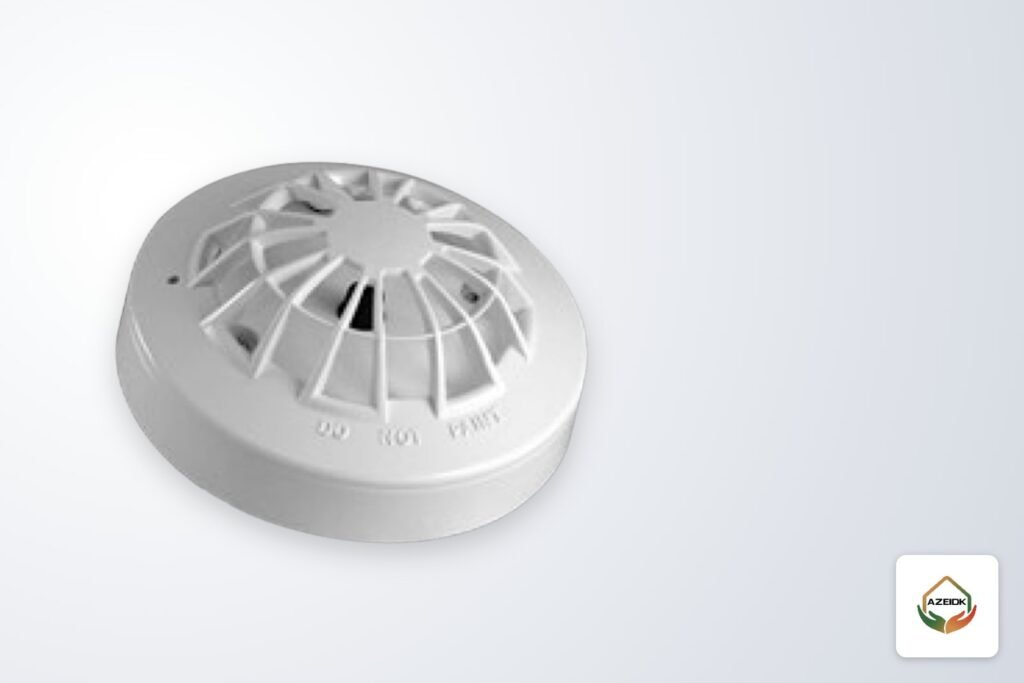
- Standard heat detector 55000-400IMC: LPCB approved, XPERT card addressing, operating range -20 to +70°C, suited to dusty areas or areas with smoke under normal conditions.
- High-temperature CS heat detector 55000-401IMC: LPCB approved, for areas with a normal temperature of 55°C, operating range -20 to +120°C.
Small workshops on conventional systems usually use conventional heat detectors, either fixed temperature or combined fixed temperature and rate of rise. Note that rate-of-rise sensing can react to a sudden hot air flow when large bay doors open in summer, so fixed-temperature detectors are preferred near big doors. Each model’s datasheet and listing remain the final reference.
Where detectors go in a service bay
A heat detector works when hot gases reach it, so the ceiling matters more than for smoke detectors. The designer checks:
- Listed spacing: every heat detector has a listed spacing, reduced for ceilings above about 3 m (10 ft) per NFPA 72 tables.
- Beams and trusses: deep beams trap heat in pockets and change detector positions and numbers.
- Very high roofs: in tall bays a fire can grow large before heat reaches the roof; linear heat cable or other detection may be studied. See FirePlus-LHD linear heat detection.
- Heat sources: never directly above an exhaust outlet or heater.
Service pits and classified areas
NEC Article 511 treats unventilated pits in repair garages as classified locations because fuel vapours are heavier than air. If the designer classifies a pit this way, any alarm device inside must suit that classification, meaning explosion-proof detection, covered in our article on explosion-proof smoke detectors and ATEX zones. Often the simpler fix is to ventilate the pit as designed.
What should report to the panel?
- Manual call points at every exit and bay door.
- Sounders loud enough over compressors and air tools, with beacons where technicians wear hearing protection.
- Sprinkler flow and supervisory switches, where sprinklers exist.
- The paint booth suppression system, so its operation or fault shows on the panel.
- Ventilation fan shutdown or extraction start, as the smoke control design requires.
In complexes with a showroom, workshop and store, zones on the addressable panel are set so the guard knows at once which bay or store raised the alarm.
Testing at handover and in service
A heat detector is not tested with canned smoke, and the test method depends on its type. Restorable detectors, including electronic addressable and rate-of-rise detectors, are tested with a dedicated heat source following the manufacturer’s instructions; the panel must then show the alarm with the correct address and description. Non-restorable fixed-temperature detectors are not heat tested, because the test destroys the heat element; their wiring and circuit are tested electrically or mechanically according to type. Every sounder and beacon in the bay is tested with compressors running, so the owner knows the signal is audible in real working conditions, not in a silent workshop on handover day.
After commissioning the system goes into a periodic maintenance programme: visual checks that detectors are not covered or coated in oil, functional testing per NFPA 72 tables, and panel battery checks. A trade article quoting the NFPA 72 test table notes that non-restorable fixed-temperature spot heat detectors are replaced, or a sample is sent for laboratory testing, 15 years after installation. AZEIDK covers this under its preventive and periodic maintenance contracts.
Common mistakes
- Copying the showroom design (smoke detectors) into the bays.
- A standard heat detector above a drying oven or under a hot closed metal roof.
- Adding lifts or ducts that block detectors after handover.
- Not connecting sprinkler switches and the paint booth system to the panel.
- Covering detectors during welding and forgetting to remove the cover.
Frequently asked questions
Is a smoke detector suitable for a car workshop?
In offices and stores, yes. In service bays it causes false alarms from exhaust and welding, so heat detectors are preferred.
What is the difference between a standard and a CS heat detector?
The standard detector is for normal temperatures; the CS detector is for areas with a high normal temperature up to 55°C, such as next to drying ovens.
How far apart should heat detectors be in a workshop?
Use the detector’s listed spacing from its datasheet, reduced for ceiling height per NFPA 72 tables. There is no single spacing for all detectors.
Is a conventional system enough for a small workshop?
Often, for a small workshop with few zones. With several bays and stores, an addressable system pinpoints the fire location more clearly.
Do I need an explosion-proof detector in a service pit?
Only if the pit is classified as hazardous because it lacks adequate ventilation. The designer decides, and proper ventilation may remove the need.
How is a heat detector tested in a workshop?
It depends on the type. A restorable detector, such as an addressable unit, is tested with a dedicated heat source per the manufacturer’s instructions, then the panel is checked for the correct address. A non-restorable fixed-temperature detector is not heat tested; its circuit is tested electrically or mechanically. Neither is tested with smoke.
Summary
A good workshop alarm system is one that does not sound without a reason: heat detectors in the bays, smoke detectors in offices and stores, ratings chosen for the real ceiling temperature, and clear links to sprinklers and the paint booth. That keeps the system switched on and trusted by staff.
Is your workshop plagued by false alarms? Send us the layout and the current detector types, and we will propose the right type and layout for each area. Contact the AZEIDK team
Related guides
- Multi-Branch CCTV Central Monitoring: VMS, Network, Bandwidth and Permissions
- Solar Farm Security Cameras: Thermal Perimeter Protection, PTZ and NVR for Remote Sites
- Fire Pump Pressure Sensing Line and Relief Valve: Why the Pump Short-Cycles
- DSPPA Public Address Systems: Analog, IP and Voice Evacuation, and How They Link to the Fire Alarm