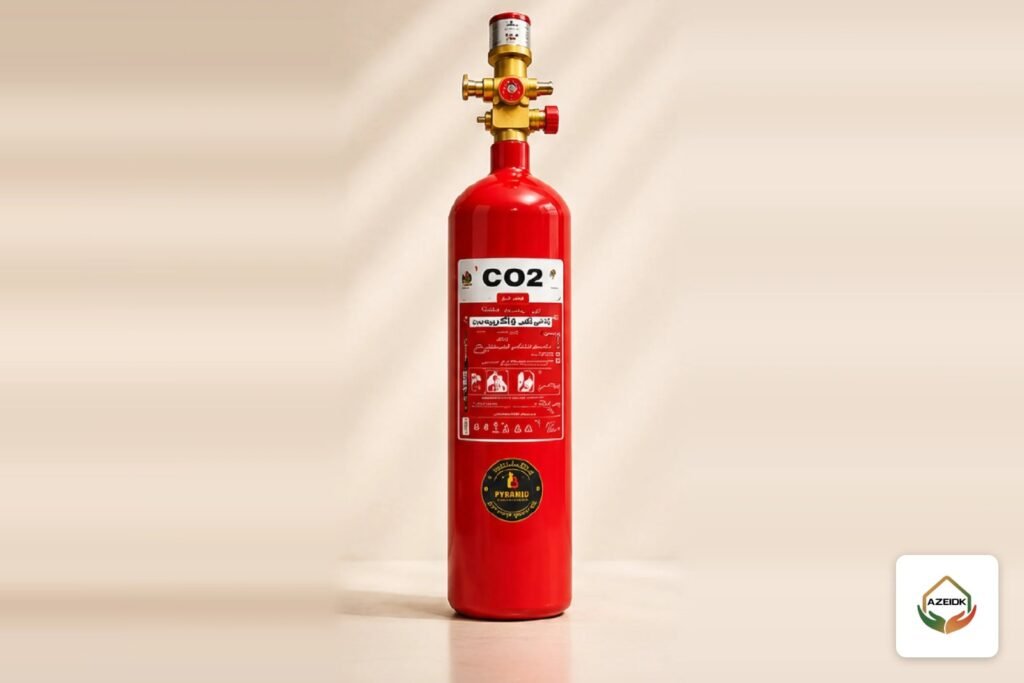
In electrical panels and closed equipment cabinets, a fire often starts where nobody can see it, and it can grow before anyone arrives with an extinguisher. That is the job of an automatic CO2 extinguisher: a compact unit installed inside or next to the protected space that releases carbon dioxide on its own when the temperature rises. This guide explains the PYRAMID Fire End unit supplied by AZEIDK Egypt, with its specifications as stated in the manufacturer datasheet, and when to choose it over a manual CO2 extinguisher or an automatic powder unit.
The full range is on the PYRAMID extinguishers page at AZEIDK Egypt, and project solutions are on the fire extinguishers in Egypt page.
Key points
- PYRAMID Fire End is an automatic CO2 extinguisher triggered by a linear sensor tube, in 3, 6 and 10 kg capacities.
- The sensor tube is a flexible polymer tube, 6 mm in diameter, that bursts at 96 °C or higher according to the datasheet.
- It suits small enclosed spaces that are hard to reach, such as electrical panels and cabinets holding sensitive equipment.
- Unlike powder it leaves no residue, and unlike a manual extinguisher it needs nobody on site.
- The datasheet does not state the volume each capacity protects, so agree on it in writing with the supplier before delivery.
In this article
How does the Fire End automatic CO2 extinguisher work?
The datasheet describes a system that detects fire automatically at an early stage to protect enclosed areas that are difficult to reach. The idea is simple: a CO2 cylinder is connected to a flexible sensor tube routed inside the protected space, and the tube is pressurised by the cylinder itself. When the heat at any point along the tube reaches its bursting temperature, the tube bursts at that point and the gas escapes through it. The tube is both the detector and the discharge path, which is why the datasheet lists the sensor tube under “Discharge”.
The valve head carries a pressure reducer that brings the cylinder’s internal pressure down from 150 bar to the working pressure of the tube, between 11 and 28 bar according to the datasheet, plus a gauge that shows the tube pressure at any moment and a safety valve to relieve excess pressure. That gauge is what you check during routine inspection: a pressure drop points to a leak or a damaged tube.
PYRAMID Fire End CO2 specifications from the datasheet
| Item | Value per the datasheet |
|---|---|
| Capacities | 3, 6 and 10 kg |
| Extinguishing agent | Carbon dioxide (CO2) |
| Test pressure | 250 bar |
| Burst pressure | 400 to 450 bar |
| Cylinder | High grade cold-drawn steel, one piece without welds |
| Valve head | Cast brass for high pressure and heavy duty, with sensor tube pressure gauge, safety valve and pressure reducer |
| Tube working pressure | 11 to 28 bar after the reducer (cylinder internal pressure 150 bar) |
| Outlets | One tube outlet ending in a metal plug; a version with two outlets and two end-of-line gauges is available |
| Sensor tube | Flexible, smooth polymer tube, 6 mm diameter |
| Tube bursting temperature | 96 °C or higher |
| Paint finish | Surface treatment and electrostatic red polyester coating, weather resistant |
| Standards | Egyptian Quality Mark; Egyptian Standard ES 735/2015 for 3 and 6 kg, ES 6115/2007 for 10 kg |
| Factory certifications | ISO 9001:2015, ISO 14001:2015 and ISO 45001:2018 |
| Warranty | 2 years from date of purchase against manufacturing defects |
The datasheet also states that the unit is made in Egypt, which matters in the Egyptian market: supply, spare parts and refilling are easier and faster than with imported units, and compliance with the Egyptian standard and Quality Mark can be shown directly at inspection.
Where does it fit in Egyptian facilities?
The PYRAMID page on the AZEIDK Egypt site presents this unit for automatic suppression in small enclosed spaces, electrical panels and sensitive equipment, because the gas leaves no residue. Places where this need comes up often in Egypt include:
- Main and sub distribution boards in residential and office buildings and malls.
- Control panels in factories and production lines, and pump and equipment control panels.
- Server and network cabinets in offices and branches, where a gas suppression system for the whole room is not justified.
- Closed cabinets holding electrical equipment that nobody enters during normal operation.
What these share is a small, defined, closed space, because CO2 works only while its concentration stays inside the space. A whole room where people work needs other solutions, covered on the special fire suppression in Egypt page.
Automatic CO2, manual CO2 or automatic powder?
All three options are PYRAMID products at AZEIDK Egypt. The comparison below comes from the datasheets and the brand page on our site:
| Item | Automatic CO2 Fire End | Manual CO2 | Automatic powder Fire End |
|---|---|---|---|
| Operation | Automatic, sensor tube bursts at 96 °C or higher | Manual squeeze lever or circular handwheel, needs a person on site | Automatic, linear sensor tube |
| Capacities | 3, 6 and 10 kg | 2, 3, 6, 10, 20 and 30 kg (10 kg and up on wheels) | 6 and 12 kg |
| Residue after discharge | None | None | Powder that needs cleaning and an equipment check |
| Best place | Small closed space, panels and sensitive equipment | Electrical and equipment rooms with trained people present | Electrical panels, motor rooms and small enclosed spaces |
| Egyptian standard | ES 735/2015 and ES 6115/2007 | ES 735/2015 and ES 6115/2007 | ES 8442/2021 per the AZEIDK page |
When to choose automatic CO2: when the likely fire is inside a closed cabinet or panel, the equipment is sensitive or expensive so you do not want powder on it, and nobody is nearby all the time. When a manual unit is enough: in rooms where technicians or security staff can reach the extinguisher quickly; see the guide to PYRAMID manual CO2 extinguishers. When automatic powder is better: when the space is not tightly closed or holds combustible solids, and powder will not harm what is inside. In most projects the automatic unit sits inside the panel and a manual extinguisher stays on the wall next to it: they work together, one does not replace the other.
Before you buy: what the datasheet does not say
The datasheet does not state the volume each capacity protects, the maximum sensor tube length, or any signal output to a fire alarm panel. So ask the supplier in writing before delivery for:
- The right capacity for each panel or cabinet, based on its internal dimensions and openings.
- The tube length and route inside the panel, and whether the two-outlet version is needed.
- How you will know the unit has discharged if the panel is somewhere nobody sees.
- A routine inspection schedule for gauge reading and cylinder weighing, and who refills the unit after discharge.
For a wider explanation of installation steps, inspection and common mistakes with both automatic types, see the guide to PYRAMID Fire End automatic extinguishers in Egypt.
Safety note
Carbon dioxide displaces oxygen, so it is dangerous to people in enclosed spaces. A unit inside a closed panel keeps the gas in the panel, but if it is installed in a small room that people enter, put a clear warning sign on the door, and nobody should enter after a discharge until the space has been well ventilated.
Frequently asked questions
At what temperature does the PYRAMID automatic CO2 extinguisher operate?
According to the datasheet, the sensor tube bursts at 96 °C or higher, and the gas is released from the burst point.
Which capacities are available?
3, 6 and 10 kg. The supplier should confirm in writing which capacity suits each space, because the datasheet does not give the protected volume per capacity.
Does it comply with Egyptian standards?
The datasheet states that the cylinder carries the Egyptian Quality Mark and complies with Egyptian Standard ES 735/2015 for 3 and 6 kg and ES 6115/2007 for 10 kg.
Does it replace the manual extinguisher?
No. It protects what is inside the panel or cabinet, while the manual extinguisher remains for fires outside it and for quick response in the room.
Summary
The PYRAMID Fire End CO2 unit is a simple way to protect small enclosed spaces that nobody watches: it needs nobody on site, leaves no residue on equipment, and complies with Egyptian standards according to its datasheet. Choose the capacity and tube for each panel, keep a manual extinguisher next to it, and read the gauge at every routine inspection.
Have electrical panels or server cabinets you want protected automatically? Send the number of panels, their internal dimensions and location, and the AZEIDK Egypt team will set the right capacity and tube length and supply PYRAMID units with their datasheet. Contact AZEIDK Egypt
Sources
Related guides
- Pharmaceutical Factory Fire Protection in Egypt: Clean Rooms, Stores, Control Rooms
- Mall Fire Protection in Egypt: Zones, Landlord and Tenant Roles, and Maintenance While Open
- Fire Network Hydrostatic Testing: Pressure, Duration and Test Records
- 1500 GPM Fire Pump from 3PUMP at 10 bar: Large Projects and Pump Rooms