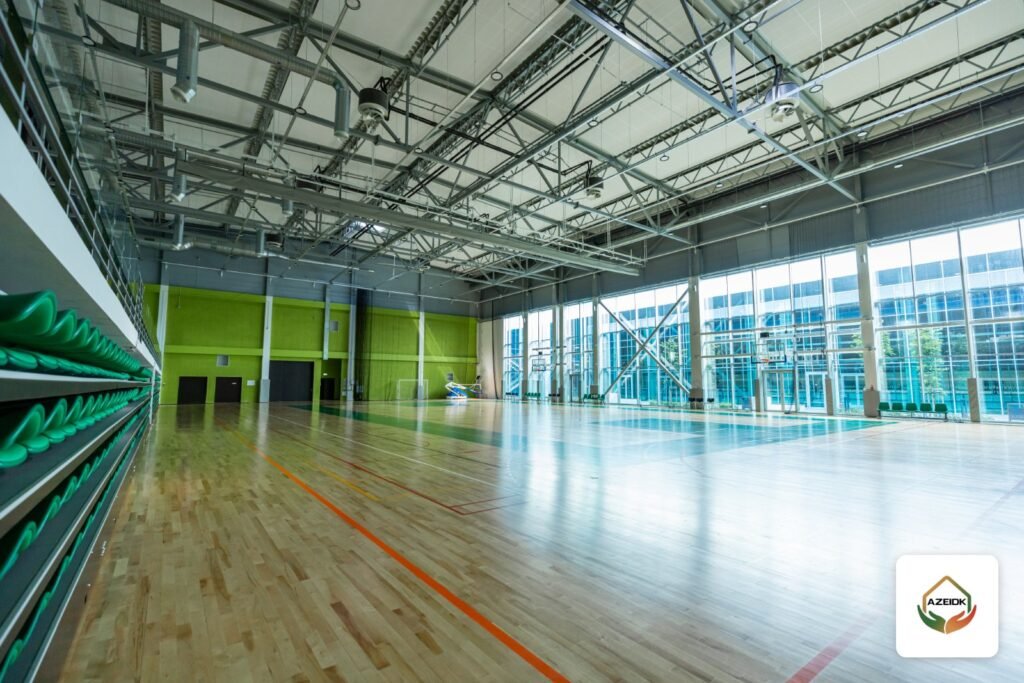
A pharmaceutical plant is sensitive in two ways: its stores and labs hold flammable materials and solvents, and its clean rooms, equipment and control systems are costly to stop. Pharmaceutical factory fire protection therefore relies on accurate early detection that finds a fire before it reaches production, and on suppression that does not damage the surroundings without need.
This article covers the hazard zones in a pharmaceutical plant, from clean rooms to raw material stores and control rooms, the role of fire detection and alarm systems from Context Plus, the AFC-227 clean agent system, and the right extinguishers for each area, as supplied by AZEIDK Egypt.
Key takeaways
- Clean rooms have strong airflow and different pressure from corridors; this affects how smoke reaches a detector and must be considered in design.
- Raw material and solvent stores carry the highest fire load and need detection, extinguishers and a fire network.
- Control and server rooms are usually protected by a clean agent system such as AFC-227 so equipment is not damaged by water or powder.
- An addressable panel pinpoints the alarm, which matters in a plant divided into many rooms and corridors.
- CO2 extinguishers suit labs, electrical panels and sensitive equipment because they leave no residue.
In this article
- Pharmaceutical factory fire protection: what is different?
- Hazard zones in a pharmaceutical plant
- Detection and alarm in clean rooms
- Control and server rooms: clean agent suppression
- The right extinguisher for each area
- Fire water network
- Maintenance and testing without stopping production
- The Egyptian framework
- Common mistakes in pharmaceutical plants
- Frequently asked questions
- Conclusion
Pharmaceutical factory fire protection: what is different?
A pharmaceutical plant is normally divided into zones of different cleanliness grades, separated by doors, airlocks and air pressure differences. This helps by limiting smoke spread, but it slows access to the fire if the alarm is not precise. Airflow from the HVAC system can also carry smoke away from a detector or dilute it, delaying the alarm if detectors are placed without regard to air movement.
The second point is the value of what burns or gets damaged. A small fire in a control room or sample store can stop a production line, and in some rooms water or powder can do more harm than the fire itself. The suppression type is therefore chosen room by room.
Hazard zones in a pharmaceutical plant
| Zone | Hazard | Typical fit |
|---|---|---|
| Clean rooms and production lines | Electrical equipment, strong airflow | Smoke detectors placed for airflow, CO2 extinguishers |
| Raw material and excipient store | Powders, cardboard, containers on racks | Smoke or beam detectors by height, ABC powder, hose cabinets |
| Solvent and alcohol store | Flammable liquids | AFFF foam and powder extinguishers, heat detection |
| Labs and quality control | Small solvent quantities, instruments | CO2 extinguishers, smoke detectors |
| Control and server rooms | Sensitive equipment and cables | AFC-227 clean agent system, early detection |
| Finished goods and packing store | Cardboard and plastic | Beam detectors in high stores, powder extinguishers |
Detection and alarm in clean rooms
An optical smoke detector is the usual choice in production rooms and corridors, such as Context Plus Series 65A conventional detectors or addressable detectors compatible with ZFP panels. The key point in clean rooms is to respect supply and return grilles: do not place a detector directly in front of a supply outlet, and consider the effect of air change rates on smoke reaching the detector. Detector selection is covered in smoke and heat detectors.
A Context Plus addressable panel shows the room name or detector number on its display, so the shift team knows where the alarm is without opening clean rooms unnecessarily. The cause and effect matrix is programmed to the design, for example a signal to the HVAC system or to the gas suppression system in the affected room. High stores use a beam detector such as TANDA TX7130.
Control and server rooms: clean agent suppression
The control room that runs the production lines and the server room holding production and quality data suit neither water nor powder. AZEIDK Egypt supplies the AFC-227 clean agent system from American Fire Control, which uses HFC-227ea and puts out the fire without leaving residue on equipment. Its success depends on room integrity and agent quantity calculated on room volume; see FM-200 quantity calculation.
The system is linked to detectors in the room and gives an alarm and a delay before discharge so occupants can leave. Room integrity is tested at handover, because open gaps weaken the agent concentration.
The right extinguisher for each area
AZEIDK Egypt supplies PYRAMID extinguishers: CO2 in 2, 3, 6, 10, 20 and 30 kg to EN3 and Egyptian standard ES 735, suited to labs, electrical panels and sensitive equipment because they leave no residue; ABC powder from 1 to 12 kg for stores and cardboard areas; and 6 and 9 L AFFF foam for the solvent store.
NFPA 10 limits travel distance to a Class A extinguisher to 22.9 m; for units up to about 18 kg the top is no higher than 1.53 m, with at least 102 mm floor clearance. In clean rooms the extinguisher is often best placed at the entrance or in the airlock, agreed with the quality department.
Fire water network
Besides alarm and extinguishers, the plant normally needs a fire fighting network with a 3PUMP pump set, Falcon Gold hose cabinets in corridors and stores, AFC FW-9000 hydrants around the buildings, and a fire department (Siamese) connection. The protection type inside clean rooms, sprinklers or otherwise, is decided by the consultant under the Egyptian code and the nature of the room.
Maintenance and testing without stopping production
Testing a detector in a clean room is not like testing one in an office. The technician needs gowning and entry procedures, and the test equipment must not contaminate the room. Agree the test schedule in advance with quality and production, and use planned shutdowns or sterilisation windows to test detectors in the most sensitive rooms.
When any zone is isolated on the panel for maintenance or sterilisation, record it in the panel log with the responsible person and the restore time, and check before the end of the shift that every zone is back in service. A periodic maintenance contract covers the panel, batteries, detectors, the clean agent system and cylinder weighing, and extinguishers; AZEIDK Egypt provides these under maintenance and technical support. Inspection frequency follows the manufacturer’s instructions, NFPA references and the Egyptian code, and each inspection is logged for civil protection or insurer review.
The Egyptian framework
The obligation comes from Building Law No. 119 of 2008 and its regulations, the Egyptian Code for the Design and Implementation of Fire Protection for Buildings, 2026 edition (Ministerial Decree No. 355 of 2026), the Egyptian code for industrial and storage facilities, and drawing review and pre-occupancy inspection by the General Directorate of Civil Protection. NFPA 72, NFPA 2001 and NFPA 10 are technical design references.
Common mistakes in pharmaceutical plants
- Placing a detector in front of a supply air grille in a clean room, delaying smoke reaching it.
- Using a conventional panel with few zones in a plant divided into dozens of rooms.
- Protecting the server room with a powder extinguisher only.
- Leaving cable openings unsealed in a clean agent room, so the integrity test fails.
- Storing alcohol and solvents with cardboard in one store.
- Isolating detectors during sterilisation or maintenance and forgetting to restore them.
Frequently asked questions
Which detector suits a clean room?
Usually an optical smoke detector, placed according to airflow and away from supply grilles.
Is clean agent suitable for a plant control room?
Yes. A system such as AFC-227 suits control and server rooms because it leaves no residue, provided the room is sealed and the agent is calculated.
Which extinguisher suits a QC lab?
CO2 is the best fit for instruments and panels, with a small foam unit if solvents are present.
Do I need an addressable alarm panel?
In a plant divided into many rooms an addressable panel is the better fit because it pinpoints the alarm.
Who decides the suppression type inside clean rooms?
The consultant, under the Egyptian code and the nature of the room, with civil protection approval.
Conclusion
Pharmaceutical factory fire protection needs accurate detection suited to clean room airflow, a panel that pinpoints the alarm, clean agent for control rooms, extinguishers chosen room by room, and a fire network for stores and corridors. That way a fire is found early and put out without stopping the plant longer than necessary.
Designing or upgrading fire protection in a pharmaceutical plant? Send us the layout and room division and we will propose detectors, the panel and suppression. Talk to the AZEIDK Egypt team
Related guides
- Fire Alarm Maintenance in Egypt: Testing Detectors, Call Points, Sounders, Panel Batteries and the Fault Log
- Fire Extinguisher Expiry: How Long It Lasts, When to Refill and When to Replace
- Fire Extinguishers for Hotels in Egypt: Type and Size for Corridors, Kitchens, Laundry and Car Parks
- Fire System Maintenance: Routine Testing and Common Causes of Failure