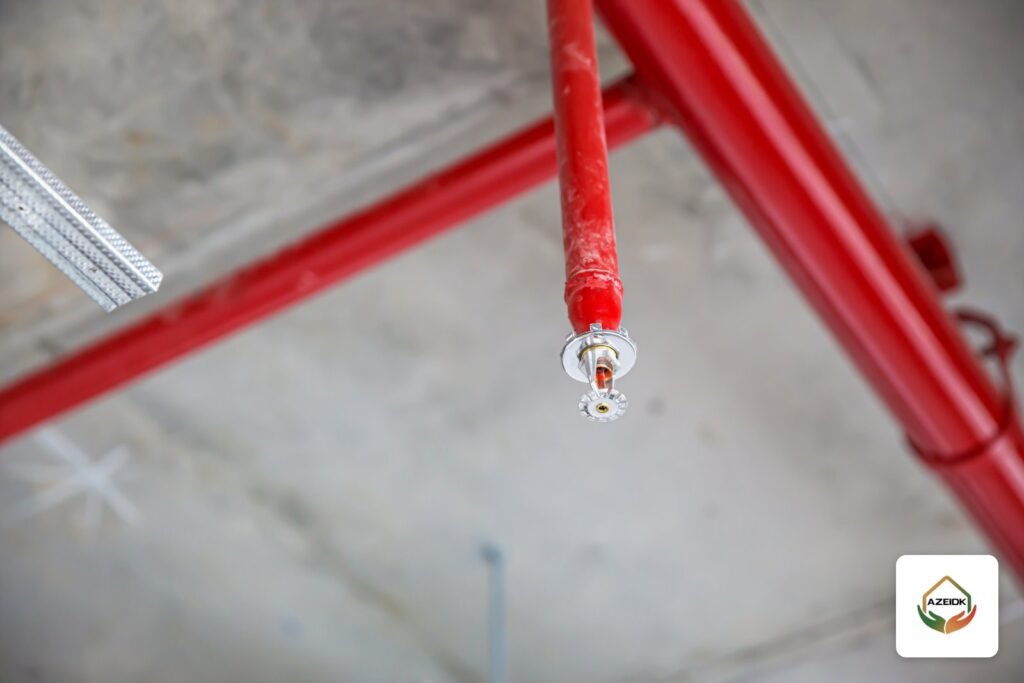
In bills of quantities and on site, three words come with every fire sprinkler: upright, pendent and sidewall. The difference is not cosmetic. It is the installation position and the shape of the deflector that spreads the water, and one type cannot be fitted in place of another. This guide explains the three types, where each one fits in Egyptian buildings, and how to confirm the type on the sprinkler and in the datasheet.
AZEIDK Egypt supplies and installs sprinkler networks and their valves as part of its fire fighting systems.
Key takeaways
- An upright sprinkler sits on top of the pipe with the deflector up, and suits exposed piping in warehouses, pump rooms and car parks.
- A pendent sprinkler hangs below the pipe with the deflector down, and drops through the suspended ceiling in offices, hotels and corridors.
- A sidewall sprinkler is fixed on the wall and throws water horizontally into the room, where running pipe in the ceiling is difficult.
- Orientation is part of each model’s listing, and each orientation has its own model number in the datasheet.
- Dry pipe systems permit upright sprinklers; pendents are limited to listed dry sprinklers or specific cases in heated areas (NFPA 13-2022).
In this article
- What is the difference between an upright and a pendent sprinkler?
- Why can’t a pendent be turned upside down to work as an upright?
- SSU and SSP: how to tell the type from the sprinkler itself
- When is an upright sprinkler used?
- When is a pendent sprinkler used?
- When is a sidewall sprinkler the answer?
- Quick comparison of the three types
- Deflector position below the ceiling
- Sprinklers on dry pipe systems
- Frequently asked questions
- Summary
- Sources
What is the difference between an upright and a pendent sprinkler?
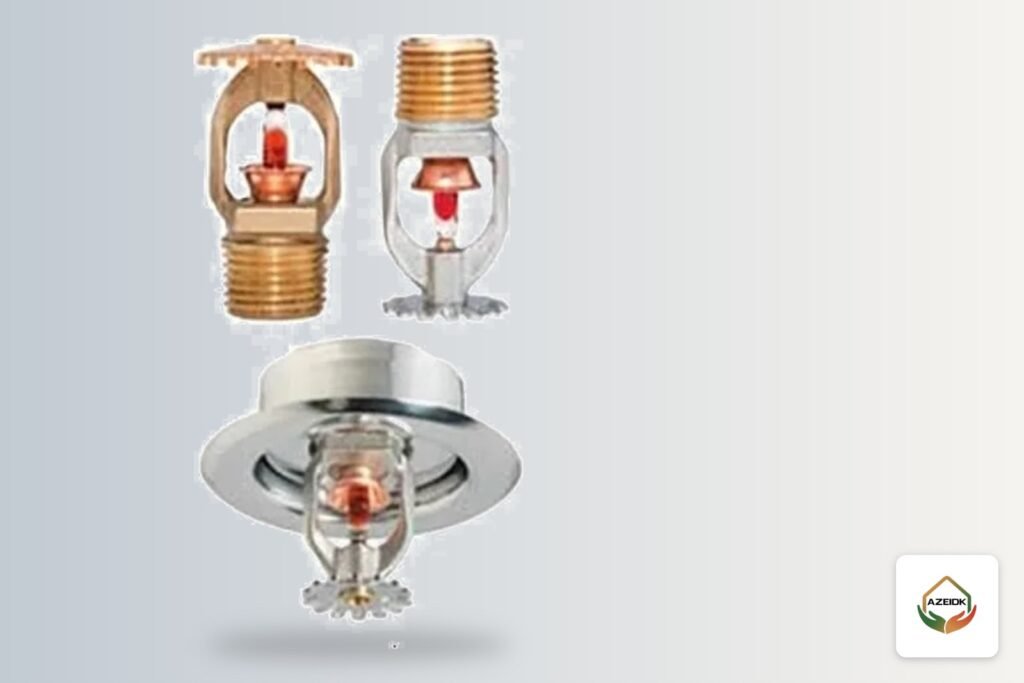
An upright sprinkler is screwed into a fitting on top of the branch line. Water leaves the orifice upwards, strikes the deflector and is thrown down in an umbrella pattern. A pendent sprinkler is installed below the pipe or on a drop, so water discharges straight down onto the deflector and spreads over the protected area.
The two may share body, glass bulb and K-factor, but the deflector differs in shape and direction, so each has its own model number. For K-factor and temperature ratings, see our guide to automatic sprinkler systems in Egypt.
Why can’t a pendent be turned upside down to work as an upright?
The deflector creates the spray pattern. An upright deflector catches rising water and turns it towards the floor; a pendent deflector catches falling water and spreads it outwards and down. Invert the sprinkler and the water hits the deflector from the wrong side, the pattern changes, and the design density no longer reaches the area it was calculated for. Datasheets state the orientation explicitly; for example, TYCO datasheet TFP151 for Series TY-B instructs that pendents be installed in the pendent position and uprights in the upright position.
When replacing a sprinkler, order a model that matches in orientation and listing, and check the sprinkler identification number (SIN) stamped on it first.
SSU and SSP: how to tell the type from the sprinkler itself
SSU stands for Standard Spray Upright and SSP for Standard Spray Pendent; both are used in catalogues and BOQs to tell the two apart. Markings on the sprinkler are not uniform between manufacturers, so on site rely on three checks together:
- The model number or SIN on the sprinkler, matched against the datasheet.
- The deflector position relative to the frame: above it on an upright, below it on a pendent.
- Any orientation marking on the deflector, confirmed against the datasheet.
In the submittal and the BOQ, uprights and pendents should appear as separate items with separate model numbers, not as a generic line such as “K5.6 sprinkler, 68°C”. See how to write the items in our fire works BOQ guide.
When is an upright sprinkler used?
Uprights are chosen where piping is exposed with no suspended ceiling below it, for example:
- Warehouses with exposed concrete or steel roofs, as in warehouse fire protection.
- Fire pump rooms, plant rooms and electrical rooms.
- Basement car parks, as in underground car park fire protection, plus factories and workshops.
An upright fits directly on the branch line with no drops and no escutcheon, and it is the orientation permitted as standard on dry pipe systems.
When is a pendent sprinkler used?
The pendent is the usual choice where a suspended ceiling (gypsum board or tiles) hides the piping, as in offices, hotels, hospitals, shops and corridors. A short drop runs from the branch line to the ceiling, and the sprinkler shows below it with an escutcheon covering the opening. In a recessed pendent, part of the body sits within the ceiling opening, and it is installed only with the recessed escutcheon specified for its model in the datasheet.
When is a sidewall sprinkler the answer?
A sidewall sprinkler is fixed on the wall near the ceiling and throws water horizontally into the room. It is used where running pipe in the ceiling is difficult, such as hotel rooms and corridors in some existing buildings. Its limits differ from standard sprinklers: no more than 4.3 m apart in light hazard and 3.0 m in ordinary hazard. The 2019 edition of NFPA 13 limits standard sidewalls to smooth, flat ceilings in light hazard, and allows them in ordinary hazard only for models listed for that use. Coverage area and throw come from each model’s listing tables.
Quick comparison of the three types
| Item | Upright | Pendent | Sidewall |
|---|---|---|---|
| Position | Above the pipe, deflector up | Below the pipe, deflector down | On the wall, horizontal throw |
| Typical ceiling | Exposed piping, no suspended ceiling | Suspended or finished ceiling | Smooth ceiling where pipe is hard to run |
| Typical uses | Warehouses, pump rooms, car parks, factories | Offices, hotels, hospitals, shops | Hotel rooms, corridors in existing buildings |
| Common abbreviation | SSU | SSP | Varies by manufacturer |
Deflector position below the ceiling
Per published summaries of the 2019 edition of NFPA 13: under an unobstructed ceiling the deflector of a standard upright or pendent sits 25 to 305 mm below the ceiling, and the 305 mm maximum remains in the 2025 edition. Under obstructed construction (beams or joists) it sits 25 to 150 mm below the structural members and no more than 560 mm below the ceiling. For spacing values, see distance between fire sprinklers, ceiling and wall.
Sprinklers on dry pipe systems
A dry pipe system is filled with pressurised air, and all water must be drained after any test or trip. An upright lets water drain back into the pipe, while the drop of a pendent traps water at a low point. The 2022 edition of NFPA 13 therefore permits upright sprinklers and listed dry sprinklers on dry systems, plus specific cases for pendent and sidewall sprinklers in areas kept at or above 4°C. In cold rooms the usual answer is a dry pendent sprinkler ordered to a specific length, as in cold store fire protection.
Frequently asked questions
What is an upright fire sprinkler?
A sprinkler installed on top of the pipe with the deflector facing up, used with exposed piping such as warehouses, pump rooms and car parks.
Can a pendent sprinkler be installed upside down as an upright?
No. The deflector is designed for one direction, and inverting it changes the spray pattern. Orientation is part of the model’s listing.
Which type suits a suspended ceiling?
A pendent or recessed pendent with the escutcheon specified for its model. If the architect wants no visible sprinkler, a concealed sprinkler with a cover plate is used.
Is the spacing different for upright and pendent sprinklers?
No, the same tables apply to both. Sidewall sprinklers have their own spacing limits.
What is binding in Egypt: NFPA 13 or the Egyptian code?
The Egyptian fire code 2026 and civil protection requirements are binding. NFPA 13 is a technical reference applied where the design adopts it or the contract requires it.
Summary
Sprinkler orientation follows the ceiling, the piping and the system type: upright for exposed piping and dry systems, pendent for suspended ceilings, sidewall where pipe cannot run in the ceiling. List each orientation as its own item with its model in the BOQ, and check the position and stamped number of every sprinkler at receiving and during periodic maintenance.
Preparing a sprinkler BOQ or replacing sprinklers in an existing building? Send the drawings or photos of the existing heads and the ceiling type, and the AZEIDK Egypt team will confirm the right orientation and network components with datasheets. Contact AZEIDK Egypt