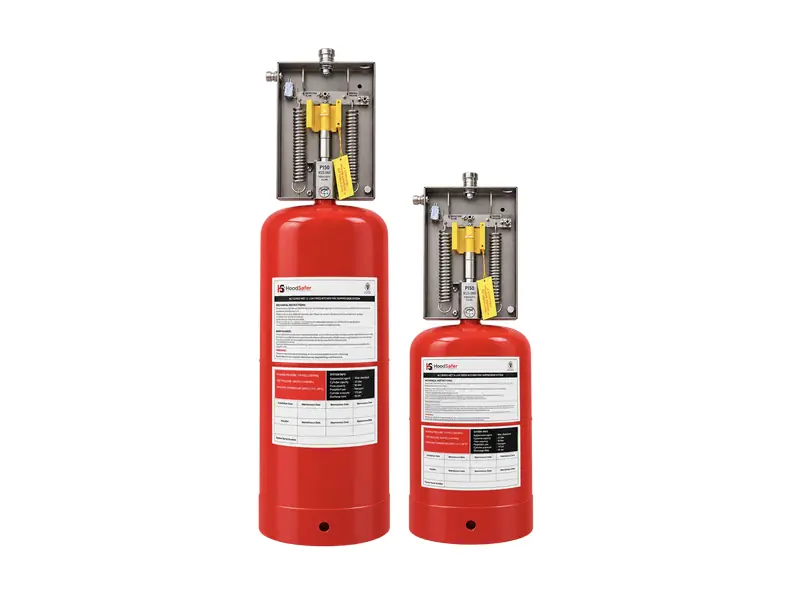
In a closed electrical panel or small engine room, a fire can grow before anyone notices. Here an automatic fire extinguisher mounted next to the hazard senses heat inside the space and releases the agent with no one there to operate it.
This article covers the PYRAMID Fire Search automatic extinguishers supplied by AZEIDK Egypt, in dry powder and CO2: how they work, where they fit, installation and inspection points, and their limits compared with a designed system.
Key takeaways
- PYRAMID Fire Search units use a pressurised polymer sensor tube routed through the protected space. The datasheets state that the tube bursts at 96 °C or above.
- Two versions are available: dry chemical powder in 6 and 12 kg, and carbon dioxide (CO2) in 3, 6 and 10 kg.
- Powder suits spaces where residue and clean-up are acceptable. CO2 suits panels and sensitive equipment because it leaves no residue, but it calls for strict precautions to protect people.
- The datasheets do not give a maximum protected volume, so confirm the right size for each space with the supplier before ordering.
- An automatic extinguisher is local, supplementary protection. It does not replace systems required by the Egyptian code or shown on drawings approved by Civil Protection.
In this article
- What is a Fire Search automatic extinguisher and how does it work?
- Published specifications for PYRAMID automatic extinguishers
- Where is an automatic fire extinguisher used?
- Keeping people safe around automatic CO2 units
- Installation: practical steps before commissioning
- An automatic extinguisher is not a substitute for a designed system
- Routine inspection after installation
- Common mistakes
- Frequently asked questions
- Conclusion
What is a Fire Search automatic extinguisher and how does it work?
Each unit is a pressurised cylinder with a brass valve head and a pressure gauge. A flexible polymer sensor tube connects to the head and runs through the space you want to protect. The tube is the detector: it stays under pressure, and when fire heat at any point on its route reaches the burst temperature, it opens there and discharge starts.
Detection happens inside the enclosed space itself, not at the room ceiling like a standard heat detector, so the tube reaches places a detector or a person cannot. The datasheets describe this as early-stage protection for hard-to-access enclosed areas.
The AZEIDK page lists these units as Fire Search, while the datasheets published on the same page give the model name as PYRAMID Fire End. When you ask for a quotation, state both the type and the capacity to avoid any confusion.
Published specifications for PYRAMID automatic extinguishers
Data below is from the AZEIDK Egypt PYRAMID page and its published datasheets. Anything not stated there is left out.
| Item | Fire Search dry powder | Fire Search CO2 |
|---|---|---|
| Capacities | 6 and 12 kg | 3, 6 and 10 kg |
| Extinguishing agent | ABC dry chemical powder, to EN 615 and ES 4833 per the AZEIDK page | Carbon dioxide gas |
| Propellant | Nitrogen | Not applicable (the gas is the agent) |
| Pressures (bar) | Working 17.5, test 35, burst 70 or above | Test 250, burst 400 to 450 |
| Cylinder | Steel to ES 1110 | One-piece cold-drawn steel, no welded seam |
| Sensor tube | Flexible polymer, 8 mm diameter | Flexible polymer, 6 mm diameter |
| Tube burst temperature | 96 °C or above | 96 °C or above |
| Operating temperature range | -20 to +70 °C | Not stated |
| Standards and marks | EN3 and an Egyptian standard per the AZEIDK page; Egyptian quality mark per the datasheet (the two sources write the Egyptian standard number differently, so ask the supplier to confirm it) | Egyptian quality mark; ES 735 for 3 and 6 kg, ES 6115/2007 for 10 kg |
| Warranty | 2 years against manufacturing defects | 2 years against manufacturing defects |
The CO2 head has a pressure reducer that drops the internal pressure (about 150 bar) to the tube working pressure (11 to 28 bar per the datasheet), and a relief valve. It comes with one tube outlet, or two outlets with two gauges at the end of the line. The powder head is nickel-chrome plated brass with a gauge and relief valve.
What the datasheets do not state: the maximum volume each capacity protects, the maximum sensor tube length, and any UL listing or FM approval. We give no figures for them; get the supplier to confirm the capacity for each space in writing.
Where is an automatic fire extinguisher used?
The AZEIDK page lists electrical panels, engine rooms and small enclosed spaces for the powder version, and electrical panels and sensitive equipment in small enclosed spaces for the CO2 version. The common thread is a small, closed or nearly closed space with a known ignition source and no one watching it. The table is good practice, not manufacturer instructions:
| Location | Closest fit | What to check before choosing |
|---|---|---|
| Electrical distribution and control panels | Usually CO2; powder if clean-up after discharge is acceptable | Panel sealing, sensitivity to powder residue, who isolates power after discharge |
| Small enclosed engine rooms | Powder | Oils or fuel, ventilation, normal ambient temperature |
| Sensitive equipment cabinets | CO2 | No residue; no people inside at discharge |
| Small enclosed spaces with poor access | Depends on the combustible materials | Size and openings, confirmed capacity, inspection access |
Powder or CO2?
ABC powder handles solids, flammable liquids and gases, but leaves residue to clean, and equipment may need checking before restart. CO2 leaves no residue, but needs the gas concentration held inside the space, so openings reduce its effect, and it is hazardous to people in enclosed spaces. For a wider comparison of agents and fire classes, see our guide to fire extinguisher types and their uses.
Keeping people safe around automatic CO2 units
The U.S. Environmental Protection Agency (EPA) report on carbon dioxide risks explains that extinguishing concentrations are far above lethal levels, and that concentrations above 17% can cause loss of consciousness and death within about a minute. It notes that most reported incidents happened during maintenance on or around CO2 systems, and that the gas can flow into adjacent low-lying spaces such as pits, tunnels and passageways.
A unit inside a closed panel keeps most of the gas in the panel, but the risk rises in a small room that people enter. The precautions the report lists include warning signs telling people to leave the area, instructions and drills for everyone working near these spaces, and a means of ventilating the space promptly, so nobody enters after a discharge until it has been ventilated. Nobody should work in a space protected by a CO2 unit without knowing it is there.
Installation: practical steps before commissioning
The steps below are general good practice. The manufacturer’s installation instructions govern every detail:
- Survey the space (ignition sources, size, openings) and get the capacity confirmed in writing.
- Mount the cylinder securely, away from direct heat sources, where the gauge is easy to read.
- Route the sensor tube over the likely hazards, such as terminals and breakers inside panels, and clip it along its route. Avoid sharp edges and tight bends.
- Make sure normal ambient temperature stays well below the tube burst temperature and, for the powder version, within the operating range in the datasheet.
- Check the gauge reading after the tube is connected and record it in the handover report.
- Put a warning label on the panel door or space entrance stating that automatic suppression is installed and which agent it uses.
- Need a signal to the fire alarm panel or automatic power isolation? The datasheets do not mention a pressure switch, so ask the supplier before approval.
An automatic extinguisher is not a substitute for a designed system
The systems a building needs are set by the Egyptian Code for the Design and Implementation of Fire Protection for Buildings — 2026 edition (Ministerial Decree No. 355 of 2026) and by the drawings approved by the General Directorate of Civil Protection (Ministry of Interior). Replacing any system on approved drawings with automatic units needs the authority’s agreement; do not assume it.
An automatic unit protects one small space. It does not detect fire outside its tube route, sends no alarm signal unless equipped to, and is not based on a design concentration for a whole room. If the whole room needs total flooding, such as a main electrical room or a room full of sensitive equipment, that is a job for special hazard suppression systems designed with proper calculations. It also does not replace the portable extinguishers placed in corridors and rooms under the project’s fire extinguisher solution.
Routine inspection after installation
Follow the manufacturer’s instructions and maintenance contract. Typical visual checks:
- Gauge reading within the normal range. Any drop points to a leak or tube damage that needs immediate attention.
- Sensor tube intact along its full route: no cuts, cracks, heat damage or missing clips.
- Cylinder body, paint and labels in good condition.
- No new equipment or openings that change the hazard.
After any discharge, a qualified party recharges or replaces the unit and tube, and the fire cause is reviewed before restart. AZEIDK Egypt provides supply, installation, maintenance and technical support for these units as part of its fire protection scope.
Common mistakes
- Sizing by guesswork.
- Fitting a CO2 unit in a small room that staff enter, or in a low pit, without warning signs or ventilation.
- Routing the tube away from the real hazard, or next to something that runs hot.
- Using CO2 in a panel with large open vents, so the gas concentration cannot be held.
- Treating the automatic extinguisher as a replacement for a system on the approved drawings or for portable extinguishers.
- Not deciding who isolates the power and who cleans the equipment after a powder discharge.
Frequently asked questions
At what temperature does a PYRAMID automatic extinguisher operate?
The datasheets state that the sensor tube bursts at 96 °C or above for both versions.
How many cubic metres does a 6 kg unit protect?
The published datasheets do not give a protected volume for any capacity, so we do not quote a figure. The supplier should confirm capacity per space in writing.
Does the unit send a signal to the fire alarm panel?
The datasheets do not mention a pressure switch or signal output. If you need a link to the alarm panel or to power isolation, ask about it before approval.
Can powder be used inside electrical panels?
Yes, the AZEIDK page lists panels for the powder version, but it must be cleaned out after discharge. CO2 is often preferred for sensitive equipment.
Can it replace a gas suppression system in an electrical room?
No. The unit protects one small, defined space. Protecting a whole room needs a system designed with concentration calculations and approved as part of the project drawings.
Conclusion
PYRAMID Fire Search automatic extinguishers protect a panel or small enclosed space right at the hazard, with a sensor tube that works unattended. Choose by the space and what can burn in it, confirm capacity with the supplier, then install and inspect to the manufacturer’s instructions. These units remain an extra layer on top of the systems and portable extinguishers required by the code and the approved drawings, not a replacement for them.
Have panels or small spaces that need automatic protection? Send us the dimensions of each space and the equipment inside it, and we will recommend the type and capacity with the datasheet. Talk to the AZEIDK Egypt team