Buyers often ask about fire extinguisher prices in Egypt before defining what they need, and get quotes that are far apart for units that look the same. An extinguisher’s price is not set by the weight on its label. It depends on the agent, the format, compliance with the Egyptian standard, cylinder and valve quality, and what follows the purchase: refilling, maintenance and installation.
There is no price list here, because prices change with quantity, timing and scope. Instead, this article explains what makes quotes differ and how to request one you can compare. The AZEIDK Egypt fire extinguishers page shows the available types and the supply and maintenance services that go with them.
Key takeaways
- Price is driven first by the agent (dry powder, CO2 or AFFF foam), then by capacity and whether the unit is portable, wheeled or automatic.
- Refillable hand-held dry powder extinguishers in Egypt fall under the mandatory standard ES 8442/2021. A non-compliant unit may look cheaper, but it is a risk.
- Cylinder, valve and pressure gauge quality explain much of the price gap between two units of the same weight.
- The real cost includes refilling and periodic inspection over the extinguisher’s life, not only the purchase price.
- An accurate quote needs a clear quantity and a layout based on the hazards, plus a clear scope: supply, installation and accessories.
In this article
- Why is there no fixed price list for fire extinguishers?
- How the extinguishing agent affects price
- Capacity and format: portable, wheeled or automatic
- Stored pressure, cylinder and valve quality
- Compliance with mandatory Egyptian standards and the quality mark
- Cost over the extinguisher’s life
- Quantity, delivery, installation and accessories
- How to request an accurate quote from AZEIDK Egypt
- Common mistakes when comparing fire extinguisher prices
- Frequently asked questions
- Conclusion
Why is there no fixed price list for fire extinguishers?
“A 6 kg extinguisher” can mean very different products. It can be a compliant stored-pressure powder unit with the quality mark, or an unbranded unit with a thinner cylinder, a plastic valve and powder of unknown specification. Same weight, different life and different performance in a fire.
Price also changes with quantity, the mix of types, delivery location and whether mounting is included. Compare quotes with the same line items, not two bare numbers.
How the extinguishing agent affects price
Choose the agent for the hazard, not the price. Still, each agent has its own build, and that shows in the cost:
- Dry chemical powder (ABC): the most common choice for offices, shops and stores, covering Class A, B and C fires. It works at normal operating pressure and is usually the lowest cost per kilogram.
- Carbon dioxide (CO2): the gas is stored at high pressure, so the unit needs a thick-walled cylinder plus a valve and discharge horn rated for that pressure. It usually costs more than a powder unit of the same weight, but leaves no residue, which suits electrical and server rooms.
- AFFF foam: for flammable liquid fires such as oils and solvents, sized in litres. Its price depends on the foam type and concentration and on the cylinder’s internal coating.
If you are unsure which type each area needs, settle that before you ask for a price. Selection by hazard is covered in Types of Fire Extinguishers and Their Uses.
Capacity and format: portable, wheeled or automatic
Larger capacity means more agent and a heavier cylinder, but cost does not rise in a straight line: wheeled units add a frame, wheels and longer hose, and automatic units add self-actuation. The table below lists the categories shown on the PYRAMID extinguishers page at AZEIDK Egypt, and what raises the cost of each:
| Category | Available capacities | Standards stated on the page | What drives the price |
|---|---|---|---|
| Portable dry powder, stored pressure | 1, 3, 6, 9 and 12 kg | EN3 and Egyptian standard ES 8442/2021, with the Egyptian quality mark | Capacity, powder type, valve and gauge quality |
| Wheeled dry powder | 25 and 50 kg | EN 1866 and Egyptian standard ES 1494 | Frame, wheels, hose length and powder quantity |
| Automatic Fire End powder | 6 and 12 kg | ES 8442/2021 and the Egyptian quality mark; actuated by a linear detection tube | Detection and self-actuation, mounting method |
| Carbon dioxide (CO2) | 2 to 30 kg (portable and wheeled) | EN3 and Egyptian standard ES 735, with the quality mark | High-pressure cylinder, valve and discharge horn |
| AFFF foam | 6 to 45 L (portable and large capacity) | EN3 and Egyptian standard ES 711 for portable sizes | Foam type and concentration, corrosion protection of the cylinder |
Do not pick a bigger unit because it feels safer. Heavy units are hard to carry and use quickly; suitable sizes at the right travel distances work better. To see when a wheeled unit is really needed, read Wheeled Fire Extinguishers. For automatic units, see PYRAMID Fire End Automatic Extinguishers.
Stored pressure, cylinder and valve quality
Powder extinguishers are either stored-pressure, with gas and powder in one cylinder and a gauge showing pressure, or cartridge-operated, where a separate gas cartridge is pierced on use. PYRAMID portable powder units are stored-pressure, so the gauge shows their condition at a glance.
Between two units of the same type and size, the gap usually comes from parts you cannot see in a photo:
- Cylinder: steel thickness, weld quality and coating, which decide how well it holds pressure and resists rust.
- Valve and head: a solid metal valve that can be removed for refilling, not one that leaks at the first service.
- Pressure gauge: a clear, accurate gauge with a visible green operating zone.
- Hose, horn and bracket: hose material, connections and a bracket suited to the unit’s weight.
- The agent itself: powder quality affects performance and price.
Compliance with mandatory Egyptian standards and the quality mark
The Egyptian Organization for Standardization and Quality (EOS) issued ES 8442/2021 for hand-operated, refillable dry chemical powder fire extinguishers. The EOS website lists it as mandatory under Decision No. 220 of 2021. It covers performance, test methods, design, manufacture and pressure resistance. Wheeled powder extinguishers have a separate Egyptian standard, ES 1494.
Compliance means testing and quality control for the manufacturer, a normal part of the price. If a unit is far cheaper than the market, ask which standard it meets and look for the quality mark. PYRAMID portable powder, CO2 and foam units are listed on their page as meeting EN3, the matching Egyptian standards and the Egyptian quality mark.
Checking that a unit is genuine is covered separately in Genuine vs Counterfeit Fire Extinguishers.
Cost over the extinguisher’s life
The purchase price is only the first cost. An extinguisher needs periodic inspection, refilling after any use, even partial, and cylinder pressure testing at intervals set by the reference standard and the manufacturer. NFPA 10 (2026 edition) is the technical reference for this, alongside the Egyptian fire code, 2026 edition (Ministerial Decree No. 355 of 2026), and the General Directorate of Civil Protection (Ministry of Interior). NFPA itself is not legally mandatory in Egypt.
This should shape your purchase:
- A refillable unit with a good valve lasts years; a cheap one may not survive opening or pressure testing.
- A supplier with spare parts and agent in stock refills faster.
- Standard types and sizes make maintenance cheaper.
AZEIDK Egypt provides periodic maintenance and recharging, and can price it with the supply quote. For the steps, read Fire Extinguisher Maintenance and Recharging.
Quantity, delivery, installation and accessories
Quantity affects the unit price. More important, the number should be calculated from floor area, hazard and travel distance, not guessed. The method is explained in How Many Fire Extinguishers Do You Need?
Then come items that may or may not be in the quote, a common reason numbers differ:
- Delivery to site, especially for wheeled units and large quantities.
- Wall mounting with suitable brackets at the correct height.
- Location signs that show where each extinguisher is.
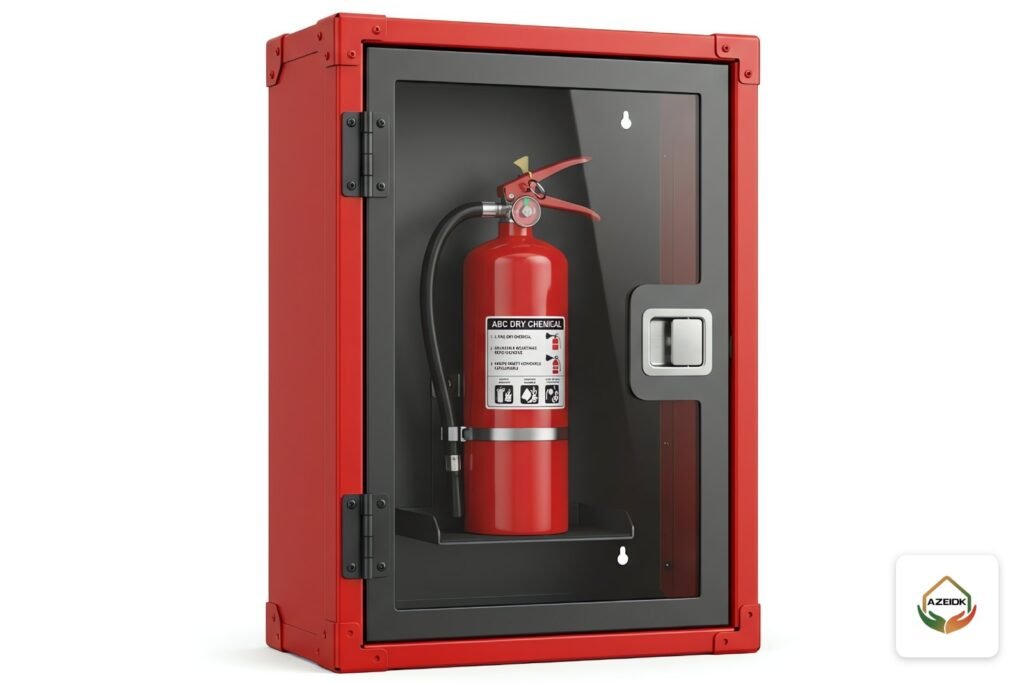
- Extinguisher cabinets in exposed areas or where tampering is likely.
- Fixing automatic units above panels or engine rooms.
Ask for each item to be stated in the quote, so you compare like with like.
How to request an accurate quote from AZEIDK Egypt
The clearer your request, the more accurate the quote. Prepare the following:
- Premises: office, shop, restaurant, warehouse or factory, with area and floors.
- Hazards present: electrical panels, server rooms, flammable liquids, stored solid materials.
- Types, sizes and quantities if set in approved drawings or a civil protection report.
- Scope of work: supply only, or supply and installation, with brackets, signs and cabinets if needed.
- Delivery address and the required date.
- Maintenance: whether you want periodic maintenance and recharging priced with the quote.
If you have no set quantity or layout, say so. The technical team can help choose types for each area as part of AZEIDK Egypt services for technical consultation and product selection. With several quotes in hand, use Comparing Fire System Supply and Installation Quotes before you sign.
Common mistakes when comparing fire extinguisher prices
- Comparing same-weight units without asking about the Egyptian standard and quality mark.
- Choosing CO2 or powder on price alone, ignoring the hazard.
- Buying the largest size to cut the count, leaving heavy units too far from some areas.
- Ignoring refill and inspection costs, then finding out the cheap unit cannot be serviced.
- Comparing a quote that includes installation, brackets and signs with a supply-only quote.
- Ordering without a calculated quantity, then adding units after the civil protection inspection.
Frequently asked questions
What determines the price of a fire extinguisher in Egypt?
Agent, capacity, format, compliance with the Egyptian standard and quality mark, cylinder and valve quality, quantity, and what the quote covers.
Is a dry powder extinguisher cheaper than a CO2 extinguisher?
Usually yes at the same weight, because CO2 needs a high-pressure cylinder and valve. But choose by hazard: CO2 suits electrical and server rooms.
Does the price include refilling and maintenance?
A new unit comes with its first fill only. Inspection and recharging are separate items you can have priced with the supply quote.
How do I request a quote for a large number of extinguishers?
Send the premises type, area, hazards, quantities if known, scope of work and delivery address. If quantities are not calculated, start with the layout.
Is a non-compliant extinguisher a problem if it works?
Refillable hand-held dry powder extinguishers fall under a mandatory Egyptian standard, ES 8442/2021. A non-compliant unit gives no assurance of performance or cylinder strength, and may not accept servicing.
Is a 6 kg dry powder extinguisher enough for a small shop?
It is common in shops, but number and size depend on area, hazard and travel distance. An electrical panel may also need a CO2 unit.
Conclusion
Fire extinguisher prices follow clear choices: the right agent, capacity and format, compliance with the Egyptian standard, build quality, lifetime maintenance and the scope of supply and installation. State these in your request and you get a quote you can compare fairly, and avoid a cheap unit that costs more later.
Putting together an extinguisher list for your premises or project? Send the premises, hazards, quantities and scope, and we will prepare a detailed PYRAMID quote, with maintenance if needed. Talk to the AZEIDK Egypt team