An office looks like a quiet, low-risk place, but it is full of things that burn: paper, furniture, carpet, cables and equipment running all day, and often a small server room and an electrical panel at the end of a corridor. Choosing a fire extinguisher for an office does not need complex calculations, but it does need two right decisions: the right type for each location, and a position the staff can reach in seconds.
To compare fire extinguisher types and what each one is for, see our guide to choosing the right extinguisher for each hazard.
This guide explains how to choose extinguishers for offices and companies in Egypt, from a small office downtown to a full floor in a tower in the New Administrative Capital or New Cairo, with examples from the PYRAMID extinguisher range that AZEIDK Egypt supplies as part of its fire extinguisher solutions.
Key takeaways
- Corridors and open work areas are usually protected with ABC powder extinguishers, because the main hazard is ordinary solids.
- Server rooms and electrical panels are protected with CO2 extinguishers, because powder leaves residue that harms electronics.
- Under NFPA 10 the travel distance to a Class A extinguisher must not exceed 22.9 m, and one extinguisher serves no more than about 1,045 m².
- An extinguisher weighing up to 18.14 kg is mounted with its top no higher than 1.53 m and its base at least 102 mm above the floor.
- Extinguishers do not replace the alarm system and fire fighting network in office buildings where the code requires them.
In this article
- What is the real risk in an office?
- Which fire extinguisher for an office, location by location?
- Server room: why CO2 and not powder?
- How many extinguishers does an office need, and where?
- The monthly check by the office manager
- Common mistakes
- Offices in a tower: owner and tenant roles
- Frequently asked questions
- Conclusion
What is the real risk in an office?
NFPA 10 (Annex A.5.4.1.1) lists offices among its examples of light hazard occupancies, because the amount of combustible material is limited compared with stores and factories. Light hazard does not mean no hazard. Most office fires start from an electrical source, such as an overloaded extension lead, a charger, an air conditioning unit or a panel in a corridor, and then spread to paper and furniture.
So an office combines two hazards: solids in work areas and archives, and electrical and electronic equipment in the server room, printers and panels. Each has a suitable extinguisher. The binding reference remains the requirements of the General Directorate of Civil Protection and the 2026 Egyptian fire code, with NFPA 10 used as the technical reference for distribution and mounting.
Which fire extinguisher for an office, location by location?
| Location | Main hazard | Suggested PYRAMID extinguisher | Notes |
|---|---|---|---|
| Corridors and open work areas | Paper, furniture, carpet | 6 kg ABC powder | Near exits and stairs, on circulation routes |
| Server or network room | Electronic equipment | 3 or 6 kg CO2 next to the door | Powder is not chosen for sensitive equipment |
| Main electrical panel | Electrical equipment | 6 kg CO2, or automatic Fire Search CO2 inside a closed room | Check access to the panel |
| Archive and store | Paper and cardboard | 6 kg ABC powder | At the door, not deep inside the store |
| Pantry or small kitchen | Appliances and light cooking | 2 or 3 kg CO2 | Kitchens with frying and a hood need special protection |
| Reception and meeting rooms | Furniture and AV equipment | ABC powder or CO2 depending on equipment | Visible, not hidden behind decor |
On full-floor offices, place an extinguisher near every stair and emergency exit first, then add units inside partitioned areas so the travel distance from any point stays within the limit.
Sizes are common office examples. The actual number is worked out from floor area and travel distances, then checked against civil protection requirements for the building.
Server room: why CO2 and not powder?
A powder extinguisher puts out most fires, but the powder spreads inside equipment and leaves residue that is hard to clean and can damage circuit boards. The 2026 draft of NFPA 10 (section 5.5.4.6.2) prohibits dry chemical extinguishers for protecting sensitive electronic equipment and calls for extinguishers listed for Class C hazards. That is why a CO2 extinguisher is placed by the server room door and electrical panels.
PYRAMID CO2 extinguishers come in 2, 3, 6, 10, 20 and 30 kg sizes, conform to EN 3 and Egyptian standard ES 735, are approved by the Egyptian Organization for Standardization and Quality and carry the Egyptian quality mark. One key rule: do not discharge a CO2 extinguisher in a small enclosed occupied space without respiratory protection, and do not hold the horn during discharge. Details are in PYRAMID CO2 extinguishers.
In larger server rooms or data centres a portable extinguisher may not be enough, and an automatic clean agent system is considered, as covered in clean agent fire suppression in Egypt.
How many extinguishers does an office need, and where?
Under NFPA 10 (2022 edition), travel distance to a Class A extinguisher must not exceed 75 ft (22.9 m), and one extinguisher serves no more than 11,250 sq ft (about 1,045 m²). Travel distance is the actual walking route around walls and partitions, not a straight line on the plan. A floor divided by many partitions may therefore need more extinguishers than an open floor of the same size.
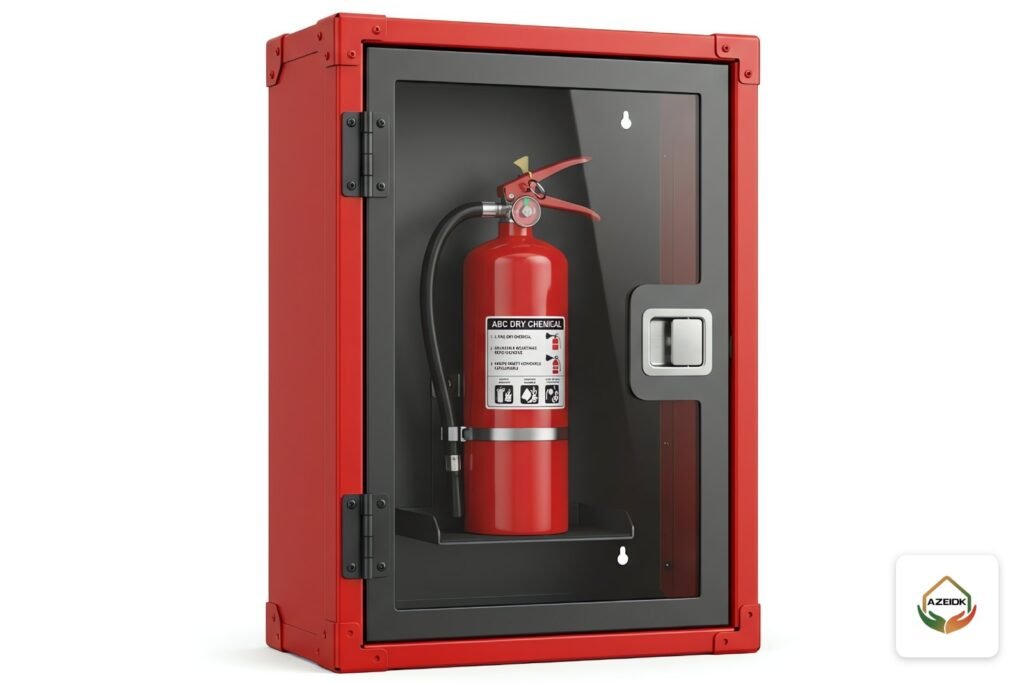
For mounting, an extinguisher with a gross weight up to 18.14 kg has its top no higher than 1.53 m, heavier units no higher than 1.07 m, and the base at least 102 mm above the floor. Mount them in visible places on circulation routes and near exits, not inside cupboards or behind office doors. The full method is in how many fire extinguishers does a space need?
The monthly check by the office manager
The monthly check does not need a specialist technician. The admin or security manager walks past each extinguisher once a month and confirms that:
- The extinguisher is in its designated place and not blocked by furniture or boxes.
- The pressure gauge reads in the green zone, on units with a gauge.
- The safety pin and seal are intact, with no sign of use.
- There is no rust, dent or damage on the cylinder or hose.
- The tag is present and shows the date of the last inspection and service.
Report anything found to the maintenance company at once, and send any extinguisher used even for a few seconds for recharging. Record the check on the extinguisher tag or in the office log.
Common mistakes
- Putting a powder extinguisher inside the server room or on top of the equipment rack.
- Hiding extinguishers behind decor or inside cupboards so they do not spoil the look of the office.
- Mounting all extinguishers in one place near the entrance, leaving the far end of the office beyond the allowed distance.
- Ignoring the monthly tag, so nobody knows when the extinguisher was last checked.
- Relying on one extinguisher per floor in a partitioned office.
- Not showing staff where the extinguishers are and how to use them.
Offices in a tower: owner and tenant roles
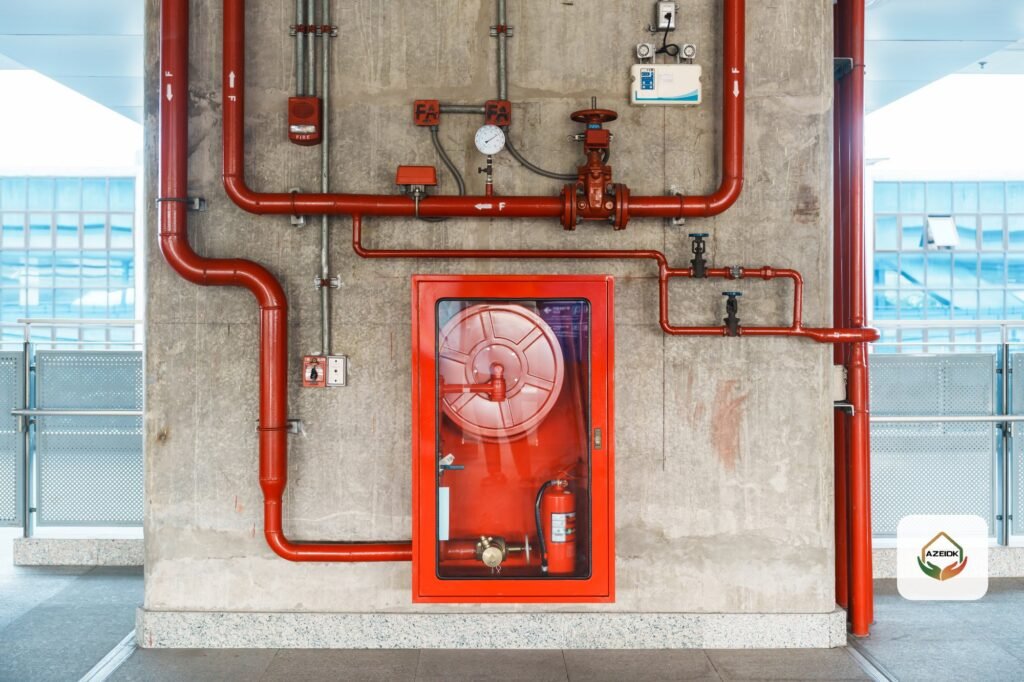
In office towers the common systems, such as hose cabinets, sprinklers and the alarm system, are usually the responsibility of the owner or building management, while the tenant fits out the office interior. New partitions or ceilings installed by a tenant can affect existing sprinklers and detectors, so they are coordinated with building management before work starts. The full picture is in fire protection for office towers.
Extinguishers are checked visually every month, serviced annually and recharged after any use, even partial, as explained in fire extinguisher maintenance and recharging.
Frequently asked questions
Which fire extinguisher should I buy for an office?
6 kg ABC powder for corridors and work areas, and CO2 next to the server room and electrical panels. The number is worked out from floor area and travel distance.
Does a powder extinguisher damage computers?
Yes. The powder leaves residue that can damage electronic equipment, so CO2 is chosen for server rooms and sensitive equipment.
How many extinguishers does a 100 m² office need?
Area alone does not decide it. Check the actual travel distance and whether there is a server room or electrical panel. A small office usually needs at least one powder and one CO2 extinguisher, and civil protection requirements decide.
At what height should an extinguisher be mounted?
Under NFPA 10, an extinguisher up to 18.14 kg is mounted with its top no higher than 1.53 m and its base at least 102 mm above the floor.
Do PYRAMID extinguishers carry the Egyptian quality mark?
Yes. PYRAMID powder and CO2 extinguishers are approved by the Egyptian Organization for Standardization and Quality and carry the Egyptian quality mark.
Conclusion
Office extinguishers follow a simple rule: powder for paper and furniture, CO2 for equipment and panels, a number based on actual travel distance, and visible mounting near exits. Add monthly checks and make sure staff know where they are, so an extinguisher is within reach in the first minute.
Fitting out a new office or moving your company? Send us the office layout and the locations of the server room and panels, and we will suggest extinguisher types, numbers and positions. Talk to the AZEIDK Egypt team
Related guides
- Bank Branch Fire Protection in Egypt: Strongrooms, Server Rooms, ATMs and Customer Halls
- Fire Hose Cabinet Locations: Spacing, 30 m Hose Reach and Mounting Height by Stairs and Exits with the Falcon Gold FG-1001S
- Fire Protection in Convalescent and Long-Term Care Facilities in Egypt
- Smoke and Heat Detectors: Choosing the Right Detector for Each Space