In a server room, control room or archive, putting the fire out is only half the job. It must go out without wrecking the equipment or stopping the service for days. That is why designers choose clean agent fire suppression for these rooms: the space is flooded with a gas that does not conduct electricity and leaves no residue.
This article covers agent types, room integrity, the releasing panel, design concentration, safety and maintenance, with notes for Egypt.
Key takeaways
- The technical reference is NFPA 2001, latest edition 2025, used alongside the Egyptian fire code and civil protection requirements.
- Clean agents are either halocarbons, such as HFC-227ea and FK-5-1-12, or inert gases, such as IG-541 and IG-55.
- The system works by total flooding, so the room must stay sealed and hold the concentration. A door fan test proves it.
- The releasing panel handles detection, pre-discharge alarm, countdown and HVAC shutdown before release.
- 3M has stopped making Novec 1230, but the agent, FK-5-1-12, is still available from other manufacturers.
In this article
- Why water is a poor fit for server rooms and sensitive equipment
- What is a clean agent fire suppression system under NFPA 2001?
- Halocarbon vs inert gas agents: the practical difference
- Room integrity and the door fan test
- The releasing panel and the release sequence
- Design concentration and people’s safety
- Cylinders and routine maintenance
- The end of Novec 1230 and the Kigali Amendment: what it means in Egypt
- Common mistakes in gas suppression systems
- Special suppression solutions from AZEIDK Egypt
- Frequently asked questions
- Summary
Why water is a poor fit for server rooms and sensitive equipment
Sprinklers protect buildings well, but in a room of servers, storage units and low-voltage panels they create three problems. Water conducts electricity, so it should not hit live equipment. Water damages electronics and paper records even in a small fire. And clean-up, drying and equipment checks can keep the service down longer than the fire would have.
A clean agent reaches inside racks and cabinets and leaves nothing to clean up. Whether sprinklers are also needed is a separate decision for the designer under the Egyptian code, the authority and the insurer; a gas system does not automatically remove sprinkler requirements elsewhere.
What is a clean agent fire suppression system under NFPA 2001?
NFPA 2001, published by the National Fire Protection Association, covers the design, installation, testing and maintenance of clean agent systems. Its latest edition is 2025. It defines a clean agent as an electrically non-conductive, volatile or gaseous extinguishant that leaves no residue when it evaporates. An April 2026 Tentative Interim Amendment (TIA) to that edition addresses the egress time study for occupied spaces.
The system works by total flooding. A calculated quantity of agent is stored in cylinders. Once a fire is confirmed, it is released through pipework and nozzles and fills the room at a concentration high enough to extinguish the fire. ISO 14520 is also used where the project specification calls for it. In Egypt, the binding framework is the Egyptian fire protection code (2026 edition) and approval by the General Directorate of Civil Protection, as explained in our article on fire protection requirements in Egypt.
Halocarbon vs inert gas agents: the practical difference
Halocarbons include HFC-227ea, widely known by the trade name FM-200, and FK-5-1-12, formerly sold as Novec 1230. They are stored as a pressurised liquid and vaporise on discharge. They mainly absorb heat from the fire, so they need relatively low concentrations and fewer cylinders. Inert gases, such as IG-541 (nitrogen, argon and carbon dioxide) and IG-55 (nitrogen and argon), are stored as compressed gas. They lower the oxygen level below what the fire needs, and they need larger quantities.
| Item | Halocarbon agents | Inert gas agents |
|---|---|---|
| Examples | HFC-227ea, FK-5-1-12 | IG-541, IG-55, IG-100 |
| Storage | Pressurised liquid | High-pressure compressed gas |
| Main mechanism | Absorbing flame heat | Reducing oxygen |
| Typical design discharge time | 10 seconds or less | Longer, roughly a minute |
| Cylinder room footprint | Smaller | Larger, more cylinders |
| Pressure relief vents | Per calculation; negative then positive pressure on discharge | Per calculation; positive pressure linked to flow rate |
| Environmental note | HFC-227ea is an HFC covered by the Kigali Amendment; engineering references place FK-5-1-12 outside expected restrictions on high-GWP compounds | Natural gases, not subject to HFC restrictions |
The table is descriptive. Binding figures come from the adopted standard and the system’s listed design manual.
Room integrity and the door fan test
Total flooding assumes a sealed room. Gaps around cables, above the ceiling or below the raised floor let the agent leak before the fire is fully out, so hold time matters as much as concentration. Specialist references citing NFPA 2001 state that the room must usually hold at least 85% of the adjusted minimum design concentration, at the height of the highest combustibles, for at least 10 minutes, unless the authority requires longer.
This is checked with a door fan test (room integrity test). A fan in the doorway pressurises and depressurises the room, the equivalent leakage area is calculated, and the hold time is predicted from it. It is done at handover and after any change to the room. A fast discharge into a sealed room can also damage lightweight walls and ceilings unless pressure relief vents are fitted.
The releasing panel and the release sequence
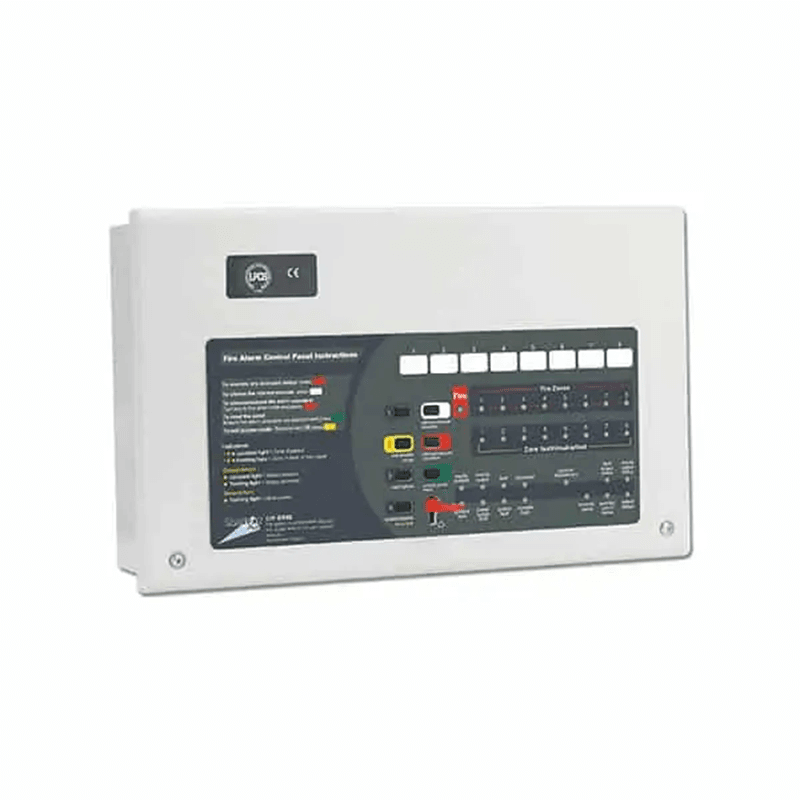
The releasing panel links detection to discharge. A common sequence is:
- First alarm: one detector operates; the panel raises a local alarm.
- Confirmation: a second detector on a different circuit operates. This cross-zoning reduces false discharges.
- Pre-discharge alarm and countdown: sounders and beacons operate inside and outside, and a time delay lets people leave.
- Shutdown points: the panel stops the HVAC, closes dampers and carries out any power shutdown the designer specifies.
- Release: the cylinder valve is actuated and a warning sign outside the door lights up.
There is usually a manual release station at the exit and an abort switch that holds the countdown while pressed; how it works depends on the panel programming and project requirements. A disable switch is provided for maintenance.
Design concentration and people’s safety
Design starts from the extinguishing concentration for each agent and hazard: the lowest concentration that put the fire out in testing. A safety factor, which depends on the fire class, is added to give the minimum design concentration. The quantity is then calculated from the room volume and the lowest expected temperature.
For halocarbons, safety is judged by the NOAEL (No Observed Adverse Effect Level), the highest concentration with no observed adverse effect, and the LOAEL, the lowest concentration with an observed effect. For inert gases, it is judged by the oxygen left in the room. A published engineering reference notes that HFC-227ea is usually limited to 10.5% in normally occupied spaces, and inert gases to about 43% (around 12% oxygen) for no more than 5 minutes. These limits do not replace evacuation: the pre-discharge alarm, time delay and keeping people out after discharge are core to the design. Halocarbons can break down in flame into harmful by-products, so early detection and fast discharge are preferred.
Cylinders and routine maintenance
Cylinders sit close to the protected room, firmly secured, within the manufacturer’s temperature limits and accessible for weighing. NFPA 2001 is the technical reference for inspection, together with the manufacturer’s instructions and the authority’s requirements. Specialist maintenance references report these key points:
- Check agent quantity and pressure at least twice a year.
- Halocarbons: refill or replace if more than 5% of the agent, or more than 10% of the temperature-corrected pressure, is lost.
- Inert gases: refill or replace if more than 5% of the temperature-corrected pressure is lost.
- Inspect the room yearly for new openings or changes to ventilation or doors, and functionally test the sequence without discharge.
For inspection programmes in general, see our fire system maintenance and inspection guide.
The end of Novec 1230 and the Kigali Amendment: what it means in Egypt
In December 2022, 3M announced it would exit PFAS manufacturing by the end of 2025, including Novec 1230 fire protection fluid. The agent itself, FK-5-1-12, is produced by other manufacturers and supplied within listed systems. When refilling, confirm the agent is listed for that system in the manufacturer’s design manual.
HFC-227ea is covered by the Kigali Amendment to the Montreal Protocol, which Egypt ratified on 22 August 2023. The national dates announced so far cover foams, refrigeration and air conditioning, not fire suppression. For now, owners should weigh environmental impact when choosing an agent and follow any later national decisions.
Common mistakes in gas suppression systems
- Leaving the raised floor or ceiling void out of the calculation when they are part of the protected volume.
- Skipping the door fan test, or adding cable openings after it without retesting.
- Not linking the panel to HVAC and damper shutdown, so the agent is drawn out.
- Leaving out pressure relief vents in rooms with lightweight walls.
- Copying a concentration or safety factor from a previous project.
- Refilling with an agent not listed for the system, or without a weight certificate.
- Leaving the disable switch on after maintenance.
Special suppression solutions from AZEIDK Egypt
The AZEIDK Egypt special fire suppression range covers total flooding for transformer and electrical rooms, AFC-227 / P227 clean agent systems from American Fire Control, Fire Search sensitive-tube systems for panels and cabinets, and suppression control panels with activation and shutdown points. According to the datasheet, the AFC-227 / AFC-P227 system uses HFC-227ea (widely known by the trade name FM-200), super-pressurised with nitrogen in the agent cylinder; the P227 version adds a separate nitrogen driver cylinder to push the agent through long or complex pipe networks. Applications such as server rooms, control rooms, archives and power stations each get a hazard study and quantity calculation by area. UL or FM approvals apply to specific models; check each model’s datasheet.
Frequently asked questions
Is FM-200 the same as a clean agent?
FM-200 is a trade name for HFC-227ea, one of the halocarbon clean agents. Clean agents also include FK-5-1-12 and inert gases such as IG-541 and IG-55.
Can people stay in the room during discharge?
No. The exposure limits protect anyone who cannot leave immediately; they are not permission to stay. The design relies on the pre-discharge alarm, time delay, evacuation and no re-entry after discharge.
What does a door fan test tell us?
It measures air leakage and predicts how long the agent will hold the required concentration. Without it, you cannot be sure the system will extinguish the fire and prevent re-ignition.
Does the end of Novec 1230 mean replacing existing systems?
Not necessarily. FK-5-1-12 is available from other manufacturers. Refills must use an agent listed for that system, following the manufacturer’s instructions.
Which is better: halocarbon or inert gas?
There is no general answer. Halocarbons need less cylinder space. Inert gases avoid HFC restrictions and allow longer pipe runs. The designer decides based on room size, available space, occupancy and the owner’s requirements.
Summary
The choice of agent alone does not make a clean agent system work. It needs a quantity calculated to the adopted edition of NFPA 2001, a sealed room proven by a door fan test, a releasing panel that runs the pre-discharge alarm and HVAC shutdown, and an inspection programme for cylinder weight, pressure and room condition, all within the Egyptian code and civil protection approval.
Do you have a server room or electrical panels that need gas protection? Send us the room dimensions and equipment type, and we will review the solution, quantity calculation and datasheets with you. Talk to the AZEIDK Egypt team