Every shop, office and warehouse fit-out raises the same question: how many fire extinguishers are required, where does each go, and at what height? The answer depends on the hazard level of the space, the fire rating of the extinguisher and the maximum walking distance to reach it, not on weight alone.
This guide explains the NFPA 10 method with a worked example, and how to apply it when choosing fire extinguishers from AZEIDK Egypt in the PYRAMID range.
Key takeaways
- Three steps: classify the hazard, find each unit’s coverage from its rating, then check travel distance on the drawing.
- Under NFPA 10 (2022 edition), travel distance to a Class A extinguisher must not exceed 75 ft (22.9 m), and one extinguisher may serve no more than 11,250 sq ft (about 1,045 m²).
- Class B extinguishers are placed within 30 or 50 ft (9.1 or 15.2 m), depending on their rating and the hazard level.
- Units of 18.14 kg (40 lb) gross weight or less: top no higher than 1.52 m. Heavier units go no higher than 1.07 m. The bottom must clear the floor by at least 102 mm.
- A European EN 3 rating (such as 21A) is not the same as a US NFPA rating (such as 2-A). Do not mix them in the calculation.
- Civil protection requirements for the activity are the final word; check them before buying.
In this article
- The legal reference and the technical reference
- Step 1: classify the hazard
- Step 2: calculate how many fire extinguishers are required for Class A
- Step 3: Class B, Class C and kitchens
- Mounting height and location
- Worked example: shop, office and warehouse
- Applying the calculation to PYRAMID extinguishers
- Common mistakes in calculating and placing extinguishers
- Frequently asked questions
- Conclusion
The legal reference and the technical reference
The legally binding reference in Egypt is the Egyptian Code for the Design and Implementation of Fire Protection for Buildings — 2026 edition (Ministerial Decree No. 355 of 2026), together with what the General Directorate of Civil Protection (Ministry of Interior) asks for when it reviews a facility or licenses an activity. Requirements vary by activity, so confirm them before fixing the final quantity.
NFPA 10, the US standard for portable extinguishers, is a technical reference for quantity and layout, not law in Egypt in its own right. The figures here come from the 2022 edition tables, as reproduced by the references below. A 2026 edition has since been published; check its text if your project adopts it.
Fire classes and types are covered in our guide to fire extinguisher types and uses. Here we focus on quantity, layout and mounting.
Step 1: classify the hazard
NFPA 10 uses three hazard levels. Liquid limits follow the 2022 definitions as quoted by QRFS; the examples are indicative:
- Light (low) hazard: few combustibles, and less than 1 gal (about 3.8 L) of flammable liquids in any room or area. Examples: offices, classrooms, places of worship and assembly halls.
- Ordinary (moderate) hazard: moderate combustibles, and 1 to 5 gal (about 3.8 to 18.9 L) of flammable liquids in a room or area. Examples: retail shops, dining areas, light manufacturing and car showrooms.
- Extra (high) hazard: many combustibles, or more than 5 gal of flammable liquids. Examples: woodworking shops, vehicle repair garages and warehouses holding large amounts of combustible goods.
The class depends on contents, not building type, and an office with heavy contents may count as ordinary hazard. A large paper store attached to an office may be classified higher and calculated separately.
Step 2: calculate how many fire extinguishers are required for Class A
Class A means ordinary solids such as wood, paper, cloth and plastics. NFPA 10 sets these limits:
| Item | Light hazard | Ordinary hazard | Extra hazard |
|---|---|---|---|
| Minimum rating of a single extinguisher | 2-A | 2-A | 4-A |
| Maximum floor area per unit of A | 3,000 sq ft (about 279 m²) | 1,500 sq ft (about 139 m²) | 1,000 sq ft (about 93 m²) |
| Maximum floor area per extinguisher | 11,250 sq ft (about 1,045 m²) | 11,250 sq ft (about 1,045 m²) | 11,250 sq ft (about 1,045 m²) |
| Maximum travel distance to an extinguisher | 75 ft (22.9 m) | 75 ft (22.9 m) | 75 ft (22.9 m) |
Multiply the A rating by the area per unit of A to get the area one unit covers, capped at about 1,045 m². Divide the floor area by this figure and round up. Example: a 2-A unit in an ordinary hazard covers 2 × 139 = about 279 m².
The 11,250 sq ft cap is roughly a square of about 32 m sides inside a 22.9 m circle around the unit. So a high-rated unit may pass the area check while real walking distances still call for more units.
Step 3: Class B, Class C and kitchens
For flammable liquids up to 1/4 in (6.35 mm) deep, such as spills, NFPA 10 links rating to travel distance:
| Hazard level | Minimum rating | Maximum travel distance |
|---|---|---|
| Light | 5-B | 30 ft (9.1 m) |
| Light | 10-B | 50 ft (15.2 m) |
| Ordinary | 10-B | 30 ft (9.1 m) |
| Ordinary | 20-B | 50 ft (15.2 m) |
| Extra | 40-B | 30 ft (9.1 m) |
| Extra | 80-B | 50 ft (15.2 m) |
Lower-rated units go closer to the hazard. Open tanks and deeper liquids follow a different method.
For Class C (energized electrical equipment), NFPA 10 sets no separate distance. Units follow the surrounding Class A or B hazard. In practice, CO2 goes near panels and server rooms because it is non-conductive and leaves no residue. In commercial kitchens using cooking oils and fats, a Class K extinguisher must be within 30 ft (9.1 m) of the hazard.
Mounting height and location
| Gross weight of the extinguisher | Maximum height of the top above the floor |
|---|---|
| 18.14 kg (40 lb) or less | 1.52 m (5 ft) |
| Over 18.14 kg, except wheeled units | 1.07 m (3.5 ft) |
| All wall-mounted units | At least 102 mm (4 in) between the bottom of the unit and the floor |
This is gross weight, not agent capacity, so check the label or datasheet before setting bracket height.
Extinguishers must be visible and easy to reach. Where racks or columns block the view, signs must show the location, and operating instructions must face outward. Good positions are walking routes, exits, and next to (not inside) the hazard.
Worked example: shop, office and warehouse
These figures use illustrative NFPA ratings (2-A, 4-A, 10-A), not PYRAMID ratings. The final quantity follows the drawing and the activity’s requirements.
| Space | Area and hazard | Rating-based check | Travel distance check | Minimum Class A units |
|---|---|---|---|---|
| Retail shop, 10 × 12 m | 120 m², ordinary | A 2-A unit covers about 279 m², so one unit | Farthest point is under 22.9 m | 1 |
| Open-plan office, 20 × 30 m | 600 m², light | A 2-A unit covers about 557 m²; 600 ÷ 557 = 1.08 | Two units meet the distance easily | 2 |
| Warehouse, 40 × 50 m | 2,000 m², extra | With 4-A units covering about 372 m²: 5.4, so 6. With 10-A units covering about 929 m²: 2.2, so 3 | Squares of about 32 m need at least a 2 × 2 grid | 6 with 4-A units, or 4 with 10-A units |
In the warehouse, travel distance governs: the rating gives 3, the dimensions demand at least 4, and rack aisles may push it higher. Add Class B units within 9.1 or 15.2 m of any flammable liquid store, and a CO2 unit near panels or server rooms. If the office is classed as ordinary hazard, a 2-A unit covers about 279 m² and the count rises to 3.
Applying the calculation to PYRAMID extinguishers
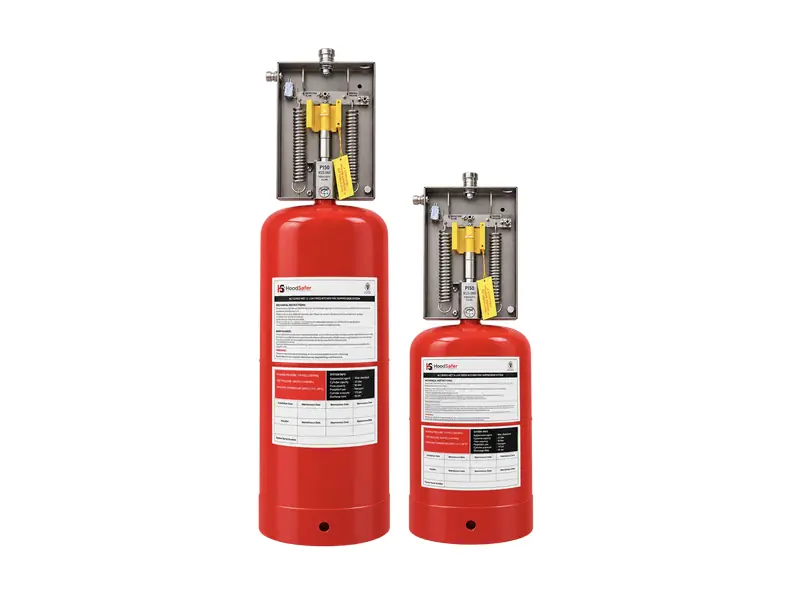
AZEIDK Egypt supplies PYRAMID extinguishers in these sizes: stored-pressure ABC dry powder in 1, 3, 6, 9 and 12 kg; wheeled powder in 25 and 50 kg; CO2 in 2, 3, 6, 10, 20 and 30 kg; AFFF foam in 6 and 9 L, plus 25 and 45 L large-capacity units; and automatic powder and CO2 extinguishers.
The datasheet for the portable powder units gives European fire ratings: 5A-21B for 1 kg, 13A-55B for 3 kg, 21A-113B for 6 kg, 27A-144B for 9 kg and 43A-183B for 12 kg. These units conform to Egyptian standard ES 8442/2021 and carry the Egyptian quality mark.
These are EN 3 ratings, not NFPA 10 units of A or B, so you cannot put 21 in place of 2 in the area formula. Apply the travel distance and maximum area limits unchanged, and agree with the designer and authority how to credit the unit’s rating. In practice, 6 kg powder suits shops and offices, larger and wheeled units suit large areas and high hazards, CO2 suits electrical equipment, and AFFF foam suits flammable liquids.
Common mistakes in calculating and placing extinguishers
- Counting by weight alone: a 12 kg unit does not cover twice the area of a 6 kg unit.
- Measuring distance in a straight line: travel distance is the real walking path around walls and racks.
- Mixing European and US ratings: 21A in the NFPA formula gives far too few units.
- Grouping units in one place: five extinguishers at the entrance do not serve the back of a warehouse.
- Ignoring Class B and electrical risks: liquid storage and panels need their own check.
- Relying on sprinklers: sprinklers do not remove the need for portable extinguishers.
- Wrong height or a hidden unit: a unit that is hard to see or lift down is of little use.
Frequently asked questions
Is there a fixed rule such as one extinguisher per so many square metres?
Not in NFPA 10. Coverage depends on rating and hazard level, capped by travel distance. Check civil protection for any local rule.
How many extinguishers does a small shop need?
In the example above, a 120 m² ordinary-hazard shop needs one Class A unit under NFPA 10, plus a CO2 unit near the electrical panel as good practice. The final quantity is set by the licensing requirements for the activity.
How high should a 6 kg extinguisher be mounted?
If its gross weight is 18.14 kg or less, which you confirm from its data, the top goes no higher than 1.52 m, with at least 102 mm clearance from the floor.
Do wheeled extinguishers count towards the total?
Wheeled units protect large areas and high hazards, but how they count is set in the design and approved by the authority. They do not replace portable units.
Is one calculation enough?
No. Changes in activity, storage or partitions can change the hazard level and walking distances, so recalculate after each change.
Conclusion
Working out how many fire extinguishers are required takes three steps: classify the hazard, find each unit’s coverage from its rating, and plot travel distances on the real layout. Then add Class B and electrical cover and set heights by weight. Checking civil protection requirements before buying avoids a short or unsuitable order.
Need the right number of extinguishers for your space? Send us the drawing or the floor area, the type of activity and what is stored. We will suggest PYRAMID types and sizes with a preliminary layout, backed by our supply, installation and maintenance services. Talk to the AZEIDK Egypt team