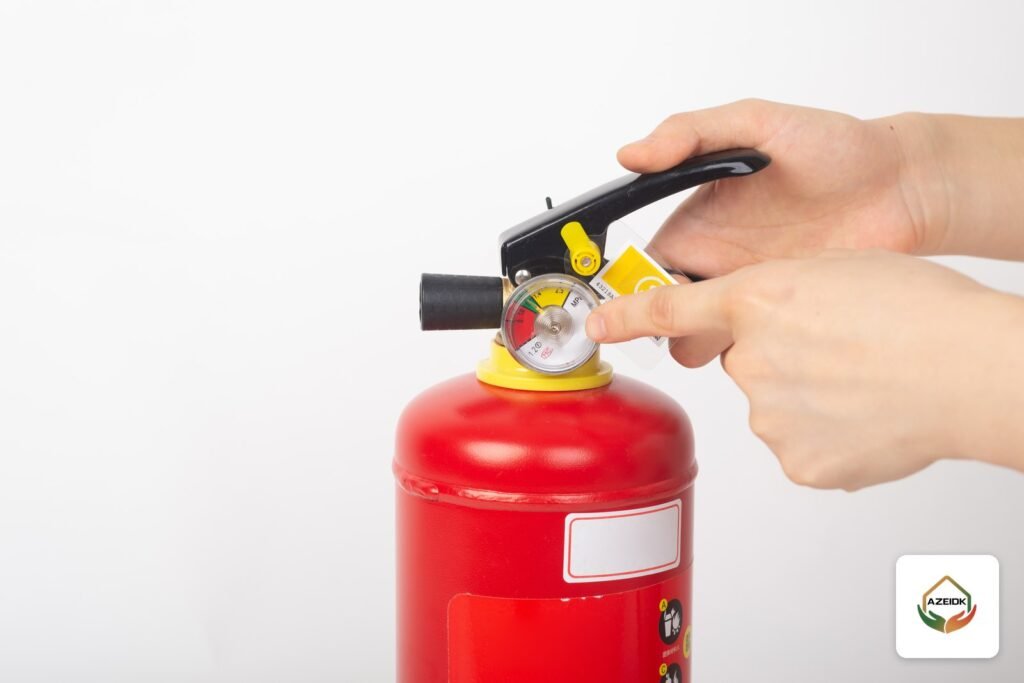
A school holds hundreds of students for long hours every day, and most of them are children who are not expected to use a fire extinguisher. So fire extinguishers for schools are chosen around the people who will actually use them, which means teachers, supervisors, security and maintenance staff, and around what can burn in each space. A classroom is not a chemistry lab, and a computer lab is not the canteen kitchen or the electrical room.
To compare fire extinguisher types and what each one is for, see our guide to choosing the right extinguisher for each hazard.
This guide explains how to select and distribute extinguishers in public, private and international schools in Egypt. It includes a table that links each space to the right type from the PYRAMID extinguisher range supplied by AZEIDK Egypt as part of its fire extinguisher solutions.
Key takeaways
- NFPA 10 lists classrooms among its light hazard examples, research operations, workshops and support areas as ordinary hazard, and cooking areas as extra hazard.
- ABC powder suits corridors, classrooms and the library. CO2 suits computer labs and electrical rooms. Science lab extinguishers depend on the materials used in the lab.
- Tampering is likely in schools. The standard allows locked cabinets in that case, provided there is a means of quick emergency access.
- Trained staff use the extinguishers, so the layout is planned around where staff are and around the escape routes.
- The binding reference is the Egyptian fire code (2026 edition) and the civil protection requirements. NFPA 10 is a technical reference.
In this article
- Who uses fire extinguishers in schools?
- Hazard level of school spaces
- Choosing fire extinguishers for schools: selection table by space
- Science and computer labs: the most sensitive spaces
- Powder extinguishers: the basis for classroom blocks
- Mounting, cabinets and tampering in schools
- Common mistakes with school extinguishers
- Frequently asked questions
- Conclusion
Who uses fire extinguishers in schools?
In a factory or a hotel, every employee can be trained on extinguishers. In a school, most occupants are students, and the usual instruction for them is to leave calmly along the escape route, not to approach the fire. The real first response falls on the teacher in the classroom or lab, the floor supervisor, the security team and the maintenance worker.
That changes how the layout is planned. Extinguishers need to be close to these people: at the staff room on each floor, at lab entrances, near the security office and next to the stairs used for evacuation. Each of them should know the nearest extinguisher and should have practised with one before they need it.
The wider picture of fire protection in schools and universities, from the alarm system to labs and maintenance, is in our article on fire protection in Egyptian schools and universities. Here we focus on extinguishers.
Hazard level of school spaces
The NFPA 10 annex, in the text of its latest revision cycle (A2025), gives examples of occupancy classification. Classrooms and assembly halls are light hazard. Research operations, and the workshop and support service areas of light hazard buildings, are ordinary hazard. Cooking areas are extra hazard.
Under the standard’s Class A table, the minimum rating is 2-A for light and ordinary hazard. The maximum floor area per unit of A is 3,000 sq ft for light and 1,500 sq ft for ordinary hazard, with a maximum travel distance of 75 ft (22.9 m). So a classroom block gets less dense coverage than a lab and workshop block, but in both cases the travel distance has a clear limit.
Choosing fire extinguishers for schools: selection table by space
| Space | Main hazard | Suggested PYRAMID extinguisher | Notes |
|---|---|---|---|
| Classroom corridors | Solids (light hazard) | 6 kg ABC powder | At stairs and at the staff room on each floor |
| Library and art rooms | Paper, books and craft materials | 6 kg ABC powder | At the entrance, not between shelves |
| Computer lab and server room | Electronic equipment | 3 or 6 kg CO2 | Powder leaves residue on equipment |
| Science and chemistry lab | Solids, flammable liquids and electrical equipment | ABC powder and CO2 at the entrance | Review the materials used in the lab |
| Technical and vocational workshops | Wood and mixed materials (ordinary hazard) | 6 or 9 kg ABC powder | Near cutting and welding machines |
| Canteen kitchen | Cooking oils, electricity and gas | Class K listed extinguisher where cooking oils are used, and a fixed system where fryers sit under a hood | Never use water on burning oil |
| Main electrical room | Electrical equipment | 6 kg CO2 or automatic Fire Search CO2 | Next to the room door |
| Generator room | Diesel and oils | AFFF foam or powder | Check the stored fuel quantity |
| Sports hall and theatre | Solids, sound and lighting equipment | ABC powder, plus CO2 near the control room | At exits and backstage |
The table is a starting point. The final decision depends on the size and contents of each space and on the civil protection requirements when the school is licensed or extended.
Science and computer labs: the most sensitive spaces
A chemistry lab puts flammable liquids such as alcohol, burners, electrical equipment and young students in one room. Two extinguishers usually go at the entrance: ABC powder for general fires, and CO2 for liquids and electrical equipment without leaving residue on the apparatus. If the lab uses combustible metals, these need a dedicated Class D agent, which is outside the PYRAMID range covered here. The lab supervisor and the designer should address it.
A computer lab fire is usually electrical, starting from an extension lead or a device. PYRAMID CO2 extinguishers suit it. They come in 2, 3, 6, 10, 20 and 30 kg and conform to EN3 and Egyptian standard ES 735. See our article on PYRAMID CO2 extinguishers. Because CO2 displaces air, it should not be discharged in a small closed room with students inside. Evacuate first.
Powder extinguishers: the basis for classroom blocks
PYRAMID powder extinguishers are stored-pressure units in 1, 3, 6, 9 and 12 kg for Class A, B and C fires. They conform to EN3 and Egyptian standard ES 8442/2021, the powder conforms to EN 615 and ES 4833, and they are approved by the Egyptian Organization for Standardization and Quality (EOS) and carry the Egyptian quality mark. The 6 kg size is the most common in corridors because it balances agent quantity with a weight a teacher or supervisor can carry.
When writing a tender specification for a school or an educational directorate, it helps to name the required Egyptian standard and the quality mark, as explained in our article on Egyptian extinguisher standards and the quality mark. This rules out extinguishers of unknown origin from the start.
Mounting, cabinets and tampering in schools
Tampering is to be expected in schools: a student pulls the safety pin, or an extinguisher falls off its bracket during break time. NFPA 10 says extinguisher cabinets shall not be locked, except where extinguishers are subject to malicious use, and then a means of quick emergency access must be provided. Where an extinguisher is exposed to physical damage, the standard requires it to be protected.
For height, NFPA 10 sets the top of an extinguisher up to 18.14 kg gross weight at no more than 1.53 m above the floor, heavier units at no more than 1.07 m, and a floor clearance of at least 102 mm. The count and spacing method is in our article on how many fire extinguishers a space needs.
Common mistakes with school extinguishers
- One type for the whole school, so computer labs end up with powder extinguishers.
- Keeping extinguishers in rooms locked by a worker who leaves at the end of the school day.
- Mounting an extinguisher in a busy student walkway with no cabinet or protection.
- Buying extinguishers without the Egyptian quality mark or a clear label because they were cheapest in the tender.
- Not training teachers and supervisors, so the extinguisher stays on the wall while the fire grows.
- Leaving extinguishers unchecked through the summer holiday and starting the school year with them as they are.
Routine inspection and recharging are covered in our article on fire extinguisher maintenance and recharging. The full inspection is best scheduled before the school year starts.
Frequently asked questions
Which extinguisher suits school classrooms?
Usually a 6 kg ABC powder extinguisher in the corridors near the stairs and the staff room, not inside every classroom.
Which extinguisher suits a computer lab?
A CO2 extinguisher, because it leaves no residue on equipment. Students should be evacuated before it is used in a small room.
Can school extinguisher cabinets be locked?
NFPA 10 allows it only where extinguishers are subject to malicious use, and only with a means of quick emergency access.
Do students use fire extinguishers?
The usual role of students is safe evacuation. Extinguishers are used by trained staff: teachers, supervisors and security.
When should school extinguishers be checked?
A monthly visual check, plus full maintenance and recharging per the manufacturer’s instructions. The full check is best scheduled before the school year starts.
Which standard should the tender specify?
The Egyptian standard for each type, such as ES 8442/2021 for powder and ES 735 for CO2, together with the Egyptian quality mark and a clear label.
Conclusion
Fire extinguishers for schools are planned around the staff who will use them and around the nature of each space: powder for classrooms, the library and workshops, CO2 for computer labs and electrical rooms, and a separate review for the science lab and the canteen. Then come cabinets, tamper control, training and a full check before every school year. That way the extinguisher is ready for the person who needs it, and students stay on the escape route.
Fitting out a new school or reviewing extinguishers before the school year? Send us the drawings and the list of labs and workshops, and we will propose types, sizes and locations from the PYRAMID range. Talk to the AZEIDK Egypt team
Related guides
- Fire Pump Power Calculation: HP and kW with a 3PUMP 1000 GPM Example
- Mosque Fire Safety in Egypt: Electrics, AC, Carpets, Alarms and Extinguishers
- Restaurant Fire Alarm Systems in Egypt: Kitchen Heat Detection, Dining Room Smoke Detection and Hood Links
- Fire Extinguisher Maintenance and Recharging: Inspection and Testing