Fire fighting systems in Egypt vary as much as the buildings they protect. What suits an office tower may not suit a high-bay warehouse, a server room or a commercial kitchen. This guide covers the main system categories, their components, where each is used, and what the designer weighs when choosing.
It also separates three levels that are often mixed up: Egyptian legal requirements, technical reference standards used in design (such as NFPA and EN), and each manufacturer’s instructions.
Key takeaways
- The legal framework is Building Law No. 119 of 2008, its executive regulations and the 2026 Egyptian fire protection code. The General Directorate of Civil Protection approves the drawings.
- Water-based systems (sprinklers, standpipes and fire pump sets) are the backbone of protection in most buildings.
- Detection and alarm sets the response time and triggers other systems, such as gas suppression and pre-action sprinklers.
- Special hazards need dedicated systems: clean agents, CO2, foam and kitchen suppression.
- Extinguishers are the first line of defence, not a replacement for fixed systems.
- No ready-made design fits every project. Occupancy, fire load and water supply all change the answer.
In this article
- The regulatory framework for fire fighting systems in Egypt
- Water-based systems: automatic sprinklers
- Standpipes, hose reels and fire pumps
- Detection and alarm systems
- Special suppression and kitchen systems
- Portable fire extinguishers
- Quick comparison of the main categories
- Why every project needs its own engineering design
- Common mistakes in fire protection projects
- Frequently asked questions
- Conclusion
The regulatory framework for fire fighting systems in Egypt
Under Article 49 of Egyptian Building Law No. 119 of 2008 and its executive regulations (Minister of Housing Decree No. 144 of 2009), the permit applicant must apply fire protection requirements in line with the Egyptian code and the regulations. The General Directorate of Civil Protection (Ministry of Interior), through its governorate departments, reviews and approves fire protection drawings and inspects the building before occupancy.
The Egyptian Code for the Design and Implementation of Fire Protection for Buildings — 2026 edition (Ministerial Decree No. 355 of 2026) was published in the Official Gazette (Al-Waqa’i Al-Misriya) on 19 May 2026. Prepared by the Housing and Building National Research Center (HBRC), it has three parts: structural and architectural requirements, mechanical fire fighting systems, and electrical requirements with detection and alarm. A separate Egyptian code covers industrial and storage facilities.
NFPA (National Fire Protection Association) and European EN standards are technical references that designers and manufacturers use for engineering detail. They do not replace the Egyptian code and are not legally binding in Egypt on their own, unless the code refers to them or the approving authority or owner requires them. For more, see our article on fire protection requirements in Egypt and our certifications and approvals page.
Water-based systems: automatic sprinklers
A sprinkler head opens when hot gases break its glass bulb or melt its fusible link. Water flows only from the heads affected, not from every head in the building. NFPA 13 (2025 edition) covers sprinkler installation and identifies four main system types.
Wet pipe system
The pipes are always full of pressurised water, so discharge is immediate. It is the most common and simplest type. It is unsuitable where pipes can freeze, which is rare in most of Egypt but does apply to cold rooms and refrigerated stores.
Dry pipe system
The pipes hold compressed air or nitrogen, and a dry pipe valve holds the water back. When a head opens, pressure drops, the valve opens and water fills the network. It is used where freezing is a risk; the delay before water arrives limits network size.
Pre-action system
Water enters the pipes only on a signal from a separate detection system. Single interlock needs a detector only; double interlock needs a detector and an open head. It suits archives and equipment rooms where accidental discharge is costly.
Deluge system
The heads or nozzles are open. A deluge valve holds the water back until the detection system signals it to open, then all nozzles discharge at once. It is used for fast-spreading hazards such as large transformers and some industrial plants. These systems rely on control valves, including alarm check valves supplied by American Fire Control.
Standpipes, hose reels and fire pumps
Standpipes and hose cabinets
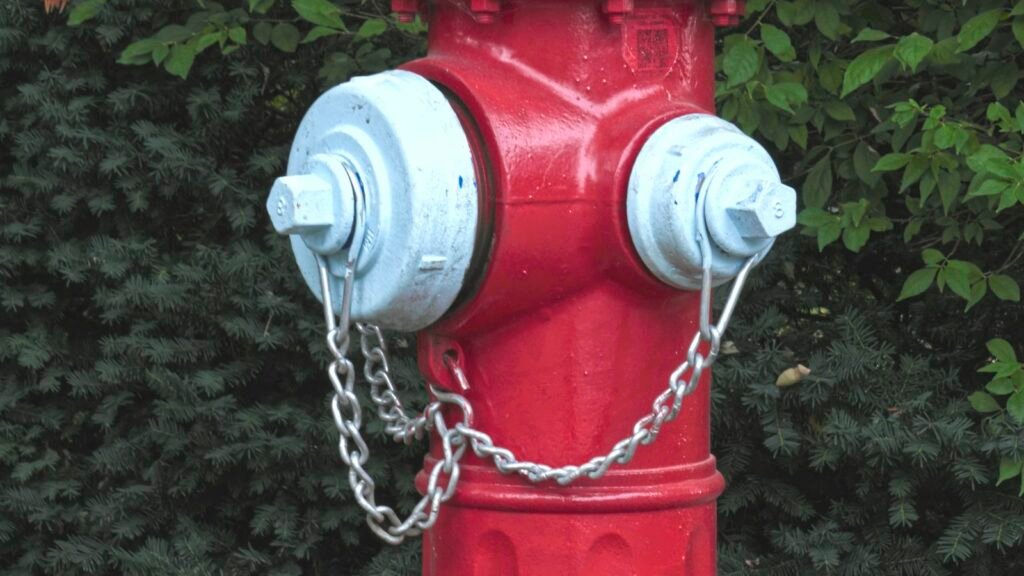
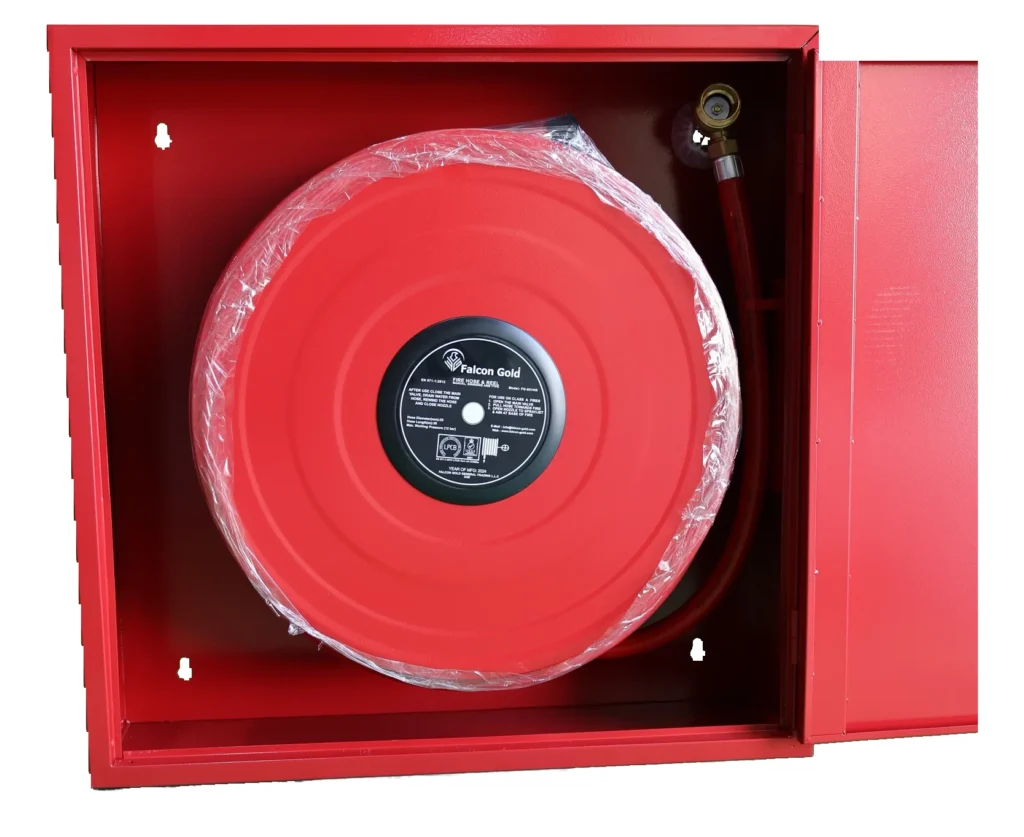
Standpipes are risers that feed hose outlets on each floor. Occupants use them through hose reels, and the fire brigade through larger landing valves, depending on the system class. NFPA 14 covers standpipe and hose systems and private hydrants. A hose reel cabinet usually holds a hose reel, a valve and sometimes an extinguisher. AZEIDK Egypt supplies Falcon Gold hose cabinets, manufactured locally in Egypt with genuine Falcon Gold components, complete with accessories.
Fire pumps
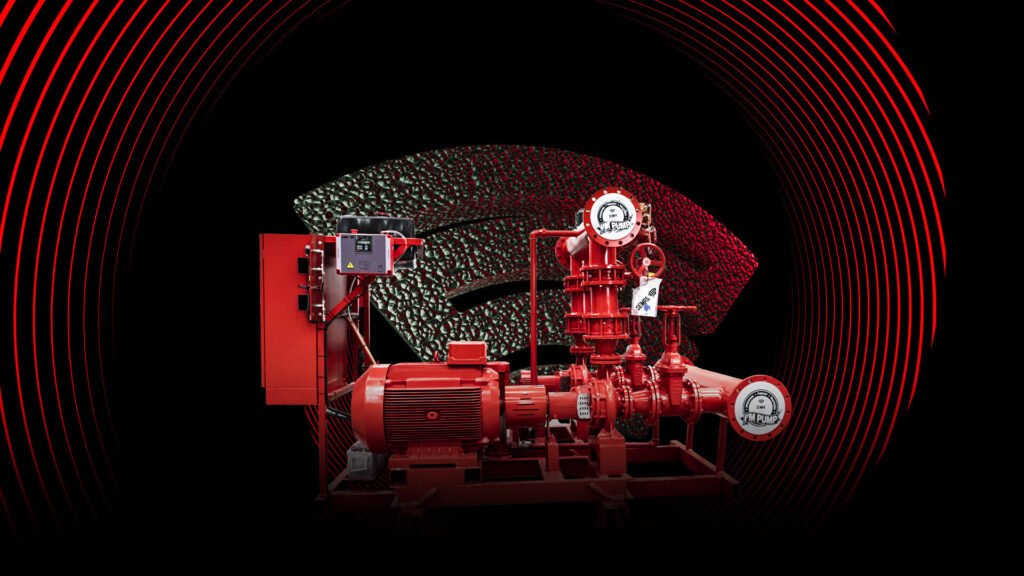
Mains pressure is rarely enough for sprinklers and standpipes, so a dedicated fire pump set is installed, covered by NFPA 20 (2025 edition). A typical set has an electric main pump, a diesel standby pump and a small jockey pump that keeps the network pressurised, each with its own controller. AZEIDK Egypt supplies complete 3PUMP sets on a common base in several duty points. Sets supplied in Egypt are Non-UL (non-listed); UL/FM-listed versions are made on request. See our article on selecting fire pumps.
Detection and alarm systems
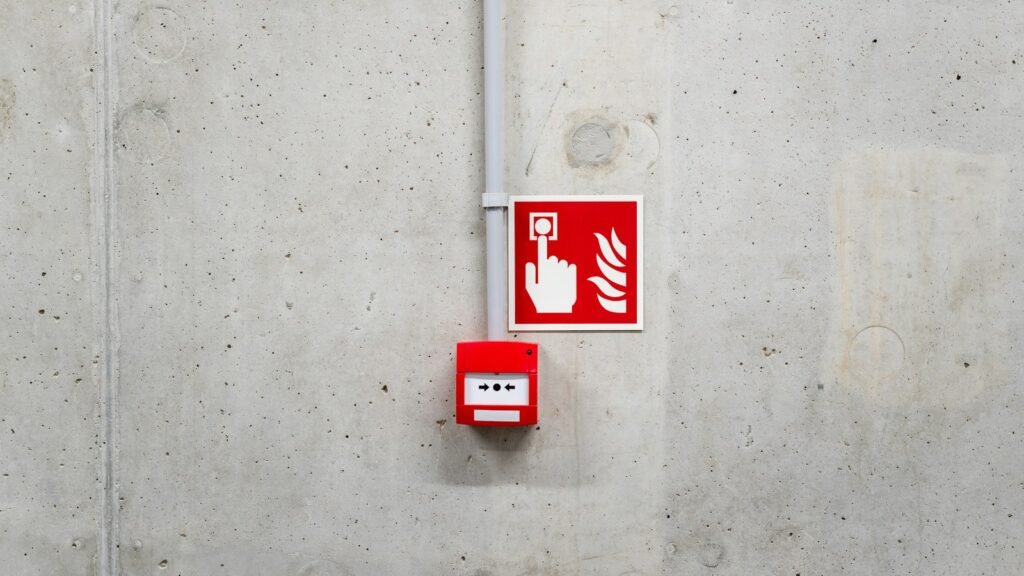
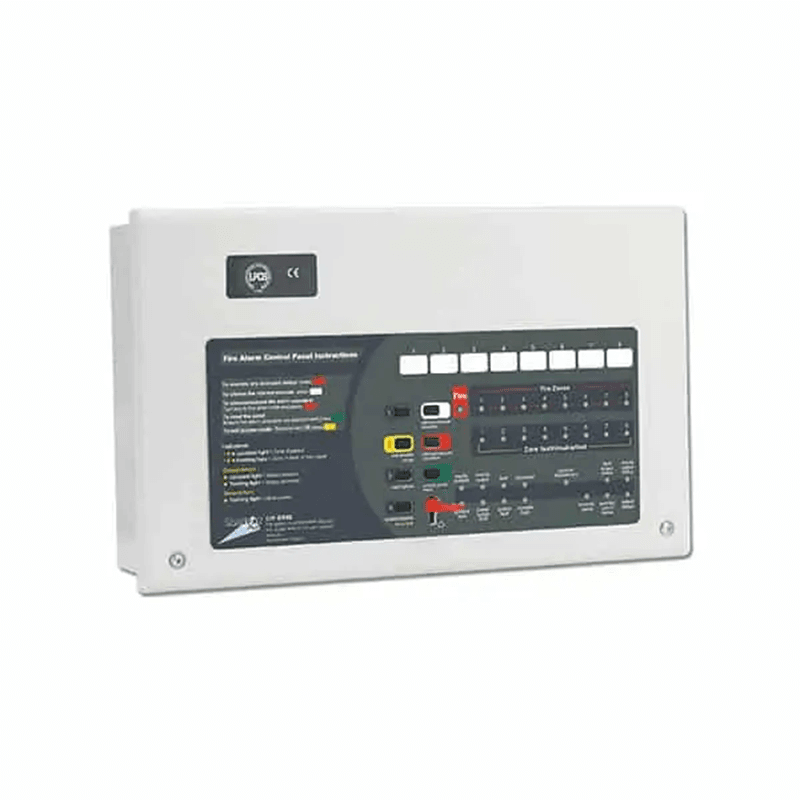
A fire alarm system has a control panel; smoke, heat and flame detectors; beam detectors for high spaces; manual call points (MCPs); sounders and beacons; and input/output modules that link it to lifts, ventilation and suppression. NFPA 72 (2025 edition) and the European EN 54 series are the main technical references.
Conventional panels identify the zone an alarm came from; addressable panels identify the exact device. We explain the differences in our article on conventional and addressable fire alarm systems. AZEIDK Egypt supplies British manufacturer Context Plus for panels and detectors, and TANDA detection devices, including the TX7130 beam detector.
Special suppression and kitchen systems
Some hazards need an agent other than water, because water damages the equipment or does not work on the fuel:
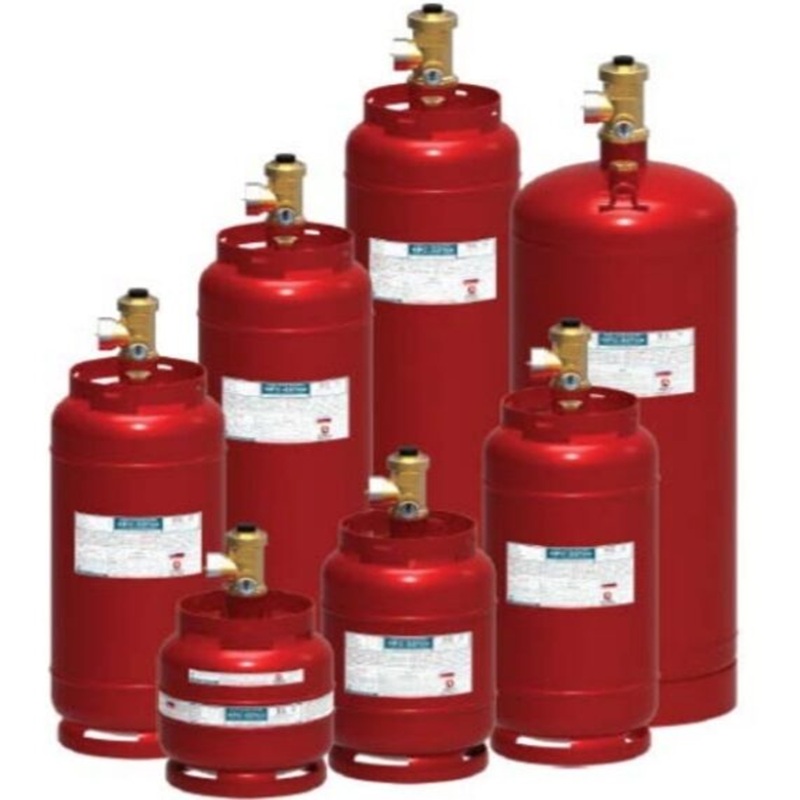
- Clean agents: for server, telecom and archive rooms, covered by NFPA 2001. They need a reasonably sealed room and an accurate concentration calculation based on room volume.
- Carbon dioxide (CO2): for some unoccupied industrial and electrical hazards, covered by NFPA 12. It needs strict life-safety precautions, because extinguishing concentrations are dangerous to people.
- Foam: for flammable liquid fires in fuel tanks and loading areas, covered by NFPA 11.
- Commercial kitchen systems: protect hoods, ducts and cooking surfaces with a wet chemical agent and automatic gas shut-off, covered by NFPA 17A (2024 edition), NFPA 96 and EN 17446.
For kitchens, AZEIDK Egypt supplies Turkish-made HoodSafer systems, conforming to EN 17446:2021 and approved by the General Directorate of Civil Protection.
Portable fire extinguishers
An extinguisher tackles a fire before it spreads; it does not replace a fixed system. The type depends on the fire class: multi-purpose dry powder (ABC) for general use, CO2 for electrical equipment, and AFFF foam for flammable liquids. NFPA 10 (2026 edition) covers selection and distribution, while Egyptian standards and EN3 govern manufacturing. PYRAMID extinguishers, for example, carry the Egyptian quality mark. More in our article on types of fire extinguishers.
Quick comparison of the main categories
| Category | Main components | Typical applications | Common technical reference |
|---|---|---|---|
| Automatic sprinklers | Heads, pipe network, control and alarm valves | Offices, hotels, hospitals, warehouses | NFPA 13 |
| Standpipes and hose reels | Risers, hose cabinets, valves, connections | Multi-storey and commercial buildings | NFPA 14 |
| Fire pumps | Electric pump, diesel pump, jockey pump, controllers | Any water network that needs guaranteed flow and pressure | NFPA 20 |
| Detection and alarm | Panel, detectors, MCPs, sounders and beacons | Almost every occupancy type | NFPA 72, EN 54 |
| Clean agents | Cylinders, nozzle network, extinguishing control panel | Server and telecom rooms | NFPA 2001 |
| Kitchen suppression | Agent tank, nozzles, heat detection, gas valve | Restaurants, hotels, hospital kitchens | NFPA 17A, EN 17446 |
| Extinguishers | Portable or wheeled units | All buildings | NFPA 10, EN3 |
Why every project needs its own engineering design
Two buildings of similar size can have very different needs. The main design inputs are:
- Occupancy and hazard classification: sets the design density and design area in the sprinkler calculations.
- Storage type and height: high-bay storage may need entirely different heads and systems from an office.
- Water source and tank capacity: set the operating duration and the pump duty point.
- Hydraulic calculations: set pipe sizes, and pressure and flow at the most remote point.
- Integration: for example, linking the alarm to ventilation shutdown and suppression release.
- Authority and insurer requirements: the insurer or owner may require UL-listed or FM-approved equipment.
A generic equipment list is therefore no substitute for a design by a specialist engineering office, approved by Civil Protection. See AZEIDK Egypt’s fire fighting system solutions for the options in each category.
Common mistakes in fire protection projects
- Choosing a pump on price or a rough flow figure, without hydraulic calculations to fix the duty point.
- Relying only on extinguishers and hose cabinets where sprinklers or automatic systems are needed.
- Installing gas suppression in an unsealed room, so the gas leaks out before reaching design concentration.
- Confusing “conforms to the standard” with “UL-listed” or “FM-approved”. Check each on the datasheet and in the certifier’s listings.
- Changing a space’s use after handover, such as turning an office into a store, without reviewing the design.
- Neglecting inspection and maintenance after handover, covered in our article on fire fighting and fire alarm system maintenance.
Frequently asked questions
Are NFPA standards mandatory in Egypt?
The legal reference is the Building Law, its regulations and the Egyptian fire protection code. NFPA is a widely used design reference, and the owner, insurer or project specification may require it.
What is the difference between wet and dry sprinkler systems?
A wet system is always full of water and responds immediately. A dry system holds compressed air, and water enters only after a head opens. Dry systems are used where water could freeze.
Are extinguishers and hose cabinets enough for my building?
It depends on occupancy, area and height under the Egyptian code. Many buildings also need sprinklers and a fire alarm system.
When do I need a clean agent system?
When the equipment is sensitive to water, as in server, telecom and archive rooms, and the room can be sealed well enough to hold the required concentration.
Who approves a fire fighting system design in Egypt?
The General Directorate of Civil Protection (Ministry of Interior), through its governorate departments. It approves the drawings and inspects the building before occupancy.
Conclusion
Fire protection is a set of systems that work together. Detection finds the fire, water-based or special systems control it, pumps deliver pressure and flow, and extinguishers allow early action. A sound choice starts with the occupancy and hazards, then a design that meets the Egyptian code and the right technical standards, then documented equipment and regular maintenance. That makes fire fighting systems in Egypt an engineering project, not just an equipment supply.
Read also: automatic sprinkler systems in Egypt, fire protection valves guide, clean agent suppression for server rooms, and warehouse fire protection in Egypt.
Preparing a new project and need to define the right equipment? Send us the drawings or the BOQ, and we will propose the available equipment for each system, with its datasheets. Talk to the AZEIDK Egypt team