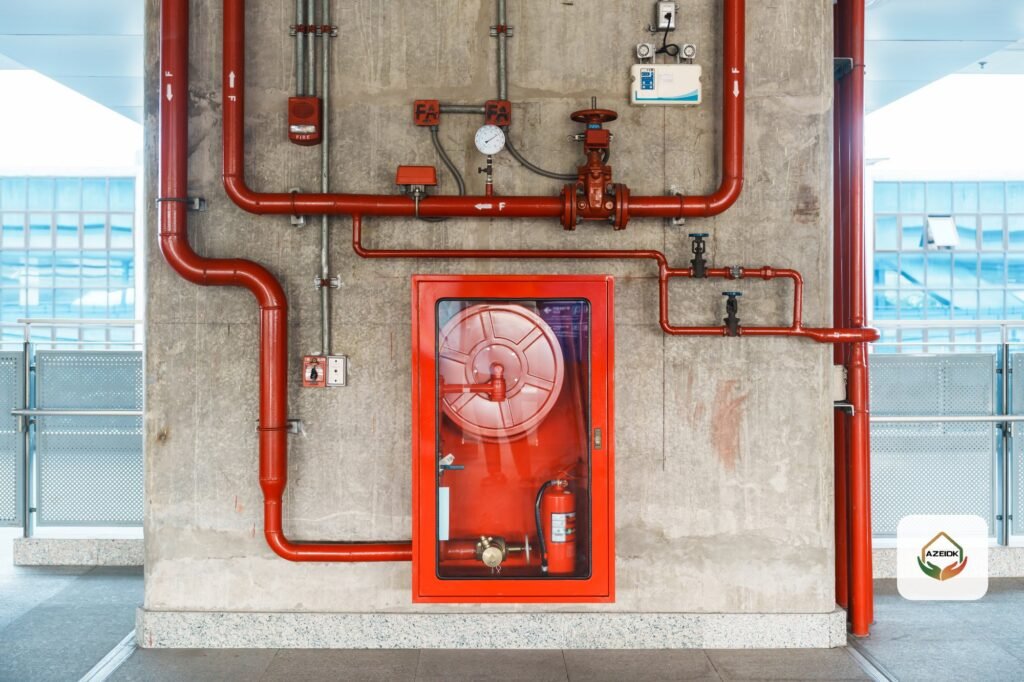
Most talk about extinguishers at home is about the apartment: a small unit in the kitchen and another near the door. But the building itself has shared spaces that belong to no single resident: the entrance, the stairs, the electricity meter room, the lift machine room, the pump room, the generator and the car park. Fire extinguishers for residential buildings in these spaces are the responsibility of the owner, the occupants’ union or the property management company, and they are usually the first thing neglected after handover.
To compare fire extinguisher types and what each one is for, see our guide to choosing the right extinguisher for each hazard.
This guide explains which extinguisher suits each shared space in an Egyptian apartment building or residential tower, and how to place and maintain them. It includes a table that links each space to the right type from the PYRAMID extinguisher range supplied by AZEIDK Egypt as part of its fire extinguisher solutions.
Key takeaways
- Extinguishers in shared spaces are separate from those inside apartments, and they are the responsibility of the owner, the occupants’ union or the property manager.
- ABC powder suits the entrance and stair landings, CO2 suits the meter room and lift machine room, and AFFF foam or powder suits the generator room.
- The NFPA 10 annex lists parking garages among its extra hazard examples, so a building car park needs denser coverage than residential floors.
- Extinguishers do not replace hose cabinets and a fire alarm system where the code requires them.
- The binding reference is the Egyptian fire code (2026 edition) and the civil protection requirements. NFPA 10 is a technical reference.
In this article
- Apartment extinguishers vs building extinguishers
- Fire extinguishers for residential buildings: selection by space
- Meter room and lift machine room: why CO2?
- Car park and generator: the highest hazard in the building
- Mounting at entrances and stairs without blocking escape
- Who maintains building extinguishers after handover?
- Common mistakes with building extinguishers
- Frequently asked questions
- Conclusion
Apartment extinguishers vs building extinguishers
Inside the apartment, NFPA 10 Annex F, an informational annex for dwellings, recommends at least one extinguisher rated 2-A:10-B:C or higher per floor level of the living unit, with a travel distance to it of no more than 40 ft (12 m). Choosing the apartment and kitchen extinguisher is covered in our article on fire extinguishers for Egyptian apartments and kitchens.
Outside the apartments, things are different. In many buildings the stair is the only escape route, the meter room gathers the cables of every apartment, the car park holds cars and fuel, and the generator has a diesel tank beside it. No single resident owns these spaces, and nobody feels responsible for them unless responsibility is set from the start in the property management contract or in the occupants’ union decisions.
The building’s fire network, from hose cabinets to alarm coverage in shared areas, is covered in our article on fire networks for residential buildings in Egypt. This article complements it and covers portable extinguishers only.
Fire extinguishers for residential buildings: selection by space
| Shared space | Main hazard | Suggested PYRAMID extinguisher | Notes |
|---|---|---|---|
| Building entrance and security desk | Solids and small equipment | 6 kg ABC powder | Visible from the door without blocking movement |
| Stair landings on each floor | Stored items and lighting circuits | 6 kg ABC powder | On the landing, not within the stair width |
| Meter room and main panel | Electrical equipment | 6 kg CO2 or automatic Fire Search CO2 | Outside or right next to the room door |
| Lift machine room | Electrical equipment and oils | 3 or 6 kg CO2 | Coordinate with the lift maintenance company |
| Generator room and diesel tank | Flammable liquids | 6 or 9 L AFFF foam, or powder | Check the stored fuel quantity |
| Water and fire pump room | Electrical equipment and motors | 6 kg CO2, plus powder where there is a diesel pump | Next to the control panels |
| Car park | Cars and fuel (extra hazard) | 9 or 12 kg ABC powder | On columns, at entrances and ramps |
| Roof and shared stores | Stored items | 6 kg ABC powder | Better still, clear the clutter |
The table is a starting point. Adjust it to the building size, the number of floors, whether there is a car park or a generator, and what civil protection requires in the building permit.
Meter room and lift machine room: why CO2?
In many Egyptian buildings, fires start in the same place again and again: the meter room or main panel at the entrance or under the stairs, where every apartment’s cables meet, sometimes with extra connections the panel was never designed for. CO2 is the right extinguisher here because it leaves no residue on meters and breakers and does not conduct electricity. PYRAMID CO2 extinguishers come in 2, 3, 6, 10, 20 and 30 kg and conform to EN3 and Egyptian standard ES 735.
Because the meter room is usually closed and unattended, a PYRAMID automatic Fire Search unit may suit it. It is available as CO2 in 3, 6 and 10 kg and as powder in 6 and 12 kg, and works through a linear detection tube run above the panels. See our article on PYRAMID automatic Fire Search extinguishers. A portable unit should still sit by the door for whoever arrives first.
Car park and generator: the highest hazard in the building
The NFPA 10 annex, in the text of its latest revision cycle (A2025), lists parking garages among its extra hazard examples. Under the standard’s Class A table, the minimum rating for extra hazard is 4-A and the maximum floor area per unit of A is 1,000 sq ft, against 3,000 sq ft for light hazard, with a maximum travel distance of 75 ft (22.9 m). So a residential tower car park needs many more extinguishers than owners usually expect. Full car park protection is covered in our article on fire protection for underground car parks.
Towers and compounds with a standby generator also have a diesel tank beside it. This hazard suits PYRAMID AFFF foam extinguishers in 6 and 9 L, conforming to EN3 and Egyptian standard ES 711, or powder units. In NFPA 10, the travel distance for Class B extinguishers is 30 or 50 ft (9.1 or 15.2 m) depending on rating and hazard level, which is shorter than for Class A.
Mounting at entrances and stairs without blocking escape
In an apartment building the stair is the escape route, so an extinguisher must not narrow it or stick out where people hurrying down could hit it. Mount it on the landing wall or in a recessed cabinet so it stays visible. Under NFPA 10, the top of an extinguisher up to 18.14 kg gross weight sits no more than 1.53 m above the floor, heavier units no more than 1.07 m, with a floor clearance of at least 102 mm.
Extinguisher cabinets should not be locked unless the extinguishers are subject to tampering, and then the standard calls for a means of quick emergency access. In buildings with many children, a cabinet with break glass is a practical solution.
Who maintains building extinguishers after handover?
The usual problem is that extinguishers are installed at handover and then nobody checks them for years. The fix is to set responsibility in writing: the owner, the occupants’ union or the property management company, with a simple log at the security desk recording the monthly check and the date of the last maintenance and recharge. When to recharge and when to replace is explained in our article on fire extinguisher service life.
When buying, ask for the Egyptian quality mark and a clear label. PYRAMID powder extinguishers, in 1, 3, 6, 9 and 12 kg, conform to EN3 and Egyptian standard ES 8442/2021, are approved by the Egyptian Organization for Standardization and Quality (EOS) and carry the Egyptian quality mark. How to spot a counterfeit unit is covered in our article on genuine vs counterfeit fire extinguishers.
Common mistakes with building extinguishers
- Assuming apartment extinguishers are enough and leaving the entrance, car park and meter room without any.
- Putting a powder extinguisher in the meter room when CO2 suits electrical equipment better.
- Storing clutter and old furniture under the stairs and on the roof next to the extinguisher.
- Locking the extinguisher room or cabinet with the key held only by the building guard.
- Not deciding who pays for maintenance, so every extinguisher expires at the same time.
- Relying on extinguishers alone in a tower that needs hose cabinets and a fire alarm system.
Frequently asked questions
Who is responsible for extinguishers in an apartment building?
Extinguishers in shared spaces are the responsibility of the owner, the occupants’ union or the property manager, ideally set in writing. The apartment extinguisher is the resident’s responsibility.
How many extinguishers does a residential building need?
The count comes from the area of each floor, the hazard level of each space and the travel distance. Extra units are added for the car park and service rooms based on their hazard, and the result is checked against the approved design and civil protection requirements.
Which extinguisher suits the electricity meter room?
A CO2 extinguisher, because it leaves no residue and does not conduct electricity. An automatic CO2 unit can be added inside the closed room.
Does the building car park need more extinguishers?
Yes. The NFPA 10 annex lists parking garages among its extra hazard examples, which means a higher rating and less floor area per unit.
Where should the extinguisher go on the stairs?
On the landing wall or in a recessed cabinet, visible and not narrowing the stair, with its top no higher than 1.53 m.
Conclusion
Fire extinguishers for residential buildings start with a list of the shared spaces: entrance, stairs, meter room, lift room, pump room, generator and car park. Each space has a suitable type, and the car park and generator need the most attention. Then comes the step that is usually forgotten: deciding who inspects and who pays, and keeping a simple log that proves each extinguisher is ready. Done this way, the shared extinguishers protect the escape route for every resident.
Taking over a new building or managing an existing residential tower? Send us the number of floors and the list of shared spaces, and we will propose types, sizes and locations from the PYRAMID range. Talk to the AZEIDK Egypt team
Related guides
- Fire Safety in Student Housing and University Dorms in Egypt: Alarm, Extinguishers and Floor Kitchens
- Fire Protection for Theatres, Cinemas and Film Studios in Egypt
- Mosque Fire Safety in Egypt: Electrics, AC, Carpets, Alarms and Extinguishers
- Wheeled Fire Extinguishers: When You Need One, Capacity and Agent