Fire protection in university student housing is different from protecting teaching buildings, because students sleep, cook and charge their devices there at night. It rests on four elements: early detection in every room with an alert loud enough to wake a sleeper, specific protection for shared kitchens, sprinklers and fire doors that keep a fire where it starts, and maintenance that does not stop during holidays.
This article covers on-campus and off-campus student housing and residences run by universities and institutes. It complements our school and educational facility fire safety guide, which mentions boarding accommodation only briefly. AZEIDK’s sector solutions are on the schools and universities page, with system details under fire fighting systems and fire alarm systems.
Key takeaways
- Student housing is a sleeping occupancy; the main risk is a night fire that a sleeping student does not notice in time.
- NFPA’s report on US dormitory-type properties (2017 to 2021) linked 86% of fires to cooking equipment.
- A room smoke detector is best paired with a sounder base that is clearly heard inside the closed room.
- Shared kitchens need heat detection and an extinguisher suited to cooking oils, plus hood suppression where there is a commercial kitchen.
- Fire doors wedged open defeat compartmentation; magnetic door holders that release on alarm solve this.
In this article
- Fire protection in university student housing: why it differs from teaching buildings
- What the student housing fire data shows
- Detection and alarm inside student rooms
- Shared kitchens and dining halls
- Sprinklers in student housing
- Fire doors and corridors
- Extinguishers and hose cabinets on residence floors
- Operation and maintenance
- Frequently asked questions
- Conclusion
Fire protection in university student housing: why it differs from teaching buildings
In faculty buildings students are awake, staff are present, and activity ends with the working day. Housing fills up in the evening and at night, when supervision is lighter and a fire takes longer to be noticed. A sleeping person does not smell smoke, so they depend entirely on the detector and the alarm device.
Add what students bring into their rooms: small heaters, cooking appliances, chargers, electronics and multi-socket extensions. In large residences this repeats across hundreds of rooms, so the design must assume a mistake will happen in some room and confine its effect there.
The binding reference in Saudi Arabia is the Saudi Building Code, including the Saudi Fire Code SBC 801, together with Civil Defense requirements; they set the systems each housing building needs according to its occupancy classification, height and area. The NFPA references in this article are technical and statistical background only. NFPA 101, the Life Safety Code, covers hotels and dormitories in dedicated chapters; its relation to the Saudi code is explained in NFPA 101 Life Safety Code.
What the student housing fire data shows
We are not aware of published Saudi statistics on student housing fires, but NFPA’s July 2023 research report on US dormitory-type properties gives a useful picture of the risk:
| Indicator | Report finding (2017 to 2021) |
|---|---|
| Average fires per year | About 3,379 structure fires in dormitories, fraternity and sorority houses and barracks |
| Cooking equipment | 86% of fires, nearly 9 in 10 |
| Peak months | February, September and October |
| Peak hours | 4 p.m. to midnight, with 54% of fires |
The practical message: the shared kitchen and evening hours are the focus of design and operation, and the start of each semester is the time for a full system check.
Detection and alarm inside student rooms
In congregate housing with an addressable system, the usual solution is a smoke detector in every room connected to the fire panel, with a sounder base mounted under the detector itself. The alert is then clearly heard inside the closed room, instead of relying on a corridor sounder behind a shut door. Context Plus devices available from AZEIDK include the addressable optical smoke detector and the 45681-702IMC integrated base sounder.
In rooms with en-suite bathrooms, steam can cause false alarms if the detector is too close to the bathroom door. That is a layout decision for the designer; a similar case is discussed in smoke detectors in hotel rooms and shower steam.
Through the cause and effect matrix the designer decides whether a room detector alerts the room first, the floor, or the whole building, in line with the code and the consultant. What matters is that the alarm reaches the security room or duty supervisor immediately and the room number shows on the panel.
Shared kitchens and dining halls
The shared kitchen on residence floors is the highest-risk space in the building according to the data above. It needs:
- A heat detector instead of a smoke detector, since cooking fumes cause repeated false alarms.
- An extinguisher for cooking oils: a wet chemical (Class K) unit near the cooking appliances, plus powder or CO2 for electrical equipment as designed.
- A fire blanket near the hobs for small pan fires.
- Power isolation: a clearly marked isolating switch for electric cookers.
A central dining hall with a commercial hooded kitchen needs a hood and fryer suppression system, which AZEIDK supplies under kitchen fire suppression systems; approval requirements are in UL 300 and NFPA 17A.
Sprinklers in student housing
An automatic sprinkler acts while the fire is still small, before smoke fills the corridor. Where the code or project documents call for sprinklers in student housing, the sprinkler type follows the space:
- Corridors: pendent or recessed sprinklers, such as the TYCO EC-8C corridor sprinkler.
- Rooms with gypsum ceilings: concealed sprinklers for a cleaner look and less tampering, such as the TYCO Royal Flush II.
- Rooms where ceiling pipework is difficult: horizontal sidewall sprinklers, such as the Victaulic FireLock FL-QR/SW.
Each model’s datasheet and the listing required by the project are checked, and the designer calculates density and spacing to the hazard classification. A common problem in housing is clothes or items hung on exposed sprinklers, one reason concealed heads are preferred in rooms.
Fire doors and corridors
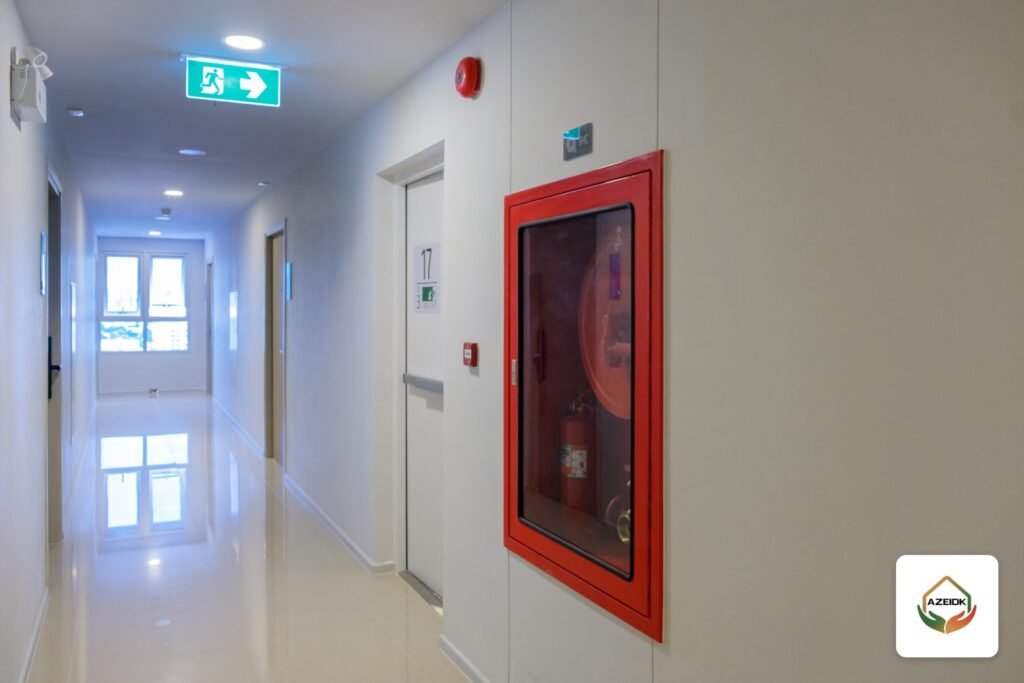
Residence buildings are divided by fire-resistant walls and doors so a fire stays in the room or wing where it started. In many buildings this fails for a simple reason: students prop corridor and stair doors open with wedges or chairs.
The practical answer is magnetic door holders that keep the door open in normal use and release it on alarm so the closer shuts it. AZEIDK supplies fire-rated steel doors under its fire-rated doors and emergency exit solutions; closers and panic hardware need periodic checks, as covered in fire-rated door inspection and maintenance.
Extinguishers and hose cabinets on residence floors
Extinguishers go in corridors near exits, in shared kitchens and in electrical rooms, so travel distance stays within what the design allows under NFPA 10 and Civil Defense requirements. Hose cabinets go where the system requires them. In student housing extinguishers tend to go missing or get misused, so the monthly check matters more than in most buildings.
Operation and maintenance
Student housing often never closes completely, so maintenance is phased to avoid leaving an occupied wing unprotected. Items worth tracking:
- A full check of alarm, sprinklers and extinguishers before each semester.
- Cleaning room and kitchen detectors, and following up detectors that alarm repeatedly.
- Rounds on fire doors to make sure none are propped open.
- Checking for items hung on sprinklers and the condition of corridor extinguishers.
AZEIDK provides annual maintenance contracts for fire and alarm systems; see the inspection schedule in our fire protection maintenance checklist.
Frequently asked questions
What fire protection does university student housing need?
Detection and alarm in rooms and corridors, kitchen protection, sprinklers and fire doors as the code and project require, distributed extinguishers and regular maintenance, all set out in the design approved by Civil Defense.
Does every student room need a smoke detector?
In congregate housing with an addressable system, a detector is usually fitted in every room, ideally with a sounder base so the alert is heard inside the closed room.
What causes most student housing fires?
NFPA’s report on US dormitory-type properties for 2017 to 2021 linked 86% of fires to cooking equipment.
Which extinguisher suits a residence kitchen?
A wet chemical (Class K) extinguisher for cooking oils, with powder or CO2 for electrical equipment as designed, and a fire blanket near the hobs.
Why are concealed sprinklers preferred in student rooms?
They are less exposed to tampering and to items being hung on them, and look cleaner, provided the model is listed and accepted by the consultant.
How do we stop fire doors being propped open?
Use magnetic holders linked to the fire alarm that keep doors open and release them on alarm, plus regular inspection rounds.
Conclusion
Fire protection in student housing starts from a simple fact: students sleep and cook there. Every room needs detection and an alert that wakes a sleeper, every kitchen needs specific protection, every corridor needs doors that actually close in a fire, and maintenance cannot wait for the holidays.
Equipping new student housing or reviewing an existing residence? Send us the drawings and the number of rooms and kitchens, and the AZEIDK team will propose suitable systems with datasheets. Contact the AZEIDK team
Related guides
- How to Evaluate a Fire Protection Contractor in Saudi Arabia Before Signing
- Fire Extinguisher Price in Saudi Arabia (KSA): What Drives the Price by Type, Capacity and Approval
- CCTV Shop in Makkah: Directory of Companies and Shops and How to Check Licensing
- Civil Defense in Saudi Arabia: A Facility Guide to Systems, Licences and Technical Requirements