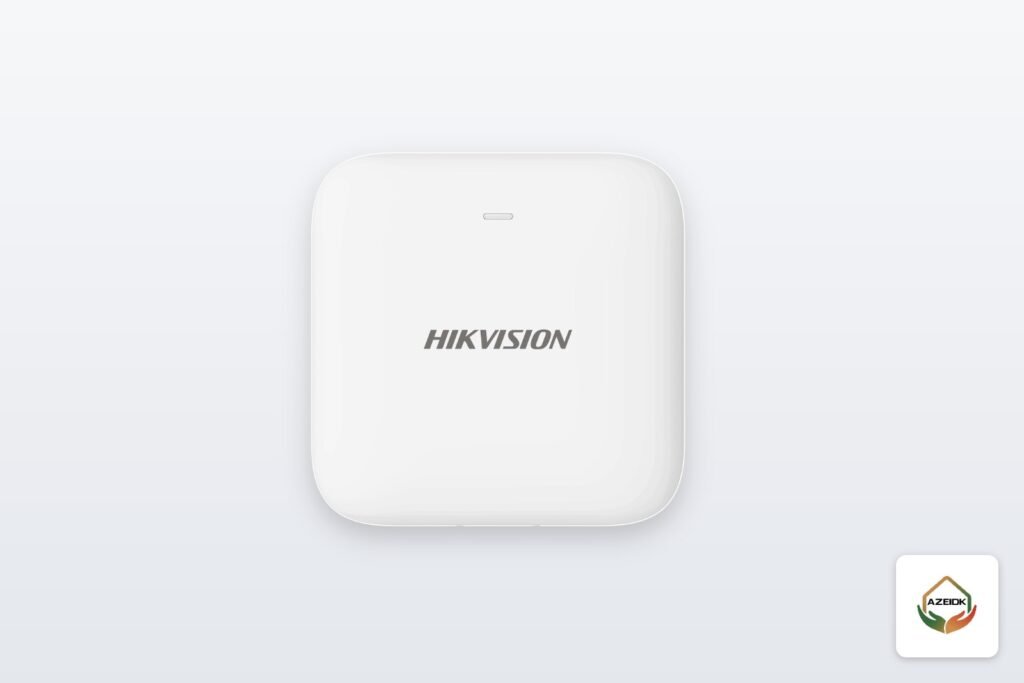
A water leak detector is a small device placed on the floor or next to a water source that raises an alarm as soon as water touches its contacts or probe. Its value is catching a leak in a network room, kitchen or tank room in the first minutes, instead of discovering it after water has reached equipment, ceilings or stock.
This guide covers where to install a water leak detector and how it works inside a wireless alarm system that alerts your phone, with the specifications of the Hikvision DS-PDWL-E-WB wireless water leak detector for AX PRO, supplied by AZEIDK within its alarm systems range.
Key points
- Install the detector at the lowest point where water collects, close to the likely source.
- The Hikvision DS-PDWL-E-WB is battery powered and wireless within the AX PRO system, with AES-128 encryption and IP66 protection.
- It works on its own or with the included external probe for tight spaces such as raised floors.
- Leak alerts reach the control panel and phone app and can trigger a sounder or wireless relay, depending on programming.
- The detector does not stop water by itself; that needs a shut-off valve tied to the system or a person closing the valve.
In this article
- Where do you need a water leak detector?
- How does a wireless water leak detector work?
- Hikvision DS-PDWL-E-WB specifications
- Exactly where to place it
- Can the water be shut off automatically?
- One system for leaks and security
- Suggested detector layout by location
- What to do when a leak alert arrives
- Common mistakes
- FAQ
- Summary
Where do you need a water leak detector?
- Network and server rooms: AC or drain pipes sometimes pass overhead, and the AC units themselves leak. Water on the floor or under a raised floor can reach cables and UPS units. See server and network room preparation.
- Kitchens: under sinks and dishwashers, where flexible hoses leak unseen.
- Bathrooms and laundry rooms: next to water heaters and washing machines.
- Tank and pump rooms in villas and buildings: a roof tank or pump joint can leak for hours unnoticed.
- Warehouses and shops: where stock sits on the floor near pipes or AC units.
- Under indoor AC units: when the condensate drain blocks.
How does a wireless water leak detector work?
Metal contacts on the underside close a circuit when water bridges them, and the detector sends a wireless signal to the panel. Models with an external probe put the contacts at the end of a lead run to the likely leak point, while the body stays on the wall.
The panel alerts the phone app and can be programmed to sound an indoor siren or operate a wireless relay from the same system. All AX PRO devices in one system must share the same frequency: this detector is the WB version on 433 MHz, so the siren, repeater and panel must be 433 MHz parts too. That makes the detector part of the smart building idea: one device detects, one system notifies and acts.
Hikvision DS-PDWL-E-WB specifications
| Item | Value |
|---|---|
| System | Hikvision AX PRO wireless |
| Radio | Tri-X two-way, 433 MHz |
| Range (free space) | 1.2 km |
| Encryption | AES-128 |
| Battery | 1 x CR2450, up to 3 years standby |
| Protection | IP66 |
| Tamper | Front and rear |
| Operating temperature | -10 to 55 °C |
| Size and weight | 62.4 x 62.4 x 14.6 mm; 85.5 g |
| Operation | Standalone or with the included external probe |
| Mounting | Wall or surface |
Source: the AZEIDK product page citing Hikvision’s official product page and datasheet.
Exactly where to place it
- At the lowest point: water collects in corners and dips, so put the detector or probe tip there, not mid-room.
- Near the likely source: under the AC unit, beside sink connections, below the tank valve.
- Use the probe in tight spaces: such as under raised floors in server rooms or behind fixed appliances, with the body on the wall.
- One detector per source: a room with two distant sources needs two detectors.
- Check the signal: tank rooms and basements can weaken radio; measure signal strength after installation and add an AX PRO repeater on the same frequency if needed.
Can the water be shut off automatically?
The detector only detects and reports. The AX PRO system, however, includes wireless output expanders such as the DS-PM1-O1H-WB high-power module, a wireless relay with one NO/NC output at 100 to 240 VAC and up to 13 A that can be triggered by an alarm scenario. In principle this relay can drive an electric shut-off valve on the main water line, provided the valve matches the relay’s voltage and current and the connection is designed by a qualified engineer. Without a valve, the phone alert lets the responsible person close the valve by hand.
One system for leaks and security
Using a detector from the alarm system itself means leak alerts arrive in the same app as intrusion alarms, with no separate device or app. A DS-PDTPH-E-WB wireless temperature detector can be added in the same network room to flag overheating when the AC fails. For AX PRO against Ajax, see Ajax vs Hikvision AX PRO.
Suggested detector layout by location
| Location | Detector position | Note |
|---|---|---|
| Network or server room | Under the AC unit and at the lowest point, or under the raised floor with the probe | Add a temperature detector in the same room |
| Villa or office kitchen | Inside the sink cabinet and behind the dishwasher | Away from daily mopping |
| Laundry room | Behind the washer and next to the water heater | Heaters are a common leak source |
| Pump and tank room | Below pump joints and the tank valve | Check wireless signal strength |
| Warehouse or shop | Under AC units and pipes running above stock | Keep stock off the floor where possible |
What to do when a leak alert arrives
- Who receives it: add more than one user in the app, such as the villa owner and the building guard or IT lead.
- Where the main valve is: known, clearly labelled and easy to reach.
- Isolate power if needed: if water is near sockets or equipment, switch off that circuit before approaching.
- Find and fix the source, then dry the detector and restore it in the system.
Common mistakes
- Placing it on a shelf, so it only triggers after a lot of water collects.
- Covering it with boxes or equipment that keep water from the contacts.
- Placing it where daily floor cleaning reaches, causing repeated alerts.
- Ignoring low-battery warnings on a device that may not trigger for years.
- Not testing it with a damp cloth on the contacts after installation.
FAQ
What is a water leak detector?
A device placed on the floor near a water source that raises an alarm as soon as water touches its contacts.
Does it send alerts to my phone?
Yes, when connected to a panel linked to an app, such as Hikvision AX PRO panels.
Where should it go in a server room?
Under AC units, at the lowest floor point, and under the raised floor using the external probe.
How long does the battery last?
Hikvision states up to 3 years standby on a CR2450 for the DS-PDWL-E-WB.
Does it shut off the water automatically?
No. A wireless relay can drive an electric shut-off valve if designed for it; otherwise close the valve manually after the alert.
Does it need power or cabling?
No. It runs on a battery and connects wirelessly, so no wiring is needed.
Summary
A water leak detector costs little compared with what it protects: network room equipment, villa floors and shop stock. Put it at the lowest point near the source, use the probe in tight spaces and link it to a system that alerts someone who can act.
Want to protect a network room or villa from leaks? Send us the layout and water source locations, and the AZEIDK team will propose detector numbers, positions and how to link them to the alarm system. Contact AZEIDK
See AZEIDK CCTV solutions: supply, installation and maintenance.
Related guides
- Fire Protection and Safety Companies in Dammam and Al Khobar: A Practical Guide
- CCTV for Warehouses and Logistics Centres: Coverage and Design
- Fire Alarm System for Fuel Stations in Saudi Arabia: Store, Electrical Room, Offices and Service Bays
- Battery Smoke Alarm or Panel Fire Alarm System? When a Standalone Alarm Is Enough (with SD-425 and RadioLINK Rules)